

Industry guide
AI consulting for mortgage lenders: governance first, then the use cases that pay
AI consulting for mortgage lenders now has two jobs: meet the AI governance rules Fannie Mae and Freddie Mac put in force in 2026, and pick the few AI uses in origination and servicing that actually cut cost per loan. This guide is for owners, COOs and compliance leads at independent mortgage banks, brokers and lending teams inside banks and credit unions. It covers what each agency requires, where AI fits by loan stage, how to govern AI that arrives inside your vendors' software, and a 90-day plan.
Book a free AI review
Two lines is enough. A specialist replies within one business day.
Executive summary
What does an AI consultant do for a mortgage lender?
An AI consultant for a mortgage lender inventories every AI and machine learning tool in origination and servicing, including vendor features, builds the governance program Fannie Mae and Freddie Mac now require, then picks and pilots the use cases with clear payback, such as document indexing, condition clearing support and servicing call summaries, with human review on every credit decision.
What to take away
- Freddie Mac's AI governance rules apply to applications received on or after March 3, 2026.
- Fannie Mae's Lender Letter LL-2026-04 took effect August 6, 2026 for sellers and servicers.
- AI built into your LOS, POS or servicing vendor counts, so inventory it first.
- Start with document and back-office work, and keep people on every credit decision.
What does AI consulting for mortgage lenders cover in 2026?
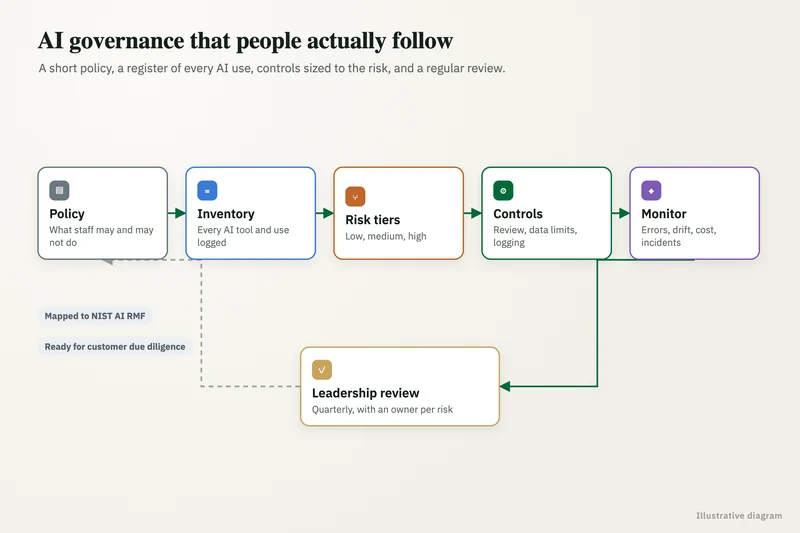
AI consulting for mortgage lenders covers three things: a governance program that satisfies the agencies you sell to, a short list of use cases ranked by payback and risk, and oversight of the AI your vendors are already switching on. Two years ago most lenders could treat AI as an experiment. That changed when both government-sponsored enterprises wrote AI governance into their seller and servicer requirements.
The work is advisory first. A good engagement produces an AI inventory, written policies, a risk rating for each use, a vendor oversight process and a ranked roadmap. Building comes second, and only for uses that clear the governance bar. Lenders that reverse the order end up with a working pilot they cannot defend when an investor, auditor or examiner asks how it is controlled.
The typical buyer is a COO who wants processors to handle more files without hiring, a compliance lead who has read the lender letters and needs a program on paper, or an owner whose LOS vendor just announced AI features and who wants to know what that means for the company's obligations.
What do Fannie Mae and Freddie Mac require for AI?
Both agencies now expect a documented, maintained AI governance program from any seller or servicer that uses AI or machine learning in origination or servicing. Freddie Mac moved first with Guide Bulletin 2025-16, issued December 3, 2025, which amended its Single-Family Seller/Servicer Guide (mainly Section 1302.8) and applies to applications received on or after March 3, 2026. Fannie Mae followed with Lender Letter LL-2026-04, issued April 8, 2026 and effective August 6, 2026.
Legal commentators describe the two differently. Cooley's April 2026 summary calls Fannie Mae's letter principles-based, giving lenders the bones of a governance program, while Freddie Mac's bulletin reads more like an operational checklist. A lender that sells to both has to meet the stricter elements of each. The table below summarizes the main points as reported by Cooley, JD Supra and Ncontracts; read the source documents with counsel, since this is not legal advice.
| Topic | Freddie Mac Bulletin 2025-16 | Fannie Mae LL-2026-04 |
|---|---|---|
| Effective | Applications received on or after March 3, 2026 | August 6, 2026 |
| Scope | AI/ML in origination and servicing, including AI inside third-party platforms | Any approved seller or servicer using AI/ML in origination or servicing, internal or vendor |
| Policies | Formal governance framework with named accountable people | Written policies covering the full AI life cycle, reviewed at least annually, with a designated owner |
| Leadership | Senior management approval, with technology, security and risk leaders involved | Oversight built into enterprise risk management with senior leadership involved |
| Monitoring and testing | Ongoing monitoring for performance degradation, bias and security issues; regular internal and external audits | Risk management calibrated to the lender's own risk tolerance |
| Vendors | Covers AI the lender neither built nor fully controls; indemnification obligations | Vendor and subcontractor AI managed with controls no less protective than internal ones |
| Security threats | Assess threats such as data poisoning and adversarial inputs | Meet Fannie Mae's existing information security obligations |
| Training and inventory | AI risk training for staff and partners; an inventory of AI/ML systems | Policies communicated to staff |
| Disclosure | Audit evidence available on request | Disclose AI systems, purposes and safeguards to Fannie Mae on request |
Where does AI pay back in a mortgage operation?
AI pays back fastest on document-heavy, repetitive work where a person can check the output quickly, and slowest on anything that decides whether a borrower gets credit. The table ranks common uses by loan stage. Risk level reflects how close the use sits to a credit decision or a consumer communication, which is also how most governance programs tier them.
Notice what is not on the list: AI that approves, denies or prices loans on its own. Automated underwriting through Desktop Underwriter and Loan Product Advisor already exists inside the agencies' own systems, and adding your own model to that decision brings fair lending testing, explainability and adverse action obligations that few small and mid-size lenders are set up to carry.
| Loan stage | AI use | Systems involved | Risk tier | Human checkpoint |
|---|---|---|---|---|
| Lead and application | Summarize inbound inquiries, draft loan officer follow-ups, answer FAQ questions on the website | CRM, POS such as Blend, website chat | Medium (consumer communication) | Loan officer sends or approves anything rate- or product-specific |
| Processing | Classify and index borrower documents (W-2s, paystubs, bank statements), extract fields, flag missing pages | LOS such as ICE Encompass or MeridianLink, document storage | Low to medium | Processor confirms extracted values before they feed the file |
| Underwriting support | Draft condition lists, summarize large-deposit explanations, compare documents against the 1003 | LOS, AUS findings | High (near the credit decision) | Underwriter makes every decision; AI output is a draft only |
| Closing and post-closing | Check closing packages for missing signatures and data mismatches, prepare QC samples | Doc prep, QC software | Medium | Closer or QC analyst signs off |
| Servicing | Summarize borrower calls, draft hardship and escrow correspondence, route requests | Servicing platform, phone system | Medium to high (loss mitigation) | Servicing specialist approves every borrower-facing letter |
| Compliance and reporting | Track regulatory calendars, assemble evidence for audits, draft policy updates | Compliance tracker, document storage | Low | Compliance owner reviews |
How should a lender govern AI inside its LOS and other vendors?
Treat vendor AI exactly like AI you build, because both agencies do. Freddie Mac's bulletin reaches AI embedded in third-party platforms that the lender neither developed nor fully controls, and Fannie Mae expects vendor and subcontractor AI to be managed at least as carefully as internal tools. In practice, most of a typical lender's AI exposure today sits in vendor features: document recognition in the LOS, chat on the POS, call analytics from the phone provider, fraud and income tools from data vendors.
Ncontracts noted in its 2026 analysis that Freddie Mac has not defined artificial intelligence or machine learning in its Guide. That ambiguity argues for a broad inventory: list anything that classifies, predicts, scores or generates, then decide what is in scope with a written rationale. A short checklist for each vendor keeps the work manageable.
- Which features in your product use AI or machine learning, and which are switched on in our instance today?
- What borrower data does each feature send, to which model provider, and is it retained or used for training?
- What testing do you run for accuracy and bias, how often, and will you share the results?
- How will you notify us before changing a model or adding an AI feature?
- What logs can we export to show who reviewed which output and when?
- What indemnification and audit rights does the contract give us for AI-related errors?
- Who on your team can join our annual policy review or an agency inquiry?
Which other rules shape AI use in mortgage lending?
The GSE requirements sit on top of rules lenders already follow, and AI does not change any of them. The Equal Credit Opportunity Act and Regulation B still require specific reasons on adverse action notices, whatever tool contributed to the decision, which is the main practical reason to keep models away from approve-or-deny calls. Fair lending reviews, privacy obligations under the Gramm-Leach-Bliley Act and TRID timing do not relax because a draft came from software.
Outbound calling is a common trap. The FCC ruled on February 8, 2024 that AI-generated voices count as artificial voices under the TCPA, so an AI calling past applicants or delinquent borrowers needs prior express consent, and some states also require the caller to disclose that it is an AI. At the state level, Colorado's SB 26-189, signed May 14, 2026 and effective January 1, 2027, is a notice-based law on automated decision-making in consequential decisions, including lending and housing, enforced by the Colorado Attorney General; our Colorado AI Act compliance guide covers it in detail. This is not legal advice.
For structure, many lenders map their program to the voluntary NIST AI Risk Management Framework, whose Govern, Map, Measure and Manage functions line up well with what both agencies ask for and give auditors a familiar vocabulary.
A 90-day AI plan for an independent mortgage lender
Most small and mid-size lenders can reach a defensible position in about 90 days without slowing production, as long as one executive owns the work and decisions are made weekly. The sequence matters: governance documents first, then one low-risk pilot that proves the controls work.
- Days 1 to 15: Build the AI inventory across origination, servicing, marketing and vendors. Interview processors and loan officers about the tools they actually use, including personal AI accounts.
- Days 16 to 30: Rate each use by risk tier, draft the written AI policy and acceptable use rules, name the accountable owner and set the review cycle. Brief senior management and record their approval.
- Days 31 to 45: Send the vendor checklist to your LOS, POS, servicing and data providers. File the answers and gaps, and start contract amendments where audit or indemnification terms are missing.
- Days 46 to 75: Pilot one low-risk use, typically document indexing or call summaries, on real files with a processor reviewing every output. Log accuracy, time saved and every correction.
- Days 76 to 90: Present results, the monitoring plan and the evidence pack to leadership. Decide whether to scale, change or stop the pilot, and pick the next use from the roadmap.
What could AI save a mid-size lender? A worked example
Any savings figure should come from your own file data, not a vendor brochure. Here is how to build the estimate, using illustrative inputs that you should replace with your numbers.
Suppose a lender funds 250 loans a month and processors spend an average of 40 minutes per file indexing, renaming and checking borrower documents. That is about 167 processor hours a month. If a pilot shows AI indexing with processor review cuts that to 15 minutes per file, the time drops to about 63 hours, freeing roughly 104 hours a month. Multiply by a fully loaded processor cost to get the monthly value, then subtract software, model usage and the time spent reviewing flagged documents.
The test is whether that net figure stays positive in a slow month. Mortgage volume swings with rates, so a tool with a large fixed monthly fee can pay back in a refinance boom and lose money a year later. Usage-based pricing, or a tool you own, usually holds up better across the cycle. Our guide to measuring AI ROI walks through the full formula.
Common mistakes, and when not to hire an AI consultant
The most common mistake is buying an AI tool before the inventory and policy exist, which leaves compliance writing a program around a decision already made. Others include letting loan officers use personal chatbots with borrower data, accepting a vendor's statement that its AI is compliant without evidence, and piloting on a high-risk use such as pre-qualification decisions because it demos well.
You may not need outside help if you sell only to aggregators that have not asked about AI, use no AI features in your systems, and have a compliance team with time to draft the program from the agency documents. Your existing compliance vendor may also offer policy templates that are enough for a small shop. Consulting earns its fee when you sell directly to both agencies, run several vendor platforms with AI switched on, or want to move beyond policy into a pilot that actually reduces cost per loan.
We saw the value of the governance plumbing in a related setting: for a regulatory consulting firm we built a compliance management tool with recurring tasks, owners and due-date reminders that saved more than 30 hours a month on status reporting. The same structure keeps an AI program's annual reviews, vendor checks and monitoring from slipping. Our case studies page has the details.
How Greenwolf Tech Labs works with mortgage lenders
We start with a free review of your AI use, vendors and agency relationships, then quote a fixed price for the governance program, the pilot or both. Deliverables include the AI inventory, written policies mapped to Fannie Mae and Freddie Mac requirements, the vendor oversight file, a monitoring plan and, where it makes sense, a reviewed pilot in your own accounts. You own the policies, prompts, code and data, and a person stays in the loop on anything touching credit, money or borrower communications.
If you are not sure where to begin, an AI readiness assessment is the lighter first step. If you already know the governance work is due, our AI governance consulting service is built for exactly this.
Case study · Logistics company, UK
Route planning automation
Dispatch typed every address into Google Maps, which optimizes only 25 stops and cannot add time at each stop. A Python tool that loads addresses automatically, adds buffer time per stop and optimizes the full route.
- Manual address entry eliminated
- Delivery estimates customers could rely on

FAQ
Frequently asked questions
Does Fannie Mae require an AI policy for lenders?
Yes, if you use AI or machine learning in origination or servicing. Lender Letter LL-2026-04, effective August 6, 2026, requires written policies covering the full AI life cycle, reviewed at least annually, with a designated owner, vendor oversight and disclosure to Fannie Mae on request.
When did Freddie Mac's AI requirements take effect?
Freddie Mac Guide Bulletin 2025-16 was issued December 3, 2025 and applies to loans with applications received on or after March 3, 2026. It requires a formal AI governance framework, monitoring for bias and performance problems, audits and oversight of AI inside vendor platforms.
Do the GSE AI rules apply to AI built into our LOS?
Yes. Freddie Mac's bulletin covers AI embedded in third-party platforms the lender did not build, and Fannie Mae expects vendor and subcontractor AI to be governed no less carefully than internal tools. Start by asking each vendor which AI features are active in your instance.
Can mortgage lenders use ChatGPT or Claude with borrower data?
Only through business or enterprise accounts with signed data terms that cover privacy and retention, and only for uses your AI policy approves. Personal or free accounts should be banned for any borrower information. A person should review every output before it reaches a borrower or a file.
What is the best first AI project for a mortgage company?
Document classification and indexing in processing is usually the safest first project, because a processor can check the output quickly and it does not decide credit. Servicing call summaries are a close second. Avoid starting with anything that approves, denies or prices a loan.
Can an AI voice agent call borrowers?
It can, but the FCC ruled in February 2024 that AI-generated voices are artificial voices under the TCPA, so outbound calls need prior express consent. Some states also require disclosure that the caller is an AI. Check consent records and state rules with counsel before launching.
How long does it take to set up AI governance for a mortgage lender?
A small or mid-size lender can usually complete the inventory, policies, vendor checks and one supervised pilot in about 90 days. Larger lenders with many vendor platforms or their own models take longer because testing and audit evidence grow with each system.
Keep reading
Related pages
Get started
Tell us where AI should pay back
Describe the work that eats your team's time and the systems you run. We reply within one business day with the use cases we would test first, the risks to plan for and a fixed-price proposal.
- Free 30-minute AI review
- Fixed quote before any work starts
- Advice that is vendor-neutral, in plain English
Prefer email? info@aiconsultingservicesusa.com
Book a free AI review
Two lines is enough to start.