

AI marketing
An AI marketing consultant for teams that want a plan, not another tool
We work as your AI marketing consultant, deciding which marketing tasks AI should take over first, which tools deserve a place in your stack and how the results get measured. It is for US owners and marketing leads at companies of roughly 20 to 1,000 staff who are tired of trials that never make it into the budget. You get a ranked plan, a tool shortlist tested on your own content, approval rules and a reporting setup, and our implementation team can build any part of it if you want.
Book a free AI review
Two lines is enough. A specialist replies within one business day.
Quick answer
What does an AI marketing consultant do?
An AI marketing consultant decides where AI belongs in your marketing, picks and tests the tools, sets the approval and disclosure rules, and defines how results are measured. The output is a ranked plan: which tasks to automate first, which stay human, what each change should save or earn, and who owns it.
- We rank marketing tasks by weekly hours and risk before recommending any tool.
- Brand voice, claims and customer data get written rules before AI drafts anything public.
- Every change is tied to a CRM or analytics metric with a recorded baseline.
- Buyers now read AI answers first, so the plan covers citations as well as rankings.
What does an AI marketing consultant actually do for a US business?
An AI marketing consultant turns a vague mandate (use AI in marketing) into a short list of decisions with owners and numbers. HubSpot's 2025 AI Trends for Marketers report found that 66% of marketers already use AI (74% in the US), so the real question is rarely whether, but where and under what rules.
We start with how work moves today: who writes campaign briefs, how leads reach HubSpot or Salesforce, how long the monthly report takes, and where content sits waiting for sign-off. Then we sort every task into three groups. Some suit AI drafting with a human editor, such as product descriptions, ad variants and email subject lines. Some suit plain automation with no generation at all, like lead routing or UTM cleanup. And some stay fully human, such as pricing claims, crisis replies and anything about health or financial outcomes.
- Audit of current marketing workflows, tools and software spend.
- Task inventory with weekly hours, owner and risk level for each item.
- A first wave of two or three changes, each with a baseline.
- Written rules for brand voice, claims review and customer data.
Which marketing tasks should AI handle first?
Start with tasks that repeat every week, have an easy human check and touch no regulated claims. Content repurposing, reporting and lead routing usually qualify; brand positioning and customer complaints usually do not.
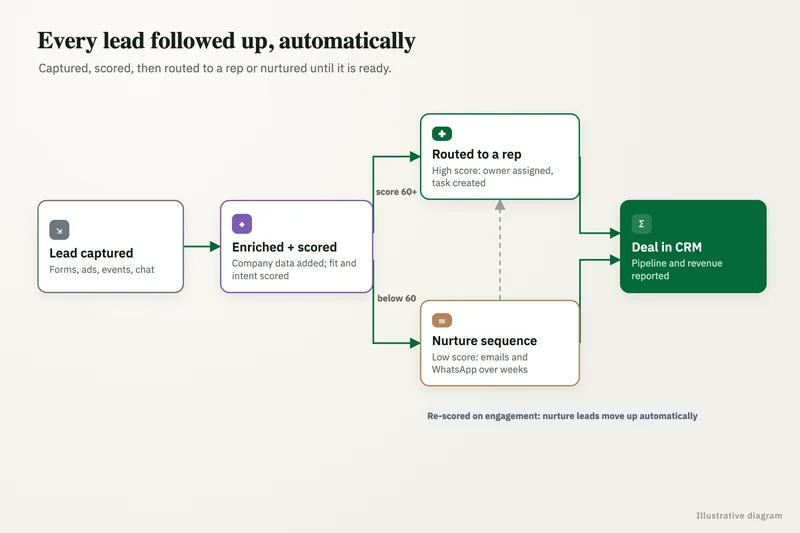
A typical first wave looks like this. A webinar recording becomes a blog draft, five social posts and a newsletter section. A weekly report pulls GA4, ad platform and CRM numbers into one sheet with a plain-language summary. New form fills get enriched and routed to the right rep within minutes instead of hours. Each change has a measurable before and after, which matters when finance asks what the spend bought.
Reporting is often the quickest win. Our case studies include an insurance brokerage where an automated pipeline merged every insurer's spreadsheet into one dashboard, cutting report time from 4-5 hours to under 5 minutes. Marketing data scattered across five platforms responds to the same treatment.
What you get
What we deliver
Scoped and quoted at a fixed price after a free review.
Marketing AI audit
A map of current workflows, tools, software spend and weekly hours, with the tasks AI could take over flagged by risk.
Prioritized first wave
Two or three changes with baselines, owners and the single metric each one must move.
Tool bake-off results
Side-by-side scores for candidate tools on your own briefs, covering accuracy, editing time and data terms.
Brand and claims rulebook
Voice guide, banned claims, disclosure rules and the approval chain for AI-assisted content.
Prompt library
Tested prompts and templates for your recurring assets, stored in your workspace and owned by you.
Measurement dashboard
A report tying content output, leads and pipeline to the specific changes we made.
Team training
Hands-on sessions so marketers use the approved tools and follow the review steps on real work.
How do you choose AI marketing tools without wasting budget?
We choose by running a short bake-off on your real work. Two or three candidate tools get the same set of briefs, and your team scores the output for accuracy, tone and editing time before anyone signs an annual contract.
Most stacks already contain AI. HubSpot, Canva, Google Ads and Meta's ad tools all ship generative features, and many teams pay for ChatGPT or Claude seats on top. Before adding software we check what you already own, what each vendor's data terms say about training on your content, and whether outputs can flow back into the CRM with source tracking intact. A tool that saves writing time but breaks attribution usually costs more than it saves.
How is AI changing the way buyers find your marketing?
Buyers increasingly read a generated summary before they click anything, so a marketing plan now has to earn citations inside AI answers as well as rankings. Pew Research reported in July 2025 that Google users clicked a traditional result 8% of the time when an AI summary appeared, against 15% when none did.
That shift changes content priorities. Pages that answer one question plainly, name their sources and include specific figures are easier for answer engines to quote. We cover the method on our answer engine optimization page, and it often becomes one workstream inside the wider marketing plan rather than a separate project.
What rules should govern AI-generated marketing content?
Every AI-assisted asset needs a named human approver, a claims check and a disclosure decision before it goes live. Those three gates prevent most of the problems we see in teams that adopted AI without a policy.
The rules come from outside as well as inside. The FTC's Consumer Reviews and Testimonials Rule, announced August 14, 2024, bans fake reviews, including AI-generated reviews from people who do not exist. Platforms add their own layer: Meta applies "AI info" labels, and YouTube requires creators to disclose realistic synthetic content. We turn all of this into a one-page checklist inside your approval flow, and we log which prompt and source produced each asset. This is not legal advice, and regulated claims should still go to your counsel.
How do you measure whether an AI marketing consultant was worth it?
Measure against the baselines recorded at the start: hours per asset, cost per lead, lead response time and pipeline sourced by marketing in the CRM. If a change does not move its metric within the agreed review window, it gets fixed or dropped.
We set up the reporting before the first change ships, usually a Looker Studio or HubSpot dashboard fed by GA4, the ad platforms and the CRM. Content speed is easy to measure. Revenue impact needs clean source tracking, so fixing UTM conventions and lifecycle stages is often an early task. You own every account, prompt library and dashboard we set up.
Case study · Insurance brokerage, Australia
Automation and dashboarding
Policy data arrived as spreadsheets from several insurers, each in a different structure, and every client report took hours of manual cleanup. An automated pipeline that standardizes every insurer's file and feeds a single reporting dashboard.
- Report time cut from 4-5 hours to under 5 minutes
- Reporting accuracy up from about 75% to 99%

How it works
How an engagement runs
- 01
Free review
A call about your goals, current marketing stack and the work that eats the most hours.
- 02
Workflow audit
We interview the team, review tools and data, and build the task inventory with baselines.
- 03
Test and decide
Candidate tools run on your real briefs, and we recommend the first wave with a business case.
- 04
Rules and reporting
We write the approval rules and set up the dashboard before anything ships.
- 05
Launch and review
Your team or our implementation team rolls out the first wave, and we review results against the baseline.
FAQ
Frequently asked questions
How much does an AI marketing consultant cost?
We quote one fixed price after a free review, based on the channels and workflows in scope. For published third-party ranges on consulting work, see our AI consultant cost guide. Software subscriptions are billed to you directly by the vendors.
Will AI replace our marketing team?
In our experience it changes what the team spends time on rather than replacing it. Drafting, resizing and reporting get faster, while strategy, approvals, customer conversations and creative direction stay with people. Every workflow we design has a named human approver.
Can AI write our blog posts and ad copy?
It can produce useful first drafts, especially when repurposing existing material into new formats. Drafts still need an editor for accuracy, voice and claims. Anything promising health, financial or performance outcomes should go through your normal legal review.
Do we need a new marketing platform to use AI?
Usually not. HubSpot, Salesforce, Canva and the major ad platforms already include AI features, so we check what you pay for before suggesting anything new. A new tool is added only when a bake-off on your own work shows a clear gain.
What is the difference between an AI marketing consultant and a marketing agency?
An agency typically produces and runs campaigns for you. An AI marketing consultant decides how AI should fit into your marketing, sets the rules and measurement, and trains your team to work that way. If you would rather have one partner, our implementation team can also handle delivery.
Is it legal to publish AI-generated marketing content?
Generally yes, but truth-in-advertising and disclosure rules still apply. The FTC bans fake reviews, including AI-generated reviews from people who do not exist, and platforms such as Meta and YouTube have their own AI labeling rules. This is not legal advice.
Keep reading
Related pages
Get started
Tell us where AI should pay back
Describe the work that eats your team's time and the systems you run. We reply within one business day with the use cases we would test first, the risks to plan for and a fixed-price proposal.
- Free 30-minute AI review
- Fixed quote before any work starts
- Advice that is vendor-neutral, in plain English
Prefer email? info@aiconsultingservicesusa.com
Book a free AI review
Two lines is enough to start.