

AI agents
AI agent consulting that decides what an agent should do before anyone builds one
Our AI agent consulting helps US companies pick the few tasks where an agent will actually pay back, then set its permissions, platform, budget and review rules before any code is written. It is for owners, COOs and operations leaders who keep hearing about agents and want a clear yes, no or not yet for their own business.
Book a free AI review
Two lines is enough. A specialist replies within one business day.
Quick answer
What is AI agent consulting?
AI agent consulting is advisory work that decides where an AI agent fits in your operations, what it is allowed to read and change, which platform runs it, and how a person checks its work. The output is a scored shortlist of agent use cases, a permissions map, a cost model and a pilot plan.
- An agent is only worth building where a task needs judgment across several systems.
- Every tool an agent can call gets a written permission: read only, draft or act.
- Cost caps per task and an eval set are agreed before the pilot starts.
- Many candidate agent ideas turn out to be cheaper as a plain rules-based workflow.
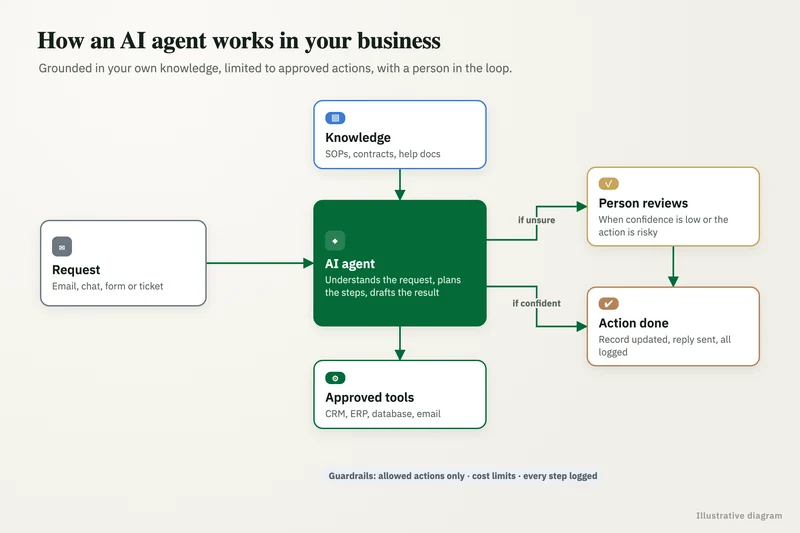
What does AI agent consulting cover?
It covers the decisions that sit between an idea and a build: which process gets an agent, what the agent may touch, where it runs and how you will know it works. We map the task as it happens today, step by step, then mark each step as deterministic (a rule can do it), judgment-based (a model helps) or sensitive (a person must sign off).
From that map we write an agent specification. It lists the inputs the agent receives, the tools it can call (search the CRM, read a SharePoint folder, draft an email, create a ticket in Zendesk), the output it must produce and the conditions that send the case to a human-review queue. That document is what a build team, ours or yours, works from.
- Process map with each step labeled rule, model or person.
- Tool list with read, draft or act permissions per system.
- Escalation rules and the confidence threshold that triggers them.
- Budget per task and per month, with a hard stop.
Which business tasks are a good fit for an AI agent?
Good candidates are repetitive tasks that still need some judgment and pull information from more than one system. Lead research before a sales call, triaging inbound support email, matching a supplier quote against past purchase orders and preparing a renewal summary from a policy file are typical examples.
Weak candidates are tasks that are fully rule-based (a scheduled workflow is cheaper and more predictable), tasks that happen a few times a month (the setup cost never pays back) and tasks where a wrong action moves money or changes a customer record with no chance to review. We score each idea on volume, time per case, error cost, data access and how easy it is to check the output, and plot them on a value and ease grid so the first pilot is obvious.
What you get
What we deliver
Scoped and quoted at a fixed price after a free review.
Agent shortlist
Your candidate agent ideas scored on value, ease and risk, with one recommended pilot and the reasons.
Agent specification
Inputs, tools, outputs, escalation rules and confidence thresholds for the chosen agent, written for a build team.
Permissions map
Every system the agent touches, with read, draft or act rights and the service account it uses.
Platform recommendation
A comparison of the platforms that fit your stack, with the one we recommend and why.
Cost model
Expected model and platform cost per task and per month, plus the cap and alert levels.
Eval and pilot plan
A test set of real past cases, pass criteria and a four to eight week pilot schedule.
When is a simple workflow better than an agent?
A workflow is better whenever the steps are known in advance and rarely change. If an invoice always arrives by email, always goes to the same folder and always needs the same five fields copied into QuickBooks, a fixed n8n or Make flow with one extraction step will be cheaper, faster and easier to audit than an agent deciding what to do next.
Agents earn their place when the path varies: the next step depends on what the last lookup returned, or the request could be one of a dozen types. In our reviews a fair share of agent ideas end up as workflows with a single model call inside, and we say so plainly, because that is usually the better business decision.
Which platform should run your business agents?
The right platform usually follows the systems you already pay for. A Microsoft 365 shop often starts with Copilot Studio because identity, SharePoint access and Teams are already in place. Companies on AWS look at Amazon Bedrock and Bedrock AgentCore, which give access to models from several providers inside their own account.
For teams that want visual control and self-hosting, n8n has AI agent nodes and MCP support, and Zapier Agents suits lighter tasks inside apps Zapier already connects. Where the logic is complex or needs careful testing, code-based agents in LangChain or LangGraph give the most control. We compare these against your stack, your security needs and who will maintain the agent after launch, then recommend one with the reasons written down.
Model choice is a separate decision. OpenAI, Claude, Gemini and open-weight models such as Llama or Mistral all work for agent tasks, and we test two or three on your own examples rather than picking by brand.
What guardrails does a business AI agent need?
At minimum: limited permissions, logging of every prompt and tool call, a spending cap and a person approving anything that touches money, customers or regulated data. We set these in the specification so they cannot be dropped later to save time.
In practice that means the agent drafts the email but a rep sends it, proposes the credit note but finance approves it, and reads patient or policy data only through an account with the narrowest access that still works. We also define an eval set of 50 to 200 real past cases with known correct answers, so every prompt or model change is tested before it reaches production, and a rollback path to the previous version if results slip.
Why do so many agent projects get canceled?
Most fail on cost, unclear value or weak controls rather than on the technology. Gartner predicted in June 2025 that over 40% of agentic AI projects will be canceled by the end of 2027 for exactly those reasons, and warned about vendors relabeling ordinary chatbots as agents.
Our AI agent consulting is built around those three failure points. Value is set as a measurable target before the pilot (hours per week, cases per day, response time). Cost is modeled per task, including model tokens and platform fees, with an alert well before the cap. Risk is handled through the permissions map and review queue described above. If an idea cannot pass all three tests on paper, we recommend not building it yet.
How it works
How an engagement runs
- 01
Free review
A call to hear the agent ideas on your list and check which systems and data they depend on.
- 02
Process mapping
We walk through the target tasks with the people who do them and label each step.
- 03
Design and scoring
We score the ideas, write the specification for the best one and price the pilot.
- 04
Pilot oversight
We run or supervise a limited pilot against the eval set, with a person approving outputs.
- 05
Go or stop decision
We compare results to the target and recommend scaling, adjusting or stopping.
FAQ
Frequently asked questions
What is the difference between an AI agent and a chatbot?
A chatbot answers questions in a conversation. An agent can also take steps on its own, such as looking up a record, calling another system and drafting an action. That extra reach is why agents need tighter permissions and review rules.
Do we need AI agent consulting before building an agent?
Not always. If the task is narrow and the systems are simple, a short review may be enough. Consulting pays off when several teams want agents, the data sits in many systems, or the agent could touch customers or money.
Can an AI agent work inside Salesforce, HubSpot or NetSuite?
Yes, through their APIs or built-in AI features. We decide which objects and fields the agent may read or update, and usually start with read access plus drafted changes that a person confirms.
How long does an AI agent pilot take?
The consulting and design phase usually takes two to four weeks. A focused pilot on one task typically runs four to eight weeks, depending on how many systems it connects to and how quickly test data is available.
How much does an agent consulting engagement cost?
We quote a fixed price after a free review, based on the number of processes and systems involved. Third-party market rates for consultants are summarized in our AI consultant cost guide.
Who owns the agent and its prompts?
You do. The accounts, prompts, code, eval sets and data stay in your name, so you can change providers or bring the work in-house at any time.
Keep reading
Related pages
Get started
Tell us where AI should pay back
Describe the work that eats your team's time and the systems you run. We reply within one business day with the use cases we would test first, the risks to plan for and a fixed-price proposal.
- Free 30-minute AI review
- Fixed quote before any work starts
- Advice that is vendor-neutral, in plain English
Prefer email? info@aiconsultingservicesusa.com
Book a free AI review
Two lines is enough to start.