

Healthcare
AI in healthcare for practices and care providers, with HIPAA settled first
AI in healthcare delivers its safest early returns on the administrative load around patients: intake packets, scheduling, prior authorization paperwork, referral faxes and billing data entry. We advise owners, practice administrators and operations directors at US clinics, therapy and behavioral health providers, home health agencies and specialty groups on which uses to fund, how to sequence them and how to stay inside HIPAA while doing it.
Book a free AI review
Two lines is enough. A specialist replies within one business day.
Quick answer
How can a medical practice use AI safely?
A medical practice can use AI in healthcare safely by starting with administrative work such as intake forms, scheduling, prior authorization packets and billing data entry, and by using only vendors that sign a Business Associate Agreement. Clinicians keep every clinical decision, protected health information stays in accounts the practice controls, and every output touching a patient record is reviewed.
- Start with administrative work: intake, scheduling, prior authorization and billing handoffs.
- Every vendor that touches protected health information must sign a BAA first.
- Clinicians keep every diagnosis and treatment decision, with AI in a support role.
- Use cases are ranked by staff hours, denial risk and EHR integration effort.
Where does AI in healthcare help a practice first?
It helps first at the front desk and in the billing office. Front-desk staff re-key intake packets into the EHR, chase insurance cards and referral letters, and spend hours on the phone rescheduling. Billing staff assemble prior authorization packets, look up payer requirements and rework denials caused by missing or mismatched data.
These are high-volume, rules-heavy tasks where a person can check the output quickly. They also sit away from diagnosis and treatment, which keeps clinical risk low while the practice builds confidence and controls.
- Intake: reading completed intake forms and referral faxes into structured fields for staff to confirm.
- Scheduling: handling reschedules, waitlist fills and reminders, with transfer to staff on anything clinical.
- Prior authorization: gathering chart notes and payer criteria into a packet a coordinator reviews and submits.
- Billing handoff: checking visit data for missing codes, durations or signatures before claims go out.
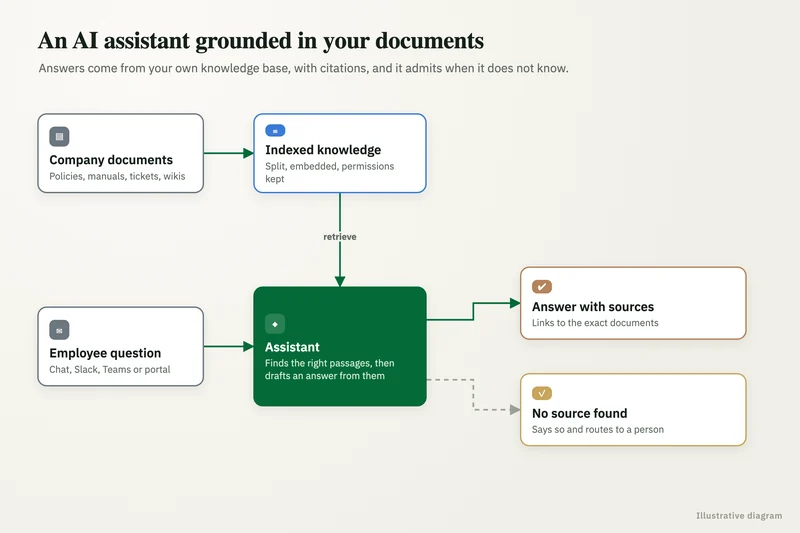
- Staff knowledge: an assistant over your policies and payer manuals that answers with citations.
- Documentation support: drafting visit summaries for clinicians to edit and sign, where your EHR allows.
What does HIPAA require before using AI in healthcare?
Any AI vendor that handles protected health information needs a signed Business Associate Agreement. The catch is that major model vendors sign BAAs only on certain API or enterprise tiers, not on consumer plans, so a staff member pasting a patient note into a personal chatbot account is a problem regardless of how useful the answer is.
Voice tools follow the same rule. Vapi sells HIPAA compliance as a paid add-on, and Bland AI includes a BAA on its Enterprise plan, so the plan you pick matters as much as the platform. If you record calls, states with two-party consent rules apply to an AI receptionist as they would to a person. This is not legal advice, and we work alongside your privacy officer or counsel.
What you get
What we deliver
Scoped and quoted at a fixed price after a free review.
Workflow study
Time and rework measured for intake, scheduling, prior authorization and billing handoffs.
BAA and vendor check
Each current and proposed vendor reviewed for BAA coverage and plan tier.
Use-case matrix
Candidates ranked by staff hours, denial impact, clinical risk and EHR effort.
Governance pack
Access rules, review steps, logging and data handling written for your privacy officer.
Sequenced roadmap
Projects in order, each with an owner, effort estimate and success measure.
First-project scope
A fixed-price scope for the top use case on covered infrastructure.
How do we prioritize AI use cases in a care organization?
We count staff hours and denials, then weigh integration effort. Discovery means sitting with front-desk staff, intake coordinators, billers and a few clinicians, and recording how long each task takes and how often it causes rework. A use case that prevents claim denials can rank highly even if it saves fewer hours, because it protects cash.
Integration with your EHR is usually the biggest variable. Some systems offer APIs or approved integration paths, others only exports or fax queues. Use cases that work outside the EHR and hand staff a prepared result tend to go first, with deeper write-back later once the BAA chain, access controls and review steps are proven.
What did a guided portal change for a therapy provider?
For a therapy services provider, we built a guided AppSheet clinician portal with validation, auto-calculated session durations, approvals and sync to billing. Clinician data entry dropped from 10 to 15 minutes a day to under 3, and errors were stopped at the source instead of being found by billing. More detail is in our case studies.
That project is a useful reminder that not every gain comes from a language model. Structured capture with validation often has to come first, because AI in healthcare is only as reliable as the session, visit and payer data underneath it.
What governance should a practice put around AI?
Governance should keep clinicians in charge, keep PHI inside covered accounts and make every AI output traceable. We write rules that name who may use which tool, what data each tool may see, and who reviews the output before it reaches a chart, a payer or a patient.
Colorado SB 26-189, effective January 1, 2027, adds notice duties for automated decision-making in consequential decisions, and healthcare is one of the named areas, with rights to an explanation of adverse outcomes, human review and data correction. Our controls are designed with rules like that in mind: logged prompts and outputs, minimum-necessary data in each request, confidence thresholds that send uncertain extractions to a human-review queue, and an eval set of de-identified past cases rerun after every change.
- BAA register covering every vendor in the data path.
- Role-based access, so front-desk tools never see full clinical notes.
- A documented fallback when the AI tool is unavailable.
How does a healthcare AI engagement run?
It starts with a free review, then a short discovery with your front desk, billing team and clinical leads, plus a check of your current vendors and BAAs. You get a ranked roadmap, a governance pack and a fixed price for the first use case.
We can build that first use case on covered infrastructure and test it with your staff, or specify it for your EHR vendor or IT partner. The practice owns every account, workflow, prompt and data store.
Case study · Therapy services provider
Clinician portal on AppSheet
Clinicians logged sessions in shared spreadsheets, so billing fixed formats, durations and missing authorizations before every cycle. A guided portal with validation, auto-calculated durations, approvals and automatic sync to billing.
- Data entry down from 10-15 minutes a day to under 3
- Errors stopped at the source
How it works
How an engagement runs
- 01
Free review
We learn your services, EHR, payers and the administrative tasks under most strain.
- 02
Discovery
We sit with front desk, billing and clinical leads and check vendor BAAs.
- 03
Roadmap
We rank use cases, write governance rules and price the first project.
- 04
Pilot
We build or specify the first use case and test it with staff on real workflows.
- 05
Measure and extend
We track hours saved and denials avoided, then move to the next item.
FAQ
Frequently asked questions
Is ChatGPT HIPAA compliant?
Not on consumer plans. Major model vendors sign Business Associate Agreements only on certain API or enterprise tiers, and you need a signed BAA before any protected health information is sent. We check plan tiers and BAAs for every tool in scope.
Can AI help with prior authorizations?
Yes. AI can gather the relevant chart notes, prior treatments and payer criteria into a draft packet, so a coordinator reviews and submits it rather than building it from scratch. Submission and any clinical justification stay with your staff.
Can an AI receptionist book patient appointments?
Yes, if it connects to your scheduling system and runs on a plan with a signed BAA. It can book, reschedule and send reminders, and should transfer to staff for anything clinical, urgent or outside its rules.
Will AI replace clinical decisions?
No, and we do not design it to. AI in healthcare engagements we run keep diagnosis and treatment with licensed clinicians, using AI for administrative work and drafts that clinicians edit and sign.
Does Colorado's AI law apply to healthcare providers?
It may. Colorado SB 26-189, effective January 1, 2027, covers automated decision-making in consequential decisions including healthcare, with explanation, human review and data correction rights. This is not legal advice, so confirm with counsel.
How much does AI consulting cost for a medical practice?
We quote a fixed price after a free review, based on your locations, systems and use cases in scope. Our AI consultant cost guide lists third-party market rates for comparison.
Keep reading
Related pages
Get started
Tell us where AI should pay back
Describe the work that eats your team's time and the systems you run. We reply within one business day with the use cases we would test first, the risks to plan for and a fixed-price proposal.
- Free 30-minute AI review
- Fixed quote before any work starts
- Advice that is vendor-neutral, in plain English
Prefer email? info@aiconsultingservicesusa.com
Book a free AI review
Two lines is enough to start.