
Logistics
AI in logistics for carriers, brokers and 3PLs that run on paperwork
AI in logistics earns its keep on the documents and status checks that sit between a load being booked and an invoice being paid. We work with owners and operations leaders at US trucking companies, freight brokers, 3PL warehouses and distributors who want to know which AI projects are worth funding, in what order, and with what controls around rates and customer promises.
Book a free AI review
Two lines is enough. A specialist replies within one business day.
Quick answer
What can AI do for a small or mid-size logistics company?
AI in logistics can read BOLs, PODs and rate confirmations into your TMS, answer track-and-trace questions from live load data, check carrier invoices against agreed rates and plan multi-stop routes. For a small or mid-size operator, the best first projects are document capture and status updates, with dispatchers approving anything that changes a rate, appointment or customer commitment.
- Document capture for BOLs, PODs and rate confirmations is usually the first win.
- Status emails and 'where is my load' calls can be answered from TMS data.
- Rates, accessorials and appointment changes always pass through a dispatcher or billing lead.
- We rank use cases by hours saved, integration depth and the cost of a mistake.
Where does AI in logistics save the most time?
It saves the most time on the documents and the status chasing. A typical brokerage or asset carrier has people retyping rate confirmations into the TMS, matching signed PODs to loads before billing can go out, logging into a dozen carrier portals for updates, and answering shippers who want to know where their freight is.
None of that needs a new routing engine. It needs something that can read a scanned BOL, find the load number, pull the consignee and pallet count, and either update the record or flag the mismatch. That kind of work is where language models and document extraction are already dependable, provided a person checks the exceptions.
- Billing: matching PODs and lumper receipts to loads so invoices go out the same day.
- Carrier invoices: checking line items and accessorials against the rate confirmation before payment.
- Track and trace: drafting status replies from TMS check calls, ELD pings and portal data.
- Order intake: turning emailed load tenders and spreadsheets into TMS orders for review.
- Warehouse: answering WMS inventory and receiving questions in plain English for customer service.
- Routing: planning multi-stop delivery runs with realistic service time at each stop.
Which logistics systems need to be in scope?
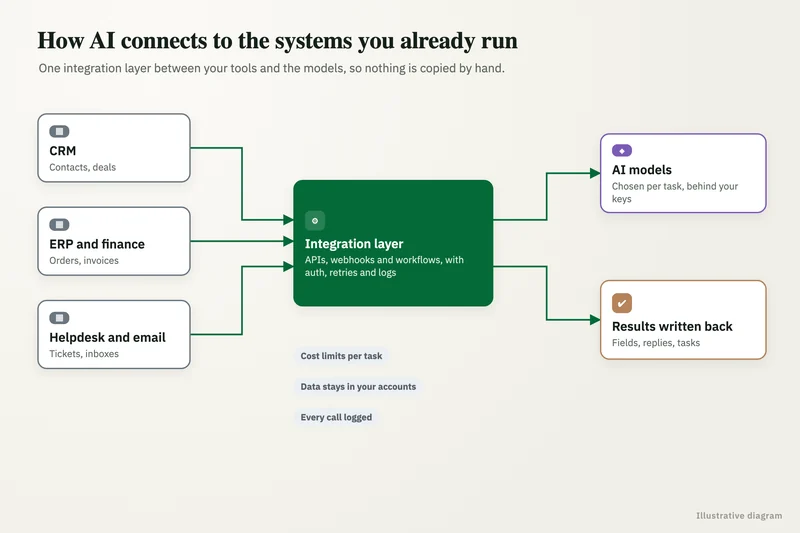
Your TMS, your WMS if you run warehouses, your accounting system, and every inbox and portal your team checks by hand. Some operators use McLeod, Aljex, Revenova or a TMS built into their ERP, while smaller fleets still dispatch from spreadsheets and a shared Gmail inbox. Accounting often runs on QuickBooks.
Integration depth decides sequencing. Reading PODs from an inbox and posting a note to the load is light work. Writing rates into the TMS or releasing carrier payments needs an API user, a mapping of every field, and an approval queue, so we place those later and design them more carefully.
What you get
What we deliver
Scoped and quoted at a fixed price after a free review.
Desk-level time study
Counts of BOLs, PODs, tenders, invoices and status requests handled per person per week.
Use-case grid
Each candidate scored on hours, cash impact, risk and ease of integration.
Systems map
TMS, WMS, accounting, inboxes and carrier portals, showing what each project reads and writes.
Control rules
Approval points for rates, accessorials and appointments, plus confidence thresholds and logging.
Sequenced roadmap
Projects in order with owners, effort estimates and the metric each must move.
First project scope
A fixed-price scope for the top-ranked use case, ready to build or hand over.
How do we prioritize AI projects for a freight or 3PL operation?
We count the hours first, then weigh them against risk. During discovery we sit with dispatch, billing and customer service and log how many BOLs, PODs, tenders and status emails each person handles in a week, and how long each takes. That gives a real number for every candidate instead of a guess.
Each use case then goes on a value and ease grid. Value covers labor hours, days sales outstanding (PODs that sit unmatched delay invoices), and missed-appointment penalties avoided. Ease covers document quality, TMS access and whether one person owns the outcome. The result is a short, sequenced roadmap, usually starting with billing paperwork because it touches cash.
Can AI handle route planning beyond consumer map tools?
Yes, with a purpose-built tool rather than a chatbot. For a logistics company in the UK, we built a Python route-planning tool that goes past Google Maps' 25-stop limit and adds buffer time at each stop. Manual address entry was eliminated, and the client could give customers delivery estimates they could rely on. The full write-up is in our case studies.
The point for planners is that route optimization is a classic algorithm problem, not a generative AI one. A language model may help clean messy addresses or read a delivery list from an email, while a solver does the sequencing. Choosing the right tool for each step is part of what we advise on.
What governance does AI in logistics need?
It needs clear limits on money, customer commitments and driver data. A model should never quote a rate, accept a load, approve a detention charge or promise a delivery window on its own. Those actions go through a dispatcher or billing lead, and the tool's job is to prepare them.
We set confidence thresholds on every extracted field, so a smudged POD signature or an unreadable seal number drops into a review queue. Prompts, outputs and the load each one touched are logged. If you plan AI phone calls to consignees or drivers, note that the FCC ruled on February 8, 2024 that AI-generated voices count as artificial voices under the TCPA, so outbound calls using them need prior express consent. This is not legal advice, and we recommend your counsel review any outbound calling plan.
- Driver and customer personal data kept in accounts you own.
- Cost caps per document and per month on model usage.
- A manual fallback so billing never stops if the tool does.
How does a logistics AI engagement run from start to finish?
We begin with a free review, then spend a short discovery period with your dispatch, billing and customer service teams, collecting a sample of real BOLs, PODs, tenders and carrier invoices. You get a ranked roadmap, governance rules and a fixed price for the first project.
From there we can build it, test it against a month of real paperwork and train the team, or hand a clear specification to your TMS vendor or internal developer. You keep ownership of the accounts, code, prompts and data in every case.
Case study · Logistics company, UK
Route planning automation
Dispatch typed every address into Google Maps, which optimizes only 25 stops and cannot add time at each stop. A Python tool that loads addresses automatically, adds buffer time per stop and optimizes the full route.
- Manual address entry eliminated
- Delivery estimates customers could rely on
How it works
How an engagement runs
- 01
Free review
We learn your freight mix, systems and where your desks lose the most time.
- 02
Discovery
We sit with dispatch, billing and customer service and collect sample documents.
- 03
Roadmap
We rank use cases, write control rules and agree the first project.
- 04
Pilot
We build or specify the first project and test it against real loads.
- 05
Measure and extend
We track hours saved and billing speed, then take the next item.
FAQ
Frequently asked questions
How is AI used in logistics today?
Most practical uses in small and mid-size operations involve paperwork and communication: reading BOLs and PODs, entering load tenders, auditing carrier invoices and answering status requests. Route optimization and forecasting use more traditional algorithms, sometimes with AI cleaning the input data.
Can AI read scanned PODs and bills of lading?
Yes, in most cases, including handwritten notes and stamps when the scan is reasonably clear. Each field gets a confidence score, and low-confidence fields go to a person before the load is billed. We test accuracy on a sample of your real documents before anything goes live.
Will AI work with our TMS?
Usually, either through the TMS API, an import format or a scheduled export. We start with read access and notes on the load, and only add write-back for rates or statuses once approval steps are in place.
Can AI answer 'where is my load' emails?
It can draft replies from TMS check calls, ELD data and portal updates, and a customer service rep sends or edits them. Once accuracy is proven on routine requests, some firms let simple updates go out automatically while exceptions still reach a person.
Are AI phone calls to drivers or consignees legal?
Outbound calls with AI-generated voices need prior express consent under the FCC's February 8, 2024 TCPA ruling, and some states require disclosure that the caller is an AI. This is not legal advice, so have counsel review any calling plan.
What does AI consulting for a logistics company cost?
We give a fixed price after a free review, based on the number of desks, systems and use cases in scope. Our AI consultant cost guide covers third-party market rates if you want a benchmark.
Keep reading
Related pages
Get started
Tell us where AI should pay back
Describe the work that eats your team's time and the systems you run. We reply within one business day with the use cases we would test first, the risks to plan for and a fixed-price proposal.
- Free 30-minute AI review
- Fixed quote before any work starts
- Advice that is vendor-neutral, in plain English
Prefer email? info@aiconsultingservicesusa.com
Book a free AI review
Two lines is enough to start.