

Accounting firms
AI for accounting firms that want a lighter tax season and a faster close
AI for accounting firms pays off in the admin that swells every tax season: chasing client documents, sorting what arrives, drafting engagement letters, preparing close work in QuickBooks and keeping compliance calendars current. We advise managing partners, firm administrators and operations leads at US CPA and bookkeeping firms on which projects to fund, how to sequence them around busy season, and how to protect client confidentiality while doing it.
Book a free AI review
Two lines is enough. A specialist replies within one business day.
Quick answer
How can accounting firms use AI?
AI for accounting firms is best used to chase and sort client documents, suggest QuickBooks transaction categories, draft engagement letters and client emails, summarize notices, prepare month-end close checklists and keep compliance calendars on track. Start with document collection and close prep, while preparers and partners keep review and sign-off on every return.
- Client document collection is the biggest time sink and usually the first project.
- Preparers and partners keep review and sign-off on every return and financial statement.
- Client financial data runs only through tiers that do not train on it.
- Projects are timed to land before busy season, not in the middle of it.
Where does AI for accounting firms save the most hours?
It saves the most hours on the chasing, sorting and re-keying that happens before real accounting work begins. Staff send organizers, follow up three times for a missing 1099, rename and file whatever arrives, then key figures into the tax software. Bookkeepers code the same vendors month after month and write the same questions to clients about uncategorized transactions.
Every one of these is rules-based and reviewable, which suits AI well. The professional judgment (the treatment of an item, the position on a return, the opinion on a statement) stays with your people.
- Document collection: tracking what each client has sent against their checklist and sending tailored reminders.
- Document sorting: classifying W-2s, 1099s, K-1s and statements, and extracting key figures for review.
- Bookkeeping: suggesting categories for QuickBooks bank feeds and drafting client questions on unclear items.
- Close prep: building month-end checklists, reconciliations to review and variance commentary drafts.
- Engagement letters: drafting letters from your templates and the scope agreed with each client.
- Notices: summarizing tax notices and client emails into a task with an owner and due date.
Which firm systems does AI need to work with?
Mostly your practice management platform, client portal, ledger software and document storage. Firms commonly run Karbon, TaxDome, Canopy or a CRM for workflow, QuickBooks Online or Xero for client books, and SharePoint or Google Drive for files, with tax software alongside.
Projects that read from these and hand a staff member a prepared result are quick and low risk. Anything that writes into client books or the tax software needs a review step, a log and a way to reverse it, so we place those later on the roadmap.
What you get
What we deliver
Scoped and quoted at a fixed price after a free review.
Season time study
Hours spent on collection, sorting, data entry, close and client email, by role.
Use-case matrix
Candidates ranked by peak-season hours, client impact, risk and ease.
Systems map
Practice management, portal, ledger, tax and file systems, with what each project uses.
Firm AI policy
Approved tools, client data rules, review steps and logging requirements.
Sequenced roadmap
Projects timed around busy season, each with an owner and success measure.
First-project scope
A fixed-price scope for the top use case, ready to build or hand over.
How should an accounting firm prioritize AI use cases?
Measure where staff hours go between January and April, and during each monthly close, then rank candidates on a value and ease matrix. Value is hours saved at peak times (an hour in March is worth more than an hour in July), fewer extensions caused by missing documents, and faster turnaround for clients. Ease is data access, template readiness and a clear owner.
Timing matters as much as ranking. We recommend building and testing outside busy season, so a new tool goes live with a few calm months of real use before the firm depends on it.
What did a compliance tool do for a regulatory consulting firm?
For a regulatory consulting firm, we built a compliance management tool with recurring task generation, named owners, due-date reminders and client-wise dashboards. Status reports now take under 15 minutes instead of 4 to 5 hours, and the firm saves more than 30 hours a month. The detail is in our case studies.
Accounting firms carry the same pattern: dozens of clients, each with recurring deadlines for payroll filings, estimates, sales tax and annual returns. A compliance calendar that generates tasks and flags slippage is often the foundation that makes AI for accounting firms work, because the AI then knows what is due and for whom.
What governance does AI need in an accounting practice?
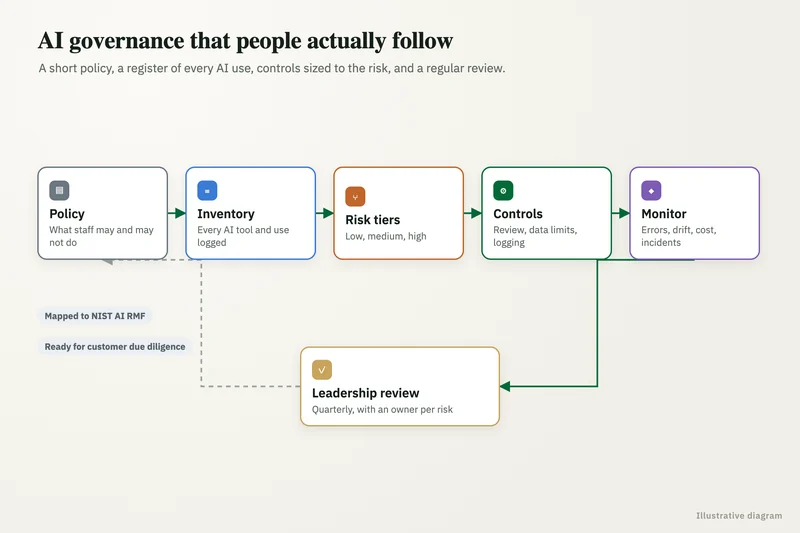
It needs controls that respect client confidentiality, keep professional sign-off with licensed staff and leave an audit trail. We write a short, firm-specific policy covering which tools staff may use, what client data may go into them and who reviews each output.
Client financial data and tax documents run only through enterprise or API tiers that do not train on your data, in accounts your firm owns. Prompts, outputs and the client file each one touched are logged. Extracted figures carry confidence scores, and anything below the threshold goes to a human-review queue before it reaches a workpaper. We also keep an eval set of real, anonymized past documents and rerun it whenever a prompt or model changes. Your firm's professional and confidentiality obligations still govern, and we work with your partners or counsel on those.
- No AI-signed returns, statements or client advice.
- A written list of approved tools, replacing ad hoc use of personal chatbot accounts.
- Cost caps per task so peak-season volume does not surprise anyone.
How does an AI engagement with an accounting firm run?
We start with a free review, then a short discovery with partners, managers, preparers and admin staff, plus a look at last season's document requests and a recent close. You receive a ranked roadmap, a firm AI policy and a fixed price for the first project.
We can build that first project and test it on a handful of friendly clients before rollout, or specify it for your practice management vendor or IT provider. Your firm owns every account, prompt, workflow and piece of client data.
How it works
How an engagement runs
- 01
Free review
We learn your service lines, systems and where busy season hurts most.
- 02
Discovery
We interview staff and study last season's document requests and a recent close.
- 03
Roadmap
We rank use cases, write the firm AI policy and price the first project.
- 04
Pilot
We build or specify the first project and test it with a few clients.
- 05
Measure and extend
We track hours saved and turnaround, then move to the next item.
FAQ
Frequently asked questions
Can AI collect and sort client tax documents?
Yes. AI can track each client's checklist, send reminders for missing items, classify uploads such as W-2s, 1099s and K-1s, and extract key figures for a preparer to review. It removes most of the chasing and filing without touching the judgment calls.
Can AI categorize transactions in QuickBooks?
It can suggest categories for bank feed transactions based on vendor history and your chart of accounts, and draft questions to clients about unclear items. A bookkeeper approves the suggestions, and low-confidence items are flagged rather than posted.
Is it safe to use ChatGPT with client financial data?
Not through personal or consumer accounts. Client data should go only through enterprise or API tiers that do not train on your data, in accounts the firm owns, with a written policy on what staff may share.
Will AI replace staff accountants?
In the firms we advise, AI takes over chasing, sorting and first drafts, so staff accountants spend more of their time on review, advisory work and client conversations. Sign-off and professional judgment stay with people.
When is the best time for an accounting firm to start an AI project?
Outside busy season. Discovery and building work best in the quieter months, so a new tool has real use and fixes behind it before the next January rush.
How much does AI consulting cost for an accounting firm?
We quote a fixed price after a free review, based on firm size, systems and the use cases in scope. Third-party market rates are in our AI consultant cost guide.
Keep reading
Related pages
Get started
Tell us where AI should pay back
Describe the work that eats your team's time and the systems you run. We reply within one business day with the use cases we would test first, the risks to plan for and a fixed-price proposal.
- Free 30-minute AI review
- Fixed quote before any work starts
- Advice that is vendor-neutral, in plain English
Prefer email? info@aiconsultingservicesusa.com
Book a free AI review
Two lines is enough to start.