

AI governance
AI governance consulting that your staff will actually follow
Our AI governance consulting gives US companies a working set of rules for AI: what data can go where, who approves new tools, what gets logged and where a person must review the output. It is for owners, COOs, finance and compliance leads at firms of roughly 20 to 1,000 staff who need control without stopping useful work.
Book a free AI review
Two lines is enough. A specialist replies within one business day.
Quick answer
What is an AI governance framework?
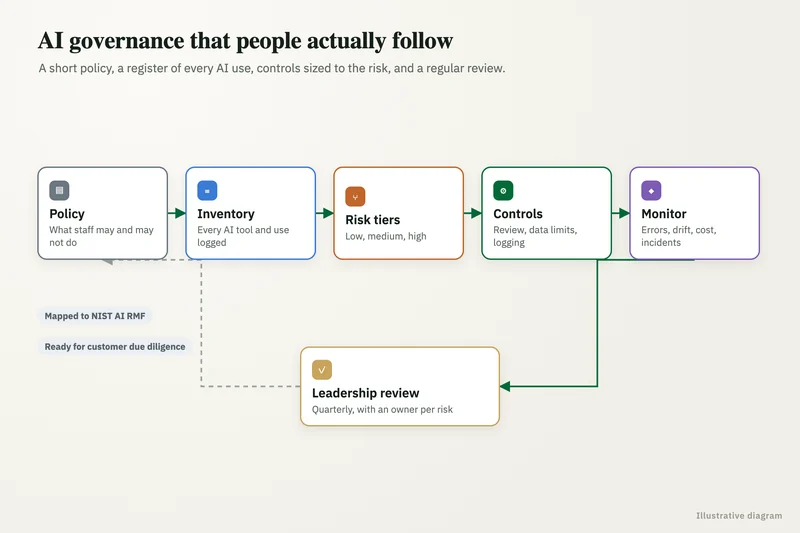
An AI governance framework is the set of policies, roles and controls that decide how a company approves, uses and monitors AI. In practice it covers an inventory of AI tools, data rules, risk tiers, human review points, logging, vendor checks and incident handling. AI governance consulting turns that into rules sized for your company.
- Governance starts with an inventory of every AI tool already in use.
- Risk tiers decide which use cases need human review before outputs take effect.
- Our policies follow the NIST AI RMF functions: Govern, Map, Measure, Manage.
- We flag where Colorado SB 26-189 or the EU AI Act may apply.
What does AI governance consulting include?
It includes an inventory of current AI use, a risk-tiering method, an acceptable-use policy, vendor and data-term checks, logging and monitoring rules, an incident process and training for managers. We write it to fit the size of your company, so a 60-person firm does not end up with a policy built for a global bank.
The output is practical. A sales rep should be able to read one page and know whether they can paste a customer contract into Claude or Copilot. An operations manager should know the steps to get a new AI tool approved. And leadership should get a monthly view of which tools are in use, what they cost and whether anything went wrong.
- AI inventory with owner, purpose, data types and vendor terms.
- Risk tiers: low, medium and high, each with required controls.
- Acceptable-use policy in plain language.
- Prompt and output logging for production tools.
- Incident and rollback process.
What is the NIST AI RMF and do we need to follow it?
The NIST AI Risk Management Framework 1.0, published in January 2023, is a voluntary US framework organized around four functions: Govern, Map, Measure and Manage. No private company is required to adopt it, but it is the most widely recognized structure for showing that AI risk is managed.
We use it as the backbone of our AI governance work because customers, insurers and auditors recognize it. Govern covers roles and policy. Map covers the inventory and the context of each use case. Measure covers eval sets, accuracy checks and bias reviews. Manage covers human review, monitoring and incident response. For generative AI, NIST published a companion Generative AI Profile, NIST AI 600-1, in July 2024, which we draw on for risks such as fabricated answers and data leakage.
What you get
What we deliver
Scoped and quoted at a fixed price after a free review.
AI inventory
Every AI tool and use case in the company, with owner, data types, vendor terms and risk tier.
Acceptable-use policy
A short, plain-language policy staff can read in minutes, with examples of allowed and blocked uses.
Risk-tier controls
Required checks for each tier, from spot checks to human-review queues and rollback plans.
Vendor review checklist
A repeatable checklist for data terms, retention, training use, access and BAA status.
Logging and monitoring
Rules for prompt and output logging, cost caps per workflow and a monthly governance report.
Regulatory map
Notes on where Colorado SB 26-189, the EU AI Act or HIPAA may apply, for review with counsel.
Manager training
A session for managers on approving requests, spotting risky use and handling incidents.
Which US and EU AI laws affect a mid-size company?
The ones most likely to matter are Colorado's new automated decision law and, if you sell into Europe, the EU AI Act. A federal executive order from December 11, 2025 also sought a national AI policy framework and created a DOJ task force to challenge state AI laws, so the state picture may keep shifting.
In Colorado, the original AI Act (SB 24-205) never took effect. It was repealed and replaced by SB 26-189, signed May 14, 2026, a narrower notice-based law covering automated decision-making in consequential decisions about education, employment, lending, healthcare, housing and insurance. It takes effect January 1, 2027 and is enforced by the Colorado Attorney General. Consumers get an explanation of adverse outcomes, human review and the chance to correct their data.
The EU AI Act, as amended by the 2026 Digital Omnibus, applies to US firms that place AI systems on the EU market or whose AI output is used in the EU. Transparency duties under Article 50, such as telling people they are talking to an AI and labeling synthetic media, apply from August 2, 2026. High-risk obligations for Annex III uses like employment and credit moved to December 2, 2027. This is not legal advice; we work alongside your counsel and flag where a use case needs their review.
How do risk tiers and human review work in practice?
Each AI use case is placed in a tier based on what a wrong output could cost, and each tier carries required controls. The tier decides how much review, logging and testing the use case needs before and after launch.
A low-tier example is drafting internal meeting summaries: approved tool, no customer data, spot checks. A medium-tier example is an assistant that answers staff questions from SharePoint policies: retrieval with citations, an eval set of known questions, and logging. A high-tier example is anything that affects a customer's money, a hiring decision or health information: outputs go to a human-review queue, confidence thresholds route uncertain cases to staff, and a rollback plan is written before launch.
How do you check whether an AI vendor is safe to use?
We review the vendor's data terms, retention settings, training use, access controls and contract tier. Consumer accounts and business accounts from the same vendor often have very different terms, which is why the plan your staff signed up for matters as much as the vendor name.
For health information, any AI vendor handling it needs a signed Business Associate Agreement, and the major model vendors sign these only on certain API or enterprise tiers, not consumer plans. We record each vendor's status in the inventory so the approval decision and its reasons are written down.
Will AI governance consulting slow our teams down?
Done well, it speeds them up, because people stop guessing what is allowed. Clear rules let staff use approved tools with confidence and give managers a fast path to approve something new.
We keep the controls proportionate. Low-risk uses get a light approval, and the heavier checks are saved for the few use cases where errors would hurt customers, money or compliance. Our case studies include a compliance management tool for a regulatory consulting firm, with recurring tasks, named owners and due-date reminders, which cut status reporting from 4-5 hours to under 15 minutes. Governance can work the same way: owners, reminders and a dashboard rather than a binder.
Case study · Insurance brokerage, Australia
Automation and dashboarding
Policy data arrived as spreadsheets from several insurers, each in a different structure, and every client report took hours of manual cleanup. An automated pipeline that standardizes every insurer's file and feeds a single reporting dashboard.
- Report time cut from 4-5 hours to under 5 minutes
- Reporting accuracy up from about 75% to 99%

How it works
How an engagement runs
- 01
Free review
A call to understand your AI use, customers, regulated data and any questions you already face.
- 02
Inventory and tiering
We list every AI tool and use case, then assign each a risk tier.
- 03
Policy and controls
We draft the policy, controls and vendor checklist, and review them with leadership and counsel.
- 04
Roll out and train
We brief managers and staff, set up logging and publish the approval process.
- 05
Monitor
We help run the first monthly governance reviews and adjust controls as usage grows.
FAQ
Frequently asked questions
Does the EU AI Act apply to US companies?
It can. According to the Act as amended in 2026, it applies to US firms that place AI systems on the EU market or whose AI output is used in the EU. Transparency duties apply from August 2, 2026, and high-risk obligations from December 2, 2027. Check your situation with counsel.
What does Colorado SB 26-189 require?
It is a notice-based law on automated decision-making in consequential decisions such as employment, lending, housing, healthcare, education and insurance, effective January 1, 2027. Consumers get an explanation of adverse outcomes, human review and data correction. It replaced the original Colorado AI Act, which never took effect.
Do small companies need an AI governance policy?
Yes, though it can be short. Even a 30-person firm benefits from a one-page policy covering approved tools, which data must never go into AI, and who to ask before trying something new.
Is it safe to put company data into ChatGPT, Claude or Gemini?
It depends on the account type and settings. Business and API tiers usually offer stronger data terms than personal accounts, and health information needs a signed BAA. A governance policy should name which plans are approved for which data.
How long does AI governance consulting take?
For most mid-size companies the inventory, policy and controls take a few weeks, with the monitoring phase running alongside the first live projects. The timeline is fixed in the scope after a free review.
Can you replace our lawyers on AI compliance?
No. We design the operational controls and document how AI is used, which makes your counsel's job faster. Legal interpretation of specific laws should always come from your own attorneys.
Keep reading
Related pages
Get started
Tell us where AI should pay back
Describe the work that eats your team's time and the systems you run. We reply within one business day with the use cases we would test first, the risks to plan for and a fixed-price proposal.
- Free 30-minute AI review
- Fixed quote before any work starts
- Advice that is vendor-neutral, in plain English
Prefer email? info@aiconsultingservicesusa.com
Book a free AI review
Two lines is enough to start.