

Insurance
AI in insurance for independent agencies, brokers and MGAs
AI in insurance helps agencies and brokers most where account managers spend their days: re-keying submissions, chasing loss runs, comparing quotes and issuing certificates. We advise principals, agency presidents and operations leaders at US agencies, brokerages and MGAs on which uses to fund, how to sequence them, and how to keep licensed staff in charge of every coverage decision.
Book a free AI review
Two lines is enough. A specialist replies within one business day.
Quick answer
How are insurance agencies using AI?
Insurance agencies are using AI in insurance operations to prefill ACORD forms from submissions, summarize loss runs, compare carrier quotes side by side, draft renewal letters, issue routine certificates of insurance and log FNOL details. Licensed staff still review coverage, pricing and claims advice, while AI removes the re-keying and lookups that slow account managers down.
- Submission intake, quote comparison and COI requests are the usual first projects.
- Licensed staff keep every coverage, binding and claims decision.
- Your agency management system is the source of truth, not the AI tool.
- Colorado SB 26-189 adds notice duties for insurance decisions from January 1, 2027.
Where does AI in insurance save time for an agency?
It saves the most time on repetitive document handling around each policy. Account managers and CSRs re-key the same insured details from an application into ACORD 125 and 126 forms, then into several carrier portals. Producers wait on someone to build a quote comparison. Certificate requests arrive by email every day and each one means opening the agency management system, checking the holder and additional insured wording, and generating the COI.
Adoption is already broad in the sector. The US Census Bureau's Business Trends and Outlook Survey reported Finance and Insurance firms using AI at 33.9% as of May 2026, well above the all-firm figure. The agencies getting value tend to aim it at these specific desks rather than at a general chatbot.
- Submissions: extracting applicant data, schedules and prior carrier details into ACORD fields for review.
- Loss runs: summarizing five years of claims into a one-page view for underwriters and producers.
- Quote comparison: lining up limits, deductibles, exclusions and premium across carrier quotes.
- Renewals: drafting remarketing summaries and renewal letters from the expiring policy.
- Certificates: preparing routine COIs and flagging holder requests that need wording a CSR must approve.
- Claims intake: capturing FNOL details from calls or emails into a structured notice.
Which agency systems does AI need to work with?
Mainly your agency management system, your carrier portals, your comparative rater and your shared inboxes. Many agencies run Applied Epic, Vertafore AMS360 or HawkSoft, and policy documents often live inside the AMS or in SharePoint. Quote data may come from a comparative rater for personal lines and from carrier PDFs for commercial.
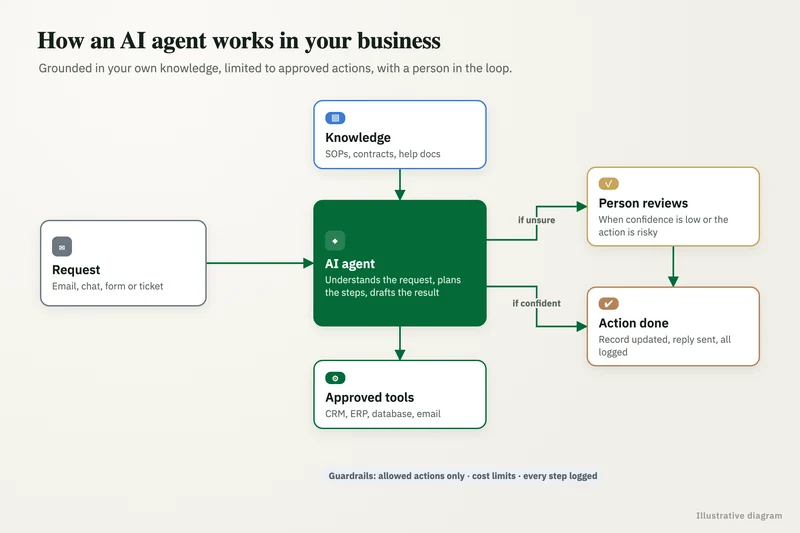
The AMS stays the system of record. A well-designed AI tool reads from it, prepares work, and posts back only after an account manager accepts the result. Carrier portals rarely offer APIs, so we usually recommend extraction from the documents they produce rather than brittle screen automation.
What you get
What we deliver
Scoped and quoted at a fixed price after a free review.
Desk analysis
Weekly volumes and handling time for submissions, renewals, COIs, endorsements and FNOL intake.
Use-case matrix
Candidates ranked by hours saved, E&O exposure and ease of integration with your AMS.
Systems map
AMS, raters, carrier portals and inboxes, with what each use case reads and writes.
Governance pack
Approval rules for licensed staff, logging, data handling and a note on state AI laws.
Sequenced roadmap
Projects in order, each with an owner, effort estimate and success measure.
First-project scope
A fixed-price scope for the top use case, ready to build or hand to a vendor.
How do we decide which AI in insurance projects come first?
We measure volume and error cost per desk, then plot each candidate on a value and ease matrix. A commercial lines team handling dozens of submissions a week has a very different top priority from a personal lines shop drowning in COI requests.
Error cost matters more in insurance than in most industries, because a wrong limit or a missed exclusion is an E&O exposure. So a use case that only drafts for review can move first even if its savings are modest, while anything close to binding or claims advice sits later, behind stronger controls and a longer test period.
What did reporting automation do for an insurance brokerage?
For an insurance brokerage in Australia, we built an automated pipeline that standardized every insurer's spreadsheet into one dashboard. Report time fell from 4 to 5 hours to under 5 minutes, and reporting accuracy rose from about 75% to 99%. Details are in our case studies.
Each carrier had its own column names, date formats and premium breakdowns, which is exactly the mess most US agencies face with commission statements and bordereaux. Standardizing that data is often the groundwork that makes later AI in insurance projects reliable.
What governance and regulation apply to AI at an insurance agency?
Your licensing duties, your carrier agreements and a growing set of state rules all apply. Colorado SB 26-189, signed May 14, 2026 and effective January 1, 2027, is a notice-based law on automated decision-making in consequential decisions, and insurance is one of the covered areas. Consumers get an explanation of adverse outcomes, human review and the chance to correct their data, enforced by the Colorado Attorney General.
In practice we write controls that keep AI in a preparation role. Coverage recommendations, declinations and claim positions come from licensed people. Every prompt, output and the policy it touched is logged in accounts you own. Applicant and claimant data runs only through enterprise or API tiers that do not train on it. This is not legal advice, and we coordinate with your counsel or compliance lead on anything state-specific.
- Confidence thresholds on extracted limits, dates and named insureds.
- Human-review queue for nonstandard COI wording and endorsements.
- An eval set of real past submissions rerun after any prompt or model change.
How does an insurance AI engagement work?
We start with a free review, then shadow account managers, CSRs and producers for a short discovery and gather sample submissions, quotes, loss runs and certificate requests. You receive a ranked roadmap, a governance pack and a fixed price for the first use case.
We can build that use case with your team testing it on real files, or write the specification for your AMS vendor or an integrator to deliver. Your agency keeps ownership of every account, prompt, workflow and piece of data.
Case study · Insurance brokerage, Australia
Automation and dashboarding
Policy data arrived as spreadsheets from several insurers, each in a different structure, and every client report took hours of manual cleanup. An automated pipeline that standardizes every insurer's file and feeds a single reporting dashboard.
- Report time cut from 4-5 hours to under 5 minutes
- Reporting accuracy up from about 75% to 99%
How it works
How an engagement runs
- 01
Free review
We learn your lines of business, AMS and the desks under most pressure.
- 02
Discovery
We shadow account managers and collect sample submissions, quotes and COI requests.
- 03
Roadmap
We rank use cases, write governance rules and price the first project.
- 04
Pilot
We build or specify the first use case and test it on real policy files.
- 05
Measure and extend
We track hours saved and errors caught, then move to the next item.
FAQ
Frequently asked questions
Can AI fill out ACORD forms from a submission?
Yes. AI can extract applicant details, locations, payroll, vehicles and prior coverage from emails and PDFs into ACORD fields. Each field carries a confidence score, and an account manager reviews the form before it goes to a carrier.
Does AI work with Applied Epic or AMS360?
Usually, through the vendor's available APIs, imports or reports, depending on your edition and permissions. We design the AMS as the system of record, with AI preparing work that staff accept before anything is posted back.
Can AI issue certificates of insurance automatically?
Routine certificates for standard holders can be prepared automatically from policy data. Requests with special wording, waivers or additional insured endorsements are flagged for a CSR, because issuing the wrong COI creates real exposure for the agency.
Is it safe to put client policy data into ChatGPT?
Not into consumer accounts. We route client and claimant data through enterprise or API tiers that do not train on your data, in accounts your agency owns, with prompts and outputs logged for review.
Do state AI laws apply to insurance agencies?
They can. Colorado SB 26-189, effective January 1, 2027, covers automated decision-making in consequential decisions including insurance, with explanation, human review and data correction rights. This is not legal advice, so confirm your obligations with counsel.
How much does AI consulting cost for an insurance agency?
We quote a fixed price after a free review, based on the desks, systems and use cases in scope. See our AI consultant cost guide for third-party market rates.
Keep reading
Related pages
Get started
Tell us where AI should pay back
Describe the work that eats your team's time and the systems you run. We reply within one business day with the use cases we would test first, the risks to plan for and a fixed-price proposal.
- Free 30-minute AI review
- Fixed quote before any work starts
- Advice that is vendor-neutral, in plain English
Prefer email? info@aiconsultingservicesusa.com
Book a free AI review
Two lines is enough to start.