

AI search
Answer engine optimization for brands that want to be cited by AI
Our answer engine optimization consulting helps US businesses get named and cited when buyers ask ChatGPT, Perplexity, Gemini or Google's AI Overviews about their category. It is for marketing leads and owners who want an AI search optimization plan built on published research and Google's own guidance rather than guesswork. You get an audit of how answer engines describe you today, a ranked content and technical plan, and a way to track citations month by month.
Book a free AI review
Two lines is enough. A specialist replies within one business day.
Quick answer
What is answer engine optimization?
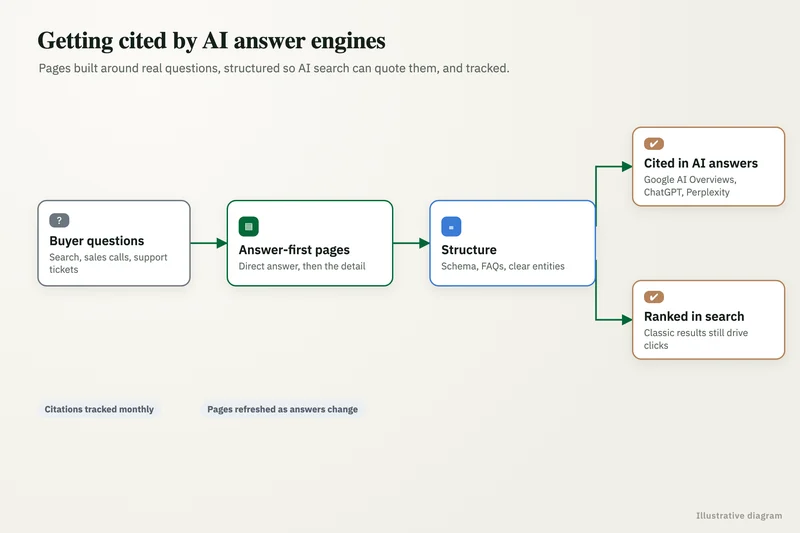
Answer engine optimization (AEO) is the practice of structuring content so AI systems such as Google AI Overviews, ChatGPT and Perplexity can find, trust and quote it. It builds on SEO, because pages still need to be indexed, but adds direct answers, cited sources, specific statistics and consistent brand facts across the web.
- Google says no special markup or AI text files are needed for AI Overviews.
- The GEO paper found citing sources, quotations and statistics improved visibility the most.
- Keyword stuffing showed little or no improvement in that same study.
- We track citations and AI referrals alongside rankings, not instead of them.
How is answer engine optimization different from SEO?
SEO aims to rank a page in a list of links, while answer engine optimization aims to have that page quoted or cited inside a generated answer. The foundations overlap heavily, but the success metric and the writing style differ.
Google's Search Central guidance on AI features states there are no additional requirements to appear in AI Overviews or AI Mode, and that no special AI text files, markup or schema are needed; pages must be indexed and eligible to show a snippet. So technical SEO is the entry ticket. What changes is how content is written: one question per section, a plain answer in the first sentence or two, named sources, and facts a model can lift without misreading them. Some people call this GEO (generative engine optimization), others AI search optimization. We treat all three as one discipline.
- SEO is judged on rankings, impressions and clicks from a results list.
- AEO is judged on how often answer engines cite or name your brand.
- Both need crawlable, indexed pages with accurate, helpful content.
- AEO puts extra weight on direct answers, named sources and specific figures.
Why does AI search optimization matter now?
It matters because fewer people click through when an AI summary sits on top of the results. Pew Research analyzed 68,879 searches by 900 US adults in July 2025 and found users clicked a traditional result 8% of the time when an AI summary appeared, compared with 15% without one, and clicked a link inside the summary only 1% of the time.
Other studies point the same way. Ahrefs and Seer Interactive both measured lower click-through rates on queries that show an AI Overview, and Seer observed that brands cited inside the overview earned more organic clicks than brands left out, which it describes as a correlation rather than proven cause. The share of searches showing AI Overviews also varies widely by study, so we plan with your own Search Console data instead of an industry average.
What you get
What we deliver
Scoped and quoted at a fixed price after a free review.
AI visibility audit
How ChatGPT, Perplexity, Gemini and Google AI features answer your buyers' questions today, and which sources they cite.
Technical access check
Indexing, snippet eligibility and crawler access issues, with a fix list for your web team.
Priority page plan
The pages to rewrite or create first, ranked by buyer intent and the size of the citation gap.
Answer-first page template
A reusable structure with question headings, short direct answers, named sources and statistics.
Entity consistency fixes
A list of company facts to align across your site, profiles and directories.
Citation tracking setup
A fixed prompt set, a monthly answer log and a GA4 channel group for AI referrals.
What does the research say actually works for answer engine optimization?
The most useful evidence is the GEO paper by Aggarwal and colleagues at IIT Delhi and Princeton, presented at KDD 2024. It found that optimizations could raise visibility in generative engine answers by up to 40%, that citing sources, adding quotations and adding statistics worked best, and that keyword stuffing showed little or no improvement.
Two findings shape our advice. First, evidence beats repetition, so we rewrite key pages around claims backed by named sources rather than around repeated phrases. Second, the paper found lower-ranked sites gained the most, which gives a smaller US company with careful, well-sourced pages a real opening against larger competitors. We also avoid selling shortcuts: Google's John Mueller has reportedly said no AI system currently uses llms.txt, so we do not present it as a lever.
What does an AEO audit cover?
An audit checks whether answer engines can reach your pages, what they currently say about you, and which category questions they answer using competitors instead. It ends with a ranked fix list your team can act on.
- Indexing and snippet eligibility in Google Search Console and Bing Webmaster Tools.
- Robots.txt and firewall rules that may block crawlers you actually want.
- A set of 30 to 100 buyer questions run through ChatGPT, Perplexity, Gemini and Google AI Mode.
- The sources each engine cites for those questions, and where you are missing.
- Consistency of company facts across your site, directories, review sites and LinkedIn.
- Page-level review of answer structure, sourcing and statistics on your top pages.
How do you measure AI search visibility?
We measure citations and brand mentions on a fixed prompt set each month, AI referral traffic in GA4, and the usual Search Console clicks and impressions. A stable prompt set tracked over time matters more than any single screenshot, because AI answers change between runs.
Referrals from tools like ChatGPT and Perplexity can be separated in GA4 by referrer, and we add a custom channel group so they are not buried in general referral traffic. For prompt tracking you can use a paid AI visibility tool or a scheduled script that logs answers to a sheet. We recommend one based on volume, and any subscription stays in your name.
Should you run AEO in-house or hire a consultant?
Many teams can run AEO in-house once the playbook, prompt set and page template exist. The consulting value sits in the audit, the priorities and the editorial rules, which your writers then apply to every new page.
We usually hand over a page template with question-led headings, a 40 to 60 word answer block, a sources section and an FAQ section, plus a short training session for writers. If you prefer, our implementation team can rewrite the priority pages and set up tracking for you.
How it works
How an engagement runs
- 01
Free review
We look at your Search Console data and run a handful of buyer questions through the main answer engines.
- 02
Audit
Full prompt-set testing, technical checks and a map of which competitors get cited and why.
- 03
Plan
A ranked list of page, entity and technical fixes with owners and review dates.
- 04
Rewrite and publish
Your writers apply the template, or our implementation team handles the first batch of pages.
- 05
Track
Monthly citation and referral reports, with the prompt set adjusted as your market changes.
FAQ
Frequently asked questions
What is the difference between AEO and GEO?
They describe the same goal: being cited inside AI-generated answers. GEO (generative engine optimization) is the term used in the 2024 research paper, while AEO is more common among marketers. We use both to mean optimizing for Google AI Overviews, ChatGPT, Perplexity and similar tools.
Do I need schema or an llms.txt file to appear in AI Overviews?
Google's Search Central guidance says no special AI text files, markup or schema are required for AI Overviews or AI Mode. Pages need to be indexed and eligible for snippets. Google's John Mueller has also reportedly said no AI system currently uses llms.txt.
Does answer engine optimization replace SEO?
No. Answer engine optimization depends on SEO basics like crawlability, indexing and helpful content, because answer engines draw on pages they can find. It changes how you structure and source content and adds citation tracking to your reporting.
How long does AEO take to show results?
Technical fixes can take effect once pages are recrawled, while shifts in citations usually take longer and vary by engine. We report monthly against a fixed prompt set so you see a trend rather than judging from one answer.
Can you make sure my brand appears in ChatGPT answers?
No one can promise that, because each answer engine decides what to cite and answers vary between runs. What we can do is remove technical obstacles, make your pages easier to quote and track whether your citation rate rises over time.
How much does answer engine optimization consulting cost?
We quote one fixed price after a free review, based on the number of pages and buyer questions in scope. Our AI consultant cost guide lists published third-party ranges for consulting work if you want to compare.
Keep reading
Related pages
Get started
Tell us where AI should pay back
Describe the work that eats your team's time and the systems you run. We reply within one business day with the use cases we would test first, the risks to plan for and a fixed-price proposal.
- Free 30-minute AI review
- Fixed quote before any work starts
- Advice that is vendor-neutral, in plain English
Prefer email? info@aiconsultingservicesusa.com
Book a free AI review
Two lines is enough to start.