

Banking
AI consulting for banks: a 2026 guide for community and regional bank leaders
AI consulting for banks helps a CEO, COO, chief credit officer or board decide which lending, deposit, compliance and service tasks to hand to AI, which core and vendor features to turn on, and how to document all of it for the next OCC, FDIC or Federal Reserve exam. This guide is written for US community and regional banks, roughly $250 million to $30 billion in assets, that want an independent plan before they sign another AI contract.
Book a free AI review
Two lines is enough. A specialist replies within one business day.
Executive summary
What does AI consulting for banks include?
AI consulting for banks typically includes a review of lending, deposit, BSA and service workflows, an inventory of AI features already in core and vendor contracts, a ranked use-case list scored by value and exam risk, an AI policy and third-party diligence pack, and one supervised pilot with a go or stop decision the board can approve.
What to take away
- The April 2026 model risk guidance excludes generative and agentic AI, so other rules carry the load.
- Third-party risk guidance from June 2023 governs most bank AI, because most of it arrives through vendors.
- Fund internal, analyst-facing tools first; leave credit decisioning and pricing for last.
- Examiners want an AI inventory, named owners, logs and a way to switch a vendor feature off.
Why banks are hiring AI consultants now
Banks are bringing in outside AI help because adoption is moving faster than governance, and the supervisory picture changed twice in six months. Cornerstone Advisors' What's Going On in Banking 2026 study, released in January 2026 and based on 416 executives at banks and credit unions with $250 million to $50 billion in assets, found that 49% of banks had already deployed generative AI. Much of that arrived as features inside core, digital banking and contact-center products rather than as a plan the board approved.
Leaders feel the gap. The CSI 2026 Banking Priorities report found that 27% of community bank leaders now rank AI as their top technology concern, ahead of cybersecurity, as summarized by ABT in 2026. A concern at the top of the list with no owner and no inventory behind it is the situation a short advisory engagement is designed to fix.
The work is not about picking a model. It is about deciding what the bank will and will not use AI for, which vendor features to accept, how each use is tested and who answers for it when an examiner asks.
What changed for bank AI oversight in 2025 and 2026?
Two OCC actions reset the ground rules. On October 6, 2025, OCC Bulletin 2025-26 clarified that its model risk guidance does not require community banks (those up to $30 billion in assets) to run annual model validations, and that the OCC will not criticize a bank solely for the validation frequency or scope it reasonably chose. Then on April 17, 2026, the OCC, Federal Reserve and FDIC replaced the 2011 model risk guidance with new interagency guidance (OCC Bulletin 2026-13, Federal Reserve SR 26-2) and stated that generative and agentic AI models are outside its scope because they are novel and changing fast.
The agencies said they plan a request for information on banks' use of AI, including generative and agentic AI. Until that produces guidance, a bank's chatbot, document reader or drafting assistant is not governed by a dedicated AI rulebook. It is governed by everything else: the June 2023 Interagency Guidance on Third-Party Relationships, information security duties under the Gramm-Leach-Bliley Act, fair lending and adverse action rules under the Equal Credit Opportunity Act and Regulation B, and UDAAP. Colorado's SB 26-189, effective January 1, 2027, adds notice, explanation and human review duties for automated decisions in lending and other consequential areas for consumers in that state.
The practical reading is simple. Do not wait for AI-specific guidance before building an inventory and a review process, because examiners can already ask about AI under the vendor, security and consumer protection rules above. This is not legal advice; bring your compliance officer and counsel into any lending or customer-facing use.
| Guidance | Date | What it means for bank AI |
|---|---|---|
| Interagency Guidance on Third-Party Relationships (OCC Bulletin 2023-17, SR 23-4) | June 6, 2023 | Covers due diligence, contracts and ongoing monitoring of vendors, which is where most bank AI comes from |
| OCC Bulletin 2025-26, model risk clarification for community banks | October 6, 2025 | No annual validation requirement for banks up to $30 billion; validation should match actual risk |
| Interagency model risk guidance (OCC Bulletin 2026-13, SR 26-2) | April 17, 2026 | Replaces the 2011 guidance; generative and agentic AI are explicitly out of scope pending an AI request for information |
| Colorado SB 26-189 | Effective January 1, 2027 | Notice, explanation of adverse outcomes and human review for automated consequential decisions, including lending |
What does AI consulting for banks include?
A sound engagement produces decisions and documents first, and a working pilot second. When you compare proposals, check which of these items each firm will actually hand over.
- Workflow and volume map: commercial and consumer lending, deposit operations and account opening, treasury management support, BSA/AML, loan review, the contact center and finance reporting, each with monthly volumes and staff hours.
- Vendor AI inventory: what your core (Jack Henry SilverLake or Core Director, Fiserv Premier or DNA, FIS Horizon or IBS), digital banking platform (Q2, Alkami, Banno), loan origination system (nCino, MeridianLink) and BSA monitoring tool already include, whether it is on by default and what data it touches.
- Ranked use-case list: each candidate scored on hours saved, customer impact, effort and exam risk, with plain automation and missing configuration separated from genuine AI work.
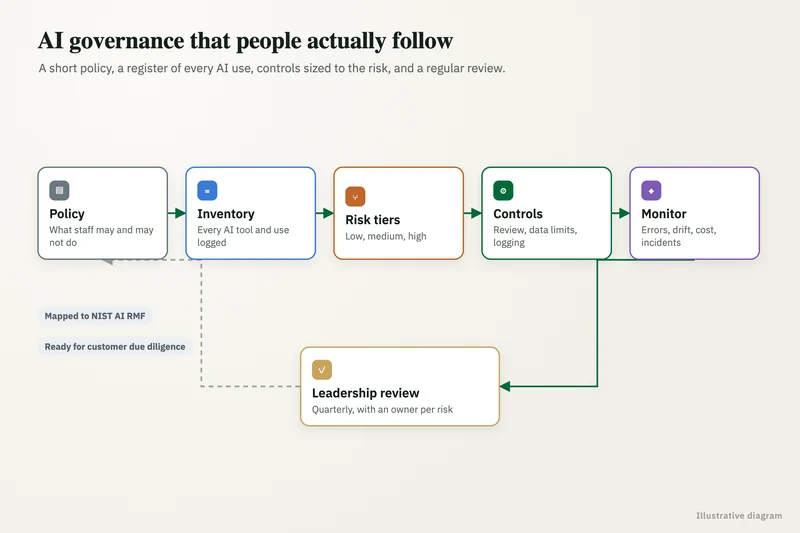
- AI policy and risk tiers: an acceptable-use policy for tools such as Microsoft 365 Copilot or ChatGPT, tiers that decide how much review each use needs, and an approval route through management, the risk committee and the board, mapped to the NIST AI Risk Management Framework.
- Third-party diligence pack: written questions, contract clauses and monitoring steps for every vendor whose AI touches customer data, aligned with the 2023 interagency guidance.
- One supervised pilot: an internal use case built in the bank's own accounts, run on real files with a person checking every output, measured against a baseline taken before it starts.
- Exam-ready file: the inventory, policy, diligence answers, test results and pilot logs in one place, plus a short board briefing.
Which AI use cases should a community bank fund first?
Start with analyst- and staff-facing work where a banker already reviews the output, move to customer-facing service next, and treat anything that influences a credit decision or price as the last and most heavily tested step. Internal tools can show measurable results within a quarter, and they build the review habits you need before customers see anything.
The ranking below is a default. Your volumes, staffing and existing contracts may reorder it.
| Use case | What AI does | Systems | Exam and customer risk | Order |
|---|---|---|---|---|
| Policy and procedure assistant | Answers banker questions from the bank's own policies with a citation to the source page | SharePoint or intranet, procedure manuals | Low: the banker reads the source before acting | First |
| Commercial loan spreading support | Extracts figures from tax returns and financial statements into the spread for an analyst to verify | nCino or LOS, spreading tool, document imaging | Medium: every figure is checked, but errors can reach a credit memo | First |
| Credit memo and annual review drafts | Drafts the narrative sections from the spread, covenant results and relationship notes | LOS, core, credit files | Medium: the analyst and approver own the conclusions | Second |
| Account opening document checks | Reads entity documents and IDs and flags missing items for the deposit operations team | Account opening platform, core, imaging | Medium: CIP and beneficial ownership duties stay with staff | Second |
| Contact-center summaries and knowledge search | Drafts call notes and finds answers for agents | Contact-center platform, CRM, core notes | Low to medium: recording consent and retention apply | Second |
| BSA/AML alert and SAR narrative drafting | Summarizes alert context and drafts the narrative for the investigator | BSA monitoring system, core | High: investigators decide and logs must show it | Third |
| Customer-facing chat in digital banking | Answers routine questions and hands account-specific ones to staff | Q2, Alkami, Banno or vendor module | Medium to high: AI disclosure, UDAAP and escalation | Third |
| AI in credit decisions or pricing | Scores applications or suggests rates | LOS, decision engine | Highest: fair lending, specific adverse action reasons, Colorado SB 26-189 | Last |
Worked example: sizing a commercial loan spreading pilot
The numbers below are assumptions for illustration, not a client result. Swap in your own baseline before using them in a business case.
Suppose a bank's credit team handles 60 commercial loan renewals and new requests a month, and each one needs about 3 hours of spreading: keying figures from business and personal tax returns, financial statements and rent rolls into the spreading tool. That is 180 analyst hours a month. If a pilot shows AI extraction plus analyst verification brings the task to about 1 hour and 15 minutes per file, the monthly total falls to 75 hours, a saving of about 105 hours.
At an assumed loaded cost of $55 an hour for a credit analyst, 105 hours is worth roughly $5,800 a month. Running costs then come off the top: the extraction feature or model usage, any added license for the spreading tool and a few hours of senior analyst time each month checking samples. If those total $1,800, the net is about $4,000 a month, or roughly $48,000 a year, before the one-time consulting and setup cost.
Two tests decide whether the saving is real. First, measure the correction rate over several weeks of real files, not a vendor demo; if analysts rewrite a third of the extracted figures, the time saved shrinks fast. Second, decide in advance where the freed hours go, whether faster turnaround for borrowers, more annual reviews completed on time or less reliance on contract analysts. Unassigned time rarely shows up in the budget.
How should a bank govern AI that comes from its vendors?
Treat every AI feature in a vendor product as a change to that vendor relationship, and run it through the same lifecycle the 2023 interagency third-party guidance describes: planning, due diligence, contract terms, ongoing monitoring and termination. Put the answers to these questions in the vendor file before the feature goes live.
- Which AI features are in our current edition, and which are enabled without us asking?
- Does customer data leave our environment, and is any of it used to train or tune models for us or for other banks?
- Which model providers sit underneath (OpenAI, Anthropic, Google, Microsoft, AWS or open-weight models), and which subcontractors process our data?
- What does the feature log, and can we export inputs, outputs, reviewer names and timestamps for an exam?
- What accuracy, bias and security testing have you done, and will you share results under NDA?
- Can we switch the feature off without breaking the rest of the product, and how fast?
- How much notice do we get before the underlying model, data terms or price change?
A 90-day AI plan for a bank board
The first engagement should end with a decision, a budget and a file an examiner can read. This is how we would sequence AI consulting for a bank with no formal AI program, involving the chief risk officer, BSA officer and compliance from the first week.
| Weeks | Work | Approved at the end |
|---|---|---|
| 1-3 | Interview heads of lending, credit, deposit operations, BSA, IT and the contact center; collect volumes and hours; list AI features across all vendor contracts | AI inventory and 8-12 candidate uses |
| 4-5 | Score candidates; draft the AI policy and risk tiers; send diligence questions to the core, digital banking and LOS vendors | Ranked shortlist, draft policy, one pilot chosen |
| 6-7 | Measure the pilot baseline (hours per file, error rate, turnaround); set review rules and accuracy thresholds | Baseline, success measure, fixed pilot budget |
| 8-11 | Run the pilot on live files with a banker checking every output; record corrections and time weekly | Weekly results versus baseline |
| 12-13 | Model monthly running cost; write the procedure; assemble the exam file; brief the board | Go, adjust or stop, plus a 12-month roadmap |
Independent consultant, core vendor, Big Four or in-house?
Use an independent consultant when you want a plan across several vendors and someone with no product to sell; let your core or LOS vendor lead when the exact feature you need is already in your contract; bring in a large audit or advisory firm when you need assurance work at scale; and build in-house only for narrow tasks you can maintain. Plenty of banks mix two of these.
| Option | Fits when | Risk to watch |
|---|---|---|
| Independent AI consultant | Several vendor pitches, mixed systems, a need for a ranked plan and governance the bank owns | Advice with no pilot; open hourly billing; a firm quietly tied to one platform |
| Core, digital banking or LOS vendor | The feature already exists in your edition and covers the use case well | Default-on features, data terms nobody reviewed, pricing that grows with accounts |
| Big Four or large advisory firm | Larger banks needing model validation, internal audit support or assurance across many uses | Fees and team sizes often built for much larger institutions |
| In-house team | A capable analyst with time and one narrow internal task | Key-person risk and unmaintained prompts when that person moves on |
Questions to ask an AI consultant for banks before you sign
Check that the firm understands bank supervision and core banking, not only AI tools. Our guide on how to choose an AI consulting firm covers the general checks; these are the bank-specific ones.
- How would you explain our AI program to an OCC, FDIC or Federal Reserve examiner, and what would be in the file?
- Which features in our current core and vendor contracts would you turn on, and which would you leave off?
- Will the pilot need customer data, and how will access be limited, logged and removed afterwards?
- How do you keep credit and pricing uses separate from internal productivity uses?
- What will the pilot cost per month to run after you leave, per file, per call or per account?
- Who owns the accounts, prompts, policies and logs when the engagement ends?
- Which of our ideas would you tell us not to fund?
When should a bank not hire an AI consultant?
Do not hire one to evaluate a single feature you have already decided to buy. A contract review, a two-week test on real files and sign-off from compliance may be all that decision needs.
Hold off during a core conversion or a merger integration. Procedures, data fields and vendors are about to change, and AI work designed around the old setup will have to be redone.
And if the only goal is safe use of Microsoft 365 Copilot or ChatGPT for writing and research, an acceptable-use policy and role-based sessions through our AI training for employees can cover it without a wider program.
How Greenwolf Tech Labs approaches AI consulting for banks
We are independent: we do not resell a core, a digital banking platform or a model, so our view on which vendor features to accept carries no commission. Our team has built reporting pipelines, compliance trackers and data tools for regulated clients. Team members bring experience from top consulting firms, and Harsh Khubchandani began his career at ZS in pharmaceutical commercial operations.
Every engagement opens with a free review of your workflows, systems and vendor contracts, after which each phase gets its own fixed price. The bank owns the accounts, prompts, policies and data, no AI output affecting customer funds or credit goes out without a banker's approval, and we model the monthly running cost before any pilot is approved. For published market rates by firm type, see our AI consultant cost guide, and if you also serve credit union peers through a CUSO, our credit union guide covers NCUA-specific points.
Case study · Logistics company, UK
Route planning automation
Dispatch typed every address into Google Maps, which optimizes only 25 stops and cannot add time at each stop. A Python tool that loads addresses automatically, adds buffer time per stop and optimizes the full route.
- Manual address entry eliminated
- Delivery estimates customers could rely on
FAQ
Frequently asked questions
What is AI consulting for banks?
It is advisory work that helps a bank decide where AI fits in lending, deposit operations, compliance, service and back-office work, and how to govern each use. A good engagement ends with an AI inventory, a ranked plan, vendor diligence, a policy and at least one use case tested on real files.
Does the 2026 model risk management guidance apply to generative AI?
No. The interagency model risk guidance issued on April 17, 2026 (OCC Bulletin 2026-13, Federal Reserve SR 26-2) says generative and agentic AI are outside its scope. The agencies plan a request for information on AI, and until then third-party, information security and consumer protection rules still apply.
Do community banks need to validate AI models every year?
Not automatically. OCC Bulletin 2025-26 from October 2025 says community banks, those up to $30 billion in assets, are not required to perform annual model validation and should set frequency and scope according to their actual risk. Higher-risk uses such as credit scoring still deserve independent testing.
What is the best first AI project for a community bank?
Usually an internal tool where a banker already checks the result, such as a policy and procedure assistant or AI support for commercial loan spreading. Volumes are steady, outputs are reviewed and no customer sees the AI directly, so risk stays low while you build governance habits.
How many banks use generative AI?
Cornerstone Advisors' What's Going On in Banking 2026 study, released in January 2026, found that 49% of banks in its survey had deployed generative AI, compared with 59% of credit unions. The survey covered 416 executives at institutions with $250 million to $50 billion in assets.
Can banks use AI to approve or deny loans?
They can, but it carries the most risk and should come last. Adverse action notices under ECOA and Regulation B must give specific reasons, fair lending testing is needed, and Colorado's SB 26-189 adds notice and human review duties from January 1, 2027. Involve compliance and counsel first.
How much does AI consulting for a bank cost?
It depends on scope and firm type. A narrow readiness review and one internal pilot cost far less than a multi-department program at a large advisory firm. Our AI consultant cost guide lists published third-party rates; we quote a fixed price per phase after a free review.
Keep reading
Related pages
Get started
Tell us where AI should pay back
Describe the work that eats your team's time and the systems you run. We reply within one business day with the use cases we would test first, the risks to plan for and a fixed-price proposal.
- Free 30-minute AI review
- Fixed quote before any work starts
- Advice that is vendor-neutral, in plain English
Prefer email? info@aiconsultingservicesusa.com
Book a free AI review
Two lines is enough to start.