

Credit unions
AI consulting for credit unions: what to fund first and how to keep examiners comfortable
AI consulting for credit unions helps a CEO, COO or board decide which member-service, lending and back-office tasks are worth handing to AI, which vendor features to switch on, and how to govern all of it so an NCUA exam goes smoothly. This guide is for US credit unions with roughly $100 million to a few billion dollars in assets that are getting AI pitches from their core, digital banking and contact-center vendors and want an independent plan before signing anything.
Book a free AI review
Two lines is enough. A specialist replies within one business day.
Executive summary
What does AI consulting for credit unions include?
AI consulting for credit unions usually covers a review of member-facing and back-office processes, a ranked list of AI use cases by member value, effort and exam risk, a review of AI features your existing vendors already offer, a governance and vendor due diligence framework, and one supervised pilot. A good adviser also tells you what not to automate.
What to take away
- Most credit union AI arrives through vendors, so due diligence on those vendors matters most.
- NCUA has no AI rulebook; existing third-party, model risk and member data rules apply.
- Start with staff-facing tools such as MSR knowledge search before member-facing or lending AI.
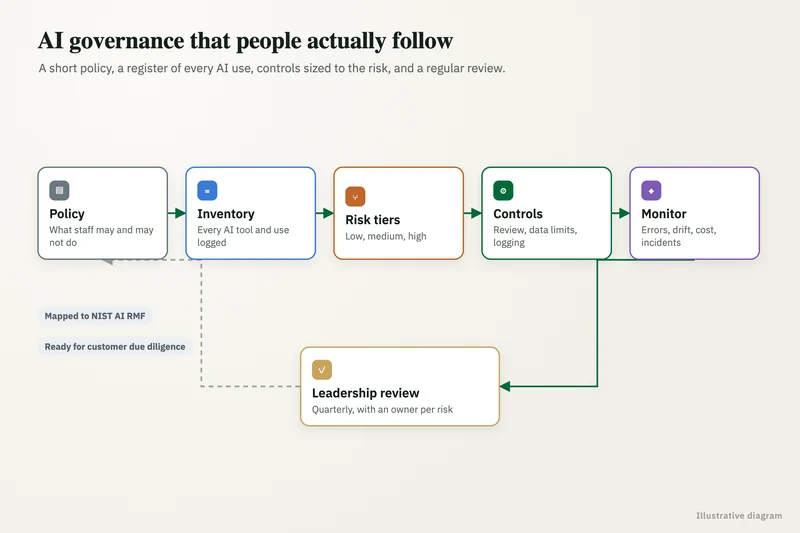
- Give the board a one-page AI inventory, a risk tier per use and a go or stop metric.
Why credit unions are hiring AI consultants in 2026
Credit unions are hiring AI consultants because AI is already arriving through their vendors, and leadership needs a plan that decides which of it to use rather than accepting whatever is bundled into the next contract renewal. Core processors, digital banking platforms, loan origination systems and contact-center software all now market AI features, and each one comes with its own data terms and pricing.
Interest is broad but depth is thin. Wipfli's State of the Credit Union 2026 report, based on a survey of 100 credit union executives published in January 2026, found 79% either researching or actively implementing AI, and noted that most adoption so far comes from vendor-enabled tools rather than a deliberate strategy. That gap between activity and a plan is exactly where an adviser earns a fee.
The supply side has moved too. In August 2026 Member Driven Technologies, a credit union service organization, announced a partnership with OnTrac AI to add AI readiness, opportunity assessment and roadmap work to its consulting practice, and CU 2.0 formed an AI-focused CUSO. When the CUSO network starts packaging AI strategy, boards start asking their CEO what the credit union's plan is.
What does AI consulting for credit unions include?
A useful engagement covers decisions first and builds second. Ask any firm, CUSO or vendor which of these it will deliver, and which it expects your staff or your core provider to handle.
- Process and volume review: member contact center, branch service, card disputes, lending intake, collections, BSA/AML alert handling, marketing and back-office reporting, with monthly volumes and staff hours for each.
- Vendor feature inventory: what your core (for example Jack Henry Symitar, Fiserv DNA or Corelation KeyStone), digital banking platform (Alkami, Q2, Banno), loan origination system (such as MeridianLink) and phone system already offer, what it costs and what data it uses.
- Use-case ranking: score each candidate on member impact, hours saved, build effort and exam or fair-lending risk, and separate real AI work from a missing configuration or plain automation.
- Governance framework: an AI inventory, risk tiers, an approval path through management and the board, and policies mapped to the NIST AI Risk Management Framework.
- Third-party due diligence pack: questions and contract terms for any vendor whose AI touches member data, including training use of data, data location, logging and exit rights.
- One supervised pilot: a staff-facing use case built in your own accounts, run on real work with a person reviewing every output, with a go or stop decision at the end.
- Board materials and staff training: a short board briefing, an acceptable-use policy for tools like Microsoft 365 Copilot or ChatGPT, and role-based training for MSRs, lenders and back-office teams.
What NCUA expects from credit unions using AI
NCUA has not issued a separate AI regulation, so AI at a credit union is supervised through the rules that already apply to vendors, models, member data and lending. On December 22, 2025 NCUA updated its artificial intelligence resource page with references from NIST, COSO, CISA, the US Treasury and FinCEN, presented as tools rather than new requirements, and pointing back to its existing third-party due diligence letters (07-CU-13 and 01-CU-20), as summarized by the Consumer Financial Services Law Monitor in January 2026.
The vendor point matters more for credit unions than for banks. The Government Accountability Office reported in May 2025 (GAO-25-107197) that NCUA lacks authority to examine technology service providers even though credit unions increasingly rely on them for AI-driven services, and that its model risk management guidance is limited in scope and detail. In practice that means the credit union itself has to do the diligence on any AI vendor, because no federal examiner is checking the vendor for you.
Several existing rules apply directly to common AI uses. Member information security programs under NCUA's Part 748 cover any tool that stores or processes member data. Adverse action notices under the Equal Credit Opportunity Act and Regulation B must give specific reasons for a credit denial, whatever model produced the decision. And Colorado's SB 26-189, effective January 1, 2027, requires notice, an explanation of adverse outcomes and human review for automated decisions in consequential areas including lending, which matters for credit unions with Colorado members. This is not legal advice; involve your compliance officer and counsel on any lending use.
Which credit union AI use cases should you fund first?
Fund staff-facing use cases with high volume and low member risk first, then member-facing service, and only then anything that influences credit decisions. Staff tools build skill and governance habits without putting a member or a fair-lending finding at risk, and they show results within a quarter.
The table ranks the common candidates. The order is a starting point; your volumes and vendor contracts may change it.
| Use case | What AI does | Systems involved | Member and exam risk | Suggested order |
|---|---|---|---|---|
| MSR and call-center knowledge assistant | Answers staff questions on products, fees and procedures with citations to your own policy documents | SharePoint or intranet, procedure manuals, contact-center desktop | Low: staff check the answer before telling the member | First |
| Call and chat summaries | Drafts the after-call note and disposition code for the agent to confirm | Contact-center platform, CRM or core member notes | Low to medium: recording consent and retention rules apply | First |
| Loan document intake | Reads pay stubs, tax forms and bank statements and fills the application fields for a processor to check | Loan origination system, document imaging | Medium: errors affect decisions, so every field is reviewed | Second |
| Card dispute and Reg E case prep | Gathers transaction history and drafts the case file and member letter | Card processor portal, core, case management | Medium: deadlines are regulated, so people own the timeline | Second |
| Member-facing chat in digital banking | Answers routine questions and hands off to staff on anything account-specific | Alkami, Q2, Banno or vendor chat module | Medium: needs disclosure that it is AI, guardrails and escalation | Second |
| BSA/AML alert triage | Summarizes alert context and drafts the investigator narrative | BSA/AML monitoring system, core | High: investigators decide; logs must show who did | Third |
| AI in credit decisioning or pricing | Scores applications or suggests pricing | Loan origination system, decision engine | Highest: fair lending, adverse action reasons, Colorado SB 26-189 | Last, with model validation |
How to govern AI vendors your credit union already uses
Most of your AI exposure will come through contracts you already have, so governance starts with an inventory of every vendor feature that uses AI, followed by the same diligence you would apply to any critical vendor. Ask each vendor these questions in writing and keep the answers in the vendor file your examiner will see.
- Which features in our current contract use AI, and which are switched on by default?
- Is member data used to train or improve models, for us or for other clients, and can we opt out in the contract?
- Which model providers sit behind the feature (OpenAI, Anthropic, Google, Microsoft, AWS or open-weight models), and where is data processed and stored?
- What is logged: the input, the output, the reviewer and the timestamp, and can we export those logs?
- How is the feature tested for accuracy and bias, and will you share the results?
- What happens to our data and prompts if we leave, and how much notice do we get before the model or pricing changes?
- Is pricing per seat, per conversation or per member, and what does it cost at double our current volume?
A 90-day AI plan a credit union board can approve
A first engagement should end with a decision the board can understand, not a slide deck. The plan below is how we would sequence AI consulting for a credit union starting from no formal program, with the supervisory committee and compliance officer involved from week one.
| Weeks | Work | What leadership signs off |
|---|---|---|
| 1-2 | Interview member service, lending, card, BSA and IT leads; pull volumes and hours; list every vendor AI feature in current contracts | AI inventory and 8-12 candidate use cases |
| 3-4 | Score candidates on value, effort and risk; draft AI policy and risk tiers; send diligence questions to key vendors | Ranked shortlist, draft policy and one chosen pilot |
| 5-6 | Measure the baseline for the pilot (handle time, after-call work, errors); set accuracy and review rules | Baseline, success measure and fixed pilot budget |
| 7-10 | Run the pilot with staff reviewing every output; log errors and time saved weekly | Weekly results against the baseline |
| 11-13 | Model monthly running cost; write the procedure; brief the board | Go, fix or stop, plus a 12-month roadmap |
Worked example: sizing a contact-center AI pilot
This is an illustrative calculation, not a client result. It shows how to size a staff-facing pilot before you sign anything; replace every assumption with your own baseline.
Assume a credit union handles 12,000 member calls a month, and each call is followed by about 2 minutes of after-call work to write notes and pick a disposition code. That is 400 staff hours a month. Suppose a pilot shows AI-drafted call summaries cut after-call work to about 45 seconds, because the agent now reviews and corrects a draft instead of typing from scratch. The new total is 150 hours, a saving of roughly 250 hours a month.
At an assumed loaded cost of $32 an hour for a member service representative, 250 hours is worth about $8,000 a month. Subtract running costs: the summary feature or model usage, transcription, and an hour or two a week of supervisor time reviewing samples. If those come to $2,500 a month, the net is about $5,500 a month, or roughly $66,000 a year, before the one-time consulting and setup fee.
Two checks keep the number honest. Saved minutes only matter if they become shorter queues, more outbound member calls or avoided overtime, so decide in advance where the time goes. And the 45-second figure is something you measure across several weeks of real calls, including the share of drafts agents had to rewrite, not a number to accept from a vendor demo.
Consultant, CUSO, core vendor or do it yourself?
Hire an independent AI consultant when you need a plan across several vendors and an honest view of what to skip; use a CUSO when you want shared programs and peer benchmarking; let your core or digital banking vendor lead when the feature you need is already in your contract; and build in-house only when you have staff who can maintain it. Many credit unions use more than one.
| Option | Best when | Watch out for |
|---|---|---|
| Independent AI consultant | You face several vendor pitches, have mixed systems and want a ranked plan and governance you own | Strategy work with no pilot; open hourly billing; advice tied to one platform |
| CUSO AI program | You want a structured program shared with peer credit unions | Standard playbooks that may not fit your systems or member base |
| Core or digital banking vendor AI | The feature already exists in your edition and covers the use case | Default-on features, data terms you have not read, pricing that scales with members |
| In-house build | You have an IT or data analyst with time and one narrow staff-facing task | Key-person risk and no one maintaining prompts when that person leaves |
Questions to ask before hiring an AI consultant for your credit union
Test whether the firm understands credit union operations and supervision, not just AI tools. Our general guide to choosing an AI consulting firm covers the standard checks; these are the credit union specific ones.
- Which of our vendors' existing AI features would you switch on, and which would you leave off?
- How will our AI inventory and vendor diligence look to an NCUA examiner?
- Do you need access to member data for the pilot, and if so, how will it be protected and logged?
- How will you keep lending and pricing uses separate from staff productivity uses?
- What will the pilot cost to run each month after you leave, per call, per member or per document?
- Who owns the accounts, prompts, policies and data at the end of the engagement?
- Which of our ideas would you advise us not to pursue?
When should a credit union not hire an AI consultant?
Skip the consultant if your real need is a single vendor feature. If your digital banking provider already offers a chat assistant that fits, a careful contract review and a test with your compliance officer may be all you need.
Wait if you are in the middle of a core conversion or a merger. AI steps designed around systems and procedures that are about to change will need redoing, so plan them once the new core and data are stable.
And if the goal is only safe staff use of tools like Microsoft 365 Copilot or ChatGPT for writing and research, a short acceptable-use policy and a few hours of role-based training may be enough. Our AI training for employees covers that without a wider engagement.
How Greenwolf Tech Labs approaches AI consulting for credit unions
We are an independent firm, so we do not resell a core, a digital banking platform or a model, and our advice on which vendor features to use is not tied to a commission. Our team has worked on compliance tracking, reporting pipelines and data tools for regulated clients; in one of our case studies, a regulatory consulting firm moved to a compliance management tool with recurring tasks, owners and reminders, and produced status reports in under 15 minutes instead of 4 to 5 hours.
We start with a free review of your processes, systems and vendor contracts, then quote a fixed price for each phase. You keep ownership of the accounts, prompts, policies and data, a person stays in the loop on anything that touches member money or credit decisions, and we model monthly running costs before you approve a pilot. For market rates across firm types, see our AI consultant cost guide.
FAQ
Frequently asked questions
What is AI consulting for credit unions?
It is advisory work that helps a credit union decide where AI fits in member service, lending, card operations, compliance and back-office work, and how to govern it. A good engagement ends with an AI inventory, a ranked plan, vendor diligence and at least one use case tested on real work.
Does NCUA have rules for AI?
NCUA has not issued a standalone AI regulation. Its AI resource page, updated in December 2025, points credit unions to NIST, COSO, CISA, Treasury and FinCEN materials and to its existing third-party due diligence guidance. Existing rules on member data security, vendors and fair lending apply to AI use.
What is the best first AI project for a credit union?
For most credit unions it is a staff-facing tool such as a knowledge assistant for member service representatives or AI-drafted call summaries. Volumes are high, a person checks every output and no credit decision is involved, so the risk is low and results show quickly.
How many credit unions use AI chatbots?
The PYMNTS Intelligence and Velera Credit Union Tracker reported in August 2026 that chatbot adoption among credit unions rose from 3% in 2019 to 46% in 2026. Many of those chatbots come bundled with digital banking platforms rather than built in-house.
Can a small credit union afford AI consulting?
Yes, if the scope is narrow. A short readiness review and one staff-facing pilot cost far less than a broad transformation program, and many useful features are already in contracts you pay for. Our AI consultant cost guide lists published market rates by firm type; we quote a fixed price after a free review.
Can credit unions use AI for loan decisions?
They can, but it is the highest-risk use and should come last. Adverse action notices must still give specific reasons, models need validation and fair-lending testing, and Colorado's SB 26-189 adds notice and human review duties from January 1, 2027. Involve compliance and counsel before any pilot.
Who is responsible when a vendor's AI makes a mistake?
The credit union remains responsible to its members and examiners for outcomes, even when the AI belongs to a vendor. GAO reported in 2025 that NCUA cannot examine technology service providers, so your contract terms, testing and logs are the main protection.
Keep reading
Related pages
Get started
Tell us where AI should pay back
Describe the work that eats your team's time and the systems you run. We reply within one business day with the use cases we would test first, the risks to plan for and a fixed-price proposal.
- Free 30-minute AI review
- Fixed quote before any work starts
- Advice that is vendor-neutral, in plain English
Prefer email? info@aiconsultingservicesusa.com
Book a free AI review
Two lines is enough to start.