

Finance
AI consulting for finance teams: what a CFO should buy, in what order
AI consulting for finance teams helps a CFO or controller decide which parts of accounts payable, the close, reporting and FP&A are worth handing to AI, then get one of them working with the controls auditors expect. This guide is for finance leaders at US companies with roughly 20 to 1,000 staff who are getting AI pitches every week and want a plan that pays back, not another pilot.
Book a free AI review
Two lines is enough. A specialist replies within one business day.
Executive summary
What does AI consulting for finance teams include?
AI consulting for finance teams usually covers a review of finance processes and systems, a ranked list of AI use cases with value and effort, controls for audit trails and approvals, and a first pilot on real transactions. Good advisers also tell you which problems need a process fix or an ERP feature rather than AI.
What to take away
- Start with high-volume, rules-heavy work: invoice capture, matching, coding and reconciliations.
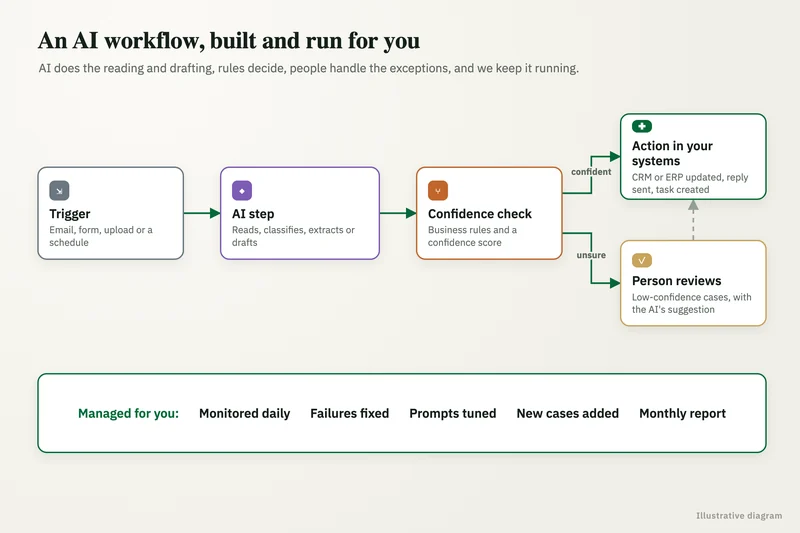
- Every AI step in finance needs a confidence threshold, a reviewer and a logged decision.
- Plan pilots around the close calendar so the team is not testing during month-end.
- Measure value in hours, days to close and error rates against a baseline taken first.
Why finance leaders are hiring AI consultants now
Finance leaders are hiring AI consultants because most finance teams already have AI tools switched on but cannot yet show the board what they are worth. Copilot is in Excel, the ERP vendor has added an assistant, the AP platform advertises auto-coding, and the CFO still closes the books the same way as two years ago.
The gap between activity and value is now the main problem. Gartner, in a survey of 204 finance leaders reported by CPA Practice Advisor in May 2026, found that 63% said AI implementation in 2025 was slower than expected, and told CFOs to measure realized value rather than counts of pilots or tools. At the same time, the Consero 2026 CFO Survey of 102 finance leaders at investor-backed companies with $20M to $500M in revenue found 42% reporting AI broadly or fully embedded in finance, up from 22% the year before. Peers are moving, and boards notice.
An outside adviser is useful at exactly this point: someone who has seen the same processes in other companies, can tell which vendor claims hold up, and will design the controls your auditors will ask about before anything touches the general ledger.
What does AI consulting for finance teams include?
AI consulting for finance teams covers the decisions before a build and, if you want it, the first build itself. Ask any firm to name which of the following it delivers, and which it leaves to your ERP vendor or IT team.
- Process and systems review: map procure-to-pay, order-to-cash, record-to-report and FP&A, with volumes, hours and error points for each.
- Use-case ranking: score candidates by hours saved, risk and effort, and separate AI work from plain automation or a missing ERP setting.
- Tool and vendor review: check what your existing licences already do (NetSuite, QuickBooks, Sage Intacct, Microsoft 365 Copilot, Bill.com, Ramp) before buying anything new.
- Controls design: confidence thresholds, approval routing, segregation of duties and logs that show what the AI proposed and who approved it.
- Pilot: one use case built in your own accounts, run on live transactions with a person reviewing every output for a set period.
- Running-cost model and value report: monthly model, platform and review costs per task, set against the baseline the CFO signed off.
Which finance processes should you apply AI to first?
Apply AI first where volume is high, inputs are documents or spreadsheets, and a wrong answer is caught by an existing check. That usually means accounts payable, reconciliations and reporting prep before forecasting. Gartner's 2024 finance survey of 121 finance leaders ranked intelligent process automation and anomaly and error detection as the two most adopted finance AI use cases, ahead of analytics.
The table shows the usual candidates, the systems they touch and what has to be true before AI can help.
| Process | What AI does | Systems involved | What you need first | Typical first-pilot fit |
|---|---|---|---|---|
| Invoice capture and coding (AP) | Reads invoices from email or PDF, extracts fields, proposes GL code and cost center | AP inbox, Bill.com or ERP AP module, NetSuite or QuickBooks | A few months of coded invoices to learn from; a vendor master that is mostly clean | Strong |
| Three-way match exceptions | Explains why PO, receipt and invoice do not match and drafts the vendor query | ERP purchasing, receiving records, email | POs used consistently for the spend in scope | Strong |
| Bank and intercompany reconciliations | Suggests matches for unmatched lines and flags outliers for review | Bank feeds, ERP, Excel reconciliation files | Consistent reconciliation templates and account mapping | Good |
| Variance commentary for monthly reporting | Drafts first-pass explanations of budget vs actual variances from GL detail | ERP, Excel or Google Sheets, BI dashboards | A stable chart of accounts and a budget at the same level of detail | Good |
| Collections and AR follow-up | Prioritizes overdue accounts and drafts reminders in the right tone | ERP AR aging, CRM such as HubSpot or Salesforce, email | Clean customer contacts and agreed escalation rules | Good |
| Cash flow forecasting | Proposes forecasts from history, open AP and AR, and pipeline | ERP, bank data, CRM, FP&A model | At least a year of reliable history and a forecast process people trust | Later, after the basics |
| Policy and contract Q&A | Answers staff questions on expense policy or contract terms with citations | SharePoint or Google Drive, policy documents | Current, single-version policy documents | Good, low risk |
How should AI be controlled in a finance function?
AI in finance should propose and a person should approve, at least until the error rate is measured and accepted. That one rule keeps the general ledger, payments and segregation of duties intact, and it is what your external auditor will look for.
In practice the controls are concrete and cheap to build in from the start. They are expensive to retrofit after an auditor asks how a journal entry was created.
- Confidence thresholds: high-confidence items go to a fast approval queue; low-confidence items go to a full review queue with the reason shown.
- No AI posting rights: the AI drafts entries, codes and matches; posting and payment release stay with named staff and existing approval limits.
- Logging: store the source document, the extracted values, the AI's proposal, the reviewer, the final value and the timestamp for every item.
- Segregation of duties: the person who configures prompts or rules should not be the person approving payments the system touches.
- Data handling: use business or enterprise terms with the model provider so prompts and outputs are not used for training, and keep bank and payroll data out of general chat tools.
- Change control: test prompt or rule changes on a saved set of past transactions before they go live, and keep the old version so you can roll back.
A 90-day plan that fits around the close
A first AI project in finance should run on a calendar that respects the close. Testing a new AP process during the last three days of the month is how pilots lose the team's goodwill. The plan below is how we would sequence a first engagement for a mid-size company with a monthly close.
| Weeks | Work | Output the CFO signs off |
|---|---|---|
| 1-2 | Interview the controller, AP, AR and FP&A leads; pull volumes and hours; inventory ERP, AP tools and licences | Process map and a list of 5-10 candidate use cases |
| 3-4 | Rank use cases; measure the baseline for the top one (hours, cycle time, exception rate); agree controls | Chosen use case, baseline and a fixed pilot budget |
| 5-9 | Build in your own accounts; run on live work mid-month with every output reviewed; pause during close | Weekly accuracy and hours against the baseline |
| 10-11 | Tune thresholds; write the procedure and review rules; model monthly running cost | Go, fix or stop decision with numbers |
| 12-13 | Hand over to the team; add the next use case to the roadmap | Operating procedure and a ranked backlog |
Worked example: what AI can save in accounts payable
Here is an illustrative calculation, not a client result, showing how to size an AP pilot before you sign anything. Replace each assumption with your own numbers from the baseline.
Assume a company processes 1,500 invoices a month and the team spends about 6 minutes on each to key, code and route it. That is 150 hours a month. Suppose a pilot shows that 60% of invoices come through with high confidence and need only a 1-minute check, while the other 40% still take the full 6 minutes. The new total is about 15 hours plus 60 hours, or 75 hours a month, a saving of roughly 75 hours.
Now cost it. At an assumed loaded cost of $45 an hour, 75 hours is worth about $3,375 a month. Subtract monthly running costs: the AP or extraction platform, model usage and the time someone spends maintaining rules. If those come to $800 a month, the net is about $2,575 a month, or roughly $31,000 a year, before the one-time consulting and build fee. That fee should be judged against this number, and a sensible pilot either pays back inside a year or is stopped.
Two cautions apply. First, saved hours only count if they are redeployed to work the team was skipping, such as variance analysis or vendor reviews, or if they avoid a hire. Second, the 60% straight-through figure is something you measure in the pilot, not something to accept from a sales deck.
Consultant, software vendor or do it in-house?
Hire an AI consultant when the question is what to do and in what order; buy software when a packaged tool already does the job inside your systems; build in-house when you have the people and a narrow, well-defined task. Many companies end up using all three for different steps.
| Option | Best when | Watch out for |
|---|---|---|
| AI consultant or advisory firm | You have several candidate uses, mixed systems and no one internally who has done it before | Strategy decks with no pilot, open hourly billing, advice tied to one vendor |
| AP, close or FP&A software vendor | Your process is standard and the vendor integrates with your ERP out of the box | Per-invoice or per-seat pricing that grows with volume; features that need clean data you lack |
| ERP vendor's built-in AI | You already run NetSuite, Sage Intacct or Dynamics and the feature covers your use case | Features that are on the roadmap but not yet in your edition |
| In-house build | You have a finance systems analyst or engineer and one narrow task | Key-person risk and no one maintaining prompts when that person leaves |
Questions to ask before hiring an AI consultant for finance
Ask questions that test whether the firm understands finance work, not just AI tools. Vague answers to the first three are a reason to keep looking. Our guide to choosing an AI consulting firm covers the general checks; these are the finance-specific ones.
- Which of our systems will you connect to, and do you need write access to the ERP or only read access?
- How will an auditor see who approved each AI-proposed entry, match or payment?
- What will you do during our close week?
- How will you measure the baseline, and who signs it off?
- What will this cost to run each month after you leave, per invoice or per task?
- Who owns the accounts, prompts, rules and data at the end?
- Which of our candidate uses would you tell us not to do, and why?
When should a finance team not hire an AI consultant?
Do not hire an AI consultant if the real problem is a process or setup issue. A chart of accounts with hundreds of unused codes, approvals that live in email, or a vendor master full of duplicates will defeat any AI tool, and fixing them is a controller project, not an AI one.
Skip it as well if your volumes are small. A team processing 150 invoices a month will usually get more from turning on the capture features already in QuickBooks or its AP tool than from a custom project. And wait if you are mid-way through an ERP migration; design the AI steps once the new system and its data are settled.
Finally, if you only want staff to use Copilot or ChatGPT safely for drafting and analysis, a short policy and a few hours of role-based training may be all you need. Our AI training for employees covers that without a wider engagement.
How Greenwolf Tech Labs works with finance teams
Our directors come from analytics and finance backgrounds, and much of our delivered work sits close to finance: reporting pipelines, dashboards, compliance trackers and supplier databases. In one of our case studies, an insurance brokerage cut a recurring report from 4 to 5 hours to under 5 minutes and lifted reporting accuracy from about 75% to 99% by standardizing every insurer's spreadsheet into one automated pipeline.
We start with a free review of your finance processes and systems, then quote a fixed price for each phase. You keep ownership of the accounts, code, prompts and data, a person stays in the loop on anything that touches money, and we model the monthly running cost before you approve a build. For budgets across the market, see our AI consultant cost guide.
Case study · Insurance brokerage, Australia
Automation and dashboarding
Policy data arrived as spreadsheets from several insurers, each in a different structure, and every client report took hours of manual cleanup. An automated pipeline that standardizes every insurer's file and feeds a single reporting dashboard.
- Report time cut from 4-5 hours to under 5 minutes
- Reporting accuracy up from about 75% to 99%

FAQ
Frequently asked questions
What is AI consulting for finance teams?
It is advisory work that helps a company's finance function decide where AI fits in AP, AR, the close, reporting and FP&A, and how to control it. A good engagement ends with a ranked plan, agreed controls and at least one use case tested on real transactions.
What is the best first AI use case for a finance team?
For most companies it is invoice capture and coding in accounts payable, because volumes are high, the inputs are documents and existing approvals catch errors. Bank reconciliations and variance commentary are common second choices.
Can AI do the month-end close?
AI can shorten the close by suggesting reconciliation matches, flagging unusual entries and drafting variance commentary, but it should not post journal entries on its own. Staff still review, approve and post, and every AI proposal should be logged.
Is it safe to put financial data into ChatGPT or Copilot?
Use business or enterprise plans whose terms say your data is not used for training, and set a policy on what can be shared. Keep bank details, payroll and customer card data out of general chat tools, and route sensitive work through systems with access controls and logs.
Will AI replace accountants in our finance team?
Current evidence points to AI changing the work rather than removing the team. The Consero 2026 CFO Survey found 87% of finance leaders were hiring more finance staff even as AI use grew. The usual effect is less keying and matching and more review and analysis.
How long does a finance AI pilot take?
A focused first pilot on one process usually fits in about 8 to 13 weeks including discovery, build, a supervised run on live work and a go or stop decision. Larger programmes covering several processes run longer and should be phased.
How much does AI consulting for a finance team cost?
Fees depend on the number of processes, systems and controls in scope. Our AI consultant cost guide collects published market rates by firm type; we quote a fixed price per phase after a free review.
Keep reading
Related pages
Get started
Tell us where AI should pay back
Describe the work that eats your team's time and the systems you run. We reply within one business day with the use cases we would test first, the risks to plan for and a fixed-price proposal.
- Free 30-minute AI review
- Fixed quote before any work starts
- Advice that is vendor-neutral, in plain English
Prefer email? info@aiconsultingservicesusa.com
Book a free AI review
Two lines is enough to start.