

Compliance guide
Colorado AI Act compliance in 2027: what SB 26-189 requires and how to get ready
Colorado AI Act compliance now means complying with SB 26-189, the law signed on May 14, 2026 that repealed the original Colorado AI Act before it ever took effect and replaced it with narrower rules for automated decision-making technology. From January 1, 2027, any company that uses software to materially influence hiring, lending, housing, insurance, healthcare, education or government-benefit decisions about Colorado residents must give notice, explain adverse outcomes within 30 days, offer human review and keep records for three years. This guide is for owners, HR, operations and compliance leads at US companies who need a practical plan, not a legal treatise.
Book a free AI review
Two lines is enough. A specialist replies within one business day.
Executive summary
What does Colorado AI Act compliance require in 2027?
Colorado AI Act compliance now means meeting SB 26-189 from January 1, 2027. Companies that use automated decision-making technology to materially influence consequential decisions must give clear notice beforehand, send a plain-language explanation within 30 days of an adverse outcome, allow data correction and meaningful human review, and keep records for at least three years.
What to take away
- SB 26-189 replaced the original Colorado AI Act before it ever took effect.
- Obligations start January 1, 2027 and apply to decisions made from that date.
- Impact assessments and the risk management program were dropped; notice and human review remain.
- Draft Attorney General rules are still open for comment, so final details may shift.
What is Colorado AI Act compliance now that SB 26-189 has replaced the old law?
It is a set of notice, explanation, correction and human review duties for companies that use automated decision-making technology (ADMT) in consequential decisions about people. The original Colorado AI Act, SB 24-205, never took effect. The legislature passed SB 26-189 in May 2026, Governor Polis signed it on May 14, 2026, and its obligations apply to decisions made on or after January 1, 2027.
This matters for search results as much as for compliance. Many pages that still rank for Colorado AI Act compliance describe the repealed law: impact assessments, an annual risk management program and a general duty of care to prevent algorithmic discrimination. Crowell & Moring's summary of the new law confirms all three were removed. If a vendor or adviser is quoting you a project built around those old requirements, ask them to re-scope it against SB 26-189.
The law defines covered ADMT broadly: technology that processes personal data and uses computation, including machine learning, to produce an output such as a score, ranking, classification or recommendation that is used to make or assist a decision about an individual. What brings a tool into scope is not the technology, it is whether that output materially influences a consequential decision.
| Topic | Original Colorado AI Act (SB 24-205) | SB 26-189 (in force January 1, 2027) |
|---|---|---|
| Status | Repealed before taking effect | Signed May 14, 2026 |
| What it regulates | High-risk AI systems | ADMT that materially influences a consequential decision |
| Impact assessments | Required | Removed |
| Risk management program | Required | Removed |
| Duty of care against algorithmic discrimination | Yes | Removed |
| Notice before use | Yes | Yes, clear and conspicuous |
| Explanation after an adverse outcome | Yes | Plain-language disclosure within 30 days |
| Human review and data correction | Appeal rights | Correction plus meaningful human review, to the extent commercially reasonable |
| Record retention | Varied by duty | At least three years |
| Enforcement | Colorado Attorney General | Colorado Attorney General only, no private right of action |
Does SB 26-189 apply to my company?
It applies if you are a deployer or developer of ADMT that materially influences a consequential decision about a Colorado consumer. Consequential decisions are those affecting access to, eligibility for or the price of education, employment, residential housing, financial or lending services, insurance, healthcare or essential government services. Your headquarters does not need to be in Colorado; a Colorado applicant, borrower, tenant or patient is enough to raise the question.
Material influence is the key test. Bradley Arant Boult Cummings, writing in July 2026, describes it as an output that is a non-de minimis factor and affects the outcome, including by constraining, ranking, scoring, recommending or classifying. The Colorado Department of Law's draft rules, revised in an interim draft on October 6, 2026, add criteria under which an output is presumed to materially influence a decision. Those criteria were still open for public comment until October 26, 2026, so treat any borderline tool as in scope until the final rules say otherwise.
Small companies should not assume they are exempt. Bradley's July 2026 analysis states that the law no longer contains a small business exemption, while some secondary guides published since May describe a carve-out for employers with 40 or fewer staff. We could not confirm that carve-out in the law-firm summaries we read, so confirm your position against the enrolled bill text with counsel before relying on it.
Which AI tools are covered and which are not?
Tools that score, rank or filter people for a consequential decision are the core of Colorado AI Act compliance. Tools that only help staff read, draft or route information for a human decision are generally outside it. The table below is our working view of common tools, based on the definitions in the law and the law-firm summaries cited in this guide. It is a starting point for your inventory, not legal advice.
| Tool or use | Likely status | Why |
|---|---|---|
| Applicant tracking system that ranks or auto-rejects candidates | Likely covered | Ranking or filtering that shapes an employment decision |
| Tenant screening score used to approve or deny a lease | Likely covered | Housing decision influenced by a score |
| Underwriting or credit model that sets eligibility or pricing | Likely covered, with accommodations | Lending and insurance are consequential; ECOA, FCRA and insurer rules may satisfy some duties |
| Chatbot that answers policy questions for staff | Likely not covered | No consequential decision about an individual |
| AI that summarizes resumes for a recruiter who decides alone | Gray area | Summarizing for human review is excluded, but check the draft presumption criteria |
| Scheduling, customer service triage, advertising, product recommendations, search | Excluded | Crowell lists these as outside consequential decisions |
| Spam filters, firewalls, antivirus, plain spreadsheets, calculators | Excluded | Listed technology exclusions |
What must deployers do under Colorado AI Act compliance rules?
Deployers carry most of the operational work. Under SB 26-189, a deployer is the business that uses the ADMT to make or assist the decision, which for most mid-size companies means you, not your software vendor.
- Notice before use: give clear and conspicuous notice before a covered ADMT materially influences a consequential decision, and explain how the person can get more information.
- Adverse outcome disclosure: within 30 days of an adverse outcome, send a plain-language explanation of the decision, the role the ADMT played, how to request more information about the system and how to exercise their rights.
- Data correction: let the person request correction of factually incorrect or materially inaccurate personal data used in the decision.
- Meaningful human review: offer review and reconsideration to the extent commercially reasonable, by a trained person with authority to override, who looks at the underlying evidence rather than deferring to the system output.
- Accessible communications: provide notices in formats accessible to people with disabilities and, per Baker Botts' summary, to consumers with limited English proficiency.
- Records: keep compliance records for at least three years after the decision.
What do developers and AI vendors owe you?
Developers must give deployers the documentation they need to comply, and this is where many companies are behind. Baker Botts lists the required items: intended and known harmful uses, categories of data used in training, known limitations and inappropriate uses, instructions for appropriate use, monitoring and meaningful human review, and information the deployer needs for its own disclosures. Developers must also notify deployers of material updates and keep records for at least three years.
The law also changes contract terms. Crowell notes that SB 26-189 voids contract clauses that try to indemnify a party for its own ADMT-related discriminatory acts, and liability is allocated by relative fault. A developer is generally liable only when the tool is used as intended, documented, marketed or configured. In practice that means your use has to match the vendor's documentation, or the liability may sit with you.
Send every in-scope vendor a written request now. Ask for the statutory documentation, the date of their last material update, how they will notify you of future changes, and whether their product can export the principal factors behind an individual output. If a vendor cannot explain why a candidate was ranked low, you cannot write a credible adverse outcome disclosure.
How does a 30-day adverse outcome disclosure work in practice?
Here is a hypothetical example to show the mechanics. A 150-person logistics company with a Colorado warehouse uses an applicant tracking system that scores candidates and automatically moves anyone below a cutoff to a rejected stage. Over a quarter it receives 600 applications for warehouse roles, and the system screens out 420 before a recruiter reads them.
Each of those 420 rejections is likely an adverse outcome influenced by ADMT. To comply, the company needs four things in place. First, a notice on the job posting or application form stating that an automated tool helps screen applications. Second, a disclosure template, triggered by the rejected status in the applicant tracking system, that explains the decision, the tool's role and the person's rights, and goes out well inside 30 days. Third, a review queue where a trained recruiter can pull the original application, see the score and its main factors, and override it. Fourth, a log that stores the notice version, the disclosure sent, any correction or review request and the outcome for at least three years.
Most of this can be automated. The rejected status can trigger the disclosure email, review requests can land in a shared queue with an owner and a due date, and the log can be written automatically. The part that cannot be automated is the review itself, which must be done by a person with real authority to change the result. Before you build anything, check two numbers: how many adverse outcomes a month you expect, and how many review requests your team can handle in a week. If the second number is far below the likely demand, the cutoff design may need to change before January.
Are banks, insurers and healthcare providers treated differently?
Yes. SB 26-189 includes sector accommodations, though none of them is a blanket exemption for employment decisions. According to Crowell and Baker Botts, insurers already subject to Colorado's insurance algorithm rules under C.R.S. 10-3-1104.9 are deemed compliant, except for their employment decisions. HIPAA-covered entities are largely exempt outside employment decisions and financial assistance determinations. Lenders that follow ECOA and FCRA adverse action processes may satisfy the post-adverse outcome disclosure through those existing notices. Schools with FERPA-compliant notices are deemed compliant with the notice requirement. Medical devices and pharmaceutical research regulated by the FDA are excluded.
The common thread is hiring. A hospital, insurer or bank that uses an AI screening tool on job applicants is treated like any other employer for that use. If your company sits in one of these sectors, your inventory should split customer-facing decisions from workforce decisions, because the obligations differ.
What are the penalties and how is the law enforced?
The Colorado Attorney General has exclusive enforcement authority, and there is no private right of action. Violations are treated as deceptive trade practices under the Colorado Consumer Protection Act, which Bradley's July 2026 analysis says carries fines of up to $20,000 per violation. Because each affected consumer can be a separate violation, a broken disclosure process in a high-volume hiring or lending workflow can add up quickly.
Before bringing an action, the Attorney General must give 60 days' notice and a chance to cure, except for knowing or repeated violations. That cure right sunsets on January 1, 2030. The cure period is a safety net for honest gaps, not a reason to wait: a company that cannot show an inventory, notices and a working review process will struggle to argue the problem was unintentional.
The federal picture adds uncertainty. A December 11, 2025 executive order sought a national AI policy framework and created a Department of Justice task force to challenge state AI laws. Until a court or Congress changes the position, plan on the Colorado law applying as written. This is not legal advice; confirm your obligations with your own counsel.
A 10-week Colorado AI Act compliance plan to January 1, 2027
With roughly ten weeks left, most mid-size companies can still be ready if they work in this order. Each step has an owner and an output, so progress can be checked weekly.
- Weeks 1-2, inventory: list every tool that touches hiring, promotion, pay, lending, pricing, tenancy, insurance, patient access or enrollment. Record the owner, vendor, data used, Colorado exposure and whether the output scores, ranks or filters people.
- Weeks 2-3, scoping: mark each tool covered, excluded or gray area using the definitions above, and send the gray-area list to counsel with the draft Attorney General rules.
- Weeks 3-5, vendor documentation: send written requests to every in-scope developer and review contracts for indemnity clauses the law now voids.
- Weeks 4-6, notices and disclosures: draft the pre-use notice and the adverse outcome template in plain language, in the languages you normally use with customers or applicants, and have counsel approve them.
- Weeks 5-8, workflow: wire the disclosure trigger, review queue, correction process and three-year log into your existing systems, such as the applicant tracking system, loan origination system or CRM.
- Weeks 8-9, training and testing: train reviewers on override authority and test the full path with sample cases, including a correction and a reversal.
- Week 10, sign-off: compare the final Attorney General rules with your design, update templates if needed and record leadership approval.
Should you hire help for Colorado AI Act compliance, and when not to?
Hire help when you have several in-scope tools, high decision volumes or no one internally who owns AI governance. The legal reading belongs with your attorneys. The operational work, the inventory, vendor requests, notice workflows, review queues and logs, is where an AI governance consultant saves time, because it is the same pattern applied across different systems.
Do not buy a large program if your inventory comes back with one low-volume tool, or none. A company whose only AI use is drafting emails and summarizing meetings has a policy question, not an SB 26-189 project, and a short internal review with counsel may be enough. Be wary of anyone selling impact assessments or a full risk management program as mandatory under Colorado law, since those requirements were removed.
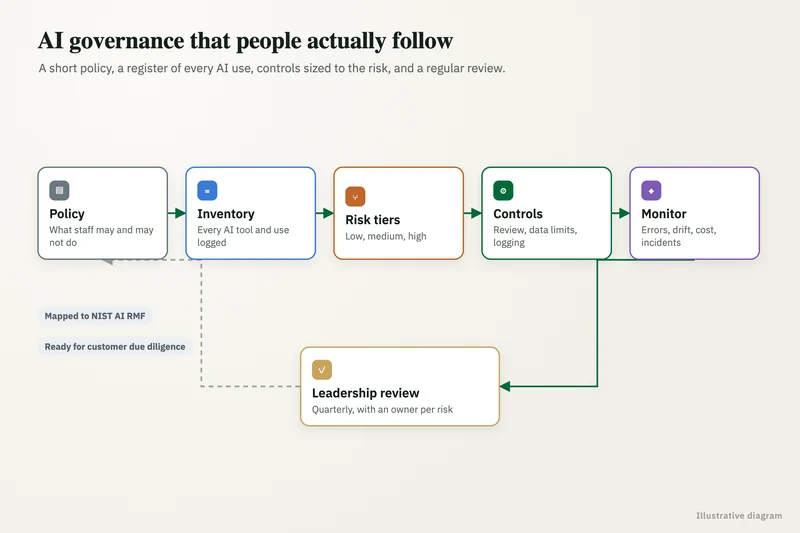
Our AI governance consulting work follows this exact sequence: inventory, risk tiering, vendor checks, notices, human review and logging, mapped to the NIST AI Risk Management Framework so the same controls hold up if other states or the EU AI Act come into play. We work alongside your counsel, scope the project after a free review and quote a fixed price.
Case study · Logistics company, UK
Route planning automation
Dispatch typed every address into Google Maps, which optimizes only 25 stops and cannot add time at each stop. A Python tool that loads addresses automatically, adds buffer time per stop and optimizes the full route.
- Manual address entry eliminated
- Delivery estimates customers could rely on

FAQ
Frequently asked questions
Is the Colorado AI Act still in effect?
The original Colorado AI Act, SB 24-205, never took effect. It was repealed and replaced by SB 26-189, signed May 14, 2026, whose obligations apply to decisions made on or after January 1, 2027. When people search for Colorado AI Act compliance today, SB 26-189 is the law that applies.
When does SB 26-189 take effect?
Its main obligations apply from January 1, 2027, to decisions made on or after that date. The Colorado Attorney General is also required to adopt rules by that date, and an interim draft of those rules was released on October 6, 2026.
Do small businesses have to comply with SB 26-189?
Possibly. Bradley Arant Boult Cummings wrote in July 2026 that the new law no longer contains a small business exemption, while some secondary guides describe a carve-out for employers with 40 or fewer staff. Confirm your position against the enrolled bill text with counsel before assuming you are exempt.
Does Colorado still require AI impact assessments?
No. SB 26-189 removed the impact assessment, the risk management program and the general duty of care against algorithmic discrimination that the original act required. The remaining duties focus on notice, adverse outcome explanations, data correction, human review and record keeping.
Does SB 26-189 apply to AI hiring tools?
Usually, if the tool scores, ranks or filters candidates in a way that materially influences who is hired or rejected. Employment is a consequential decision, and even sectors with other accommodations, such as insurers and HIPAA-covered entities, are covered for their hiring decisions.
What is the penalty for violating Colorado's AI law?
Violations are deceptive trade practices under the Colorado Consumer Protection Act, enforced only by the Attorney General, with fines of up to $20,000 per violation according to Bradley's July 2026 analysis. The Attorney General must offer a 60-day cure period first, except for knowing or repeated violations, until January 1, 2030.
Does the Colorado law apply to companies outside Colorado?
It can. The law protects Colorado consumers, so an out-of-state employer, lender or landlord that uses covered ADMT in decisions about Colorado residents should assume it is in scope. Some employers choose to apply the same notices nationwide to keep one process.
Keep reading
Related pages
Get started
Tell us where AI should pay back
Describe the work that eats your team's time and the systems you run. We reply within one business day with the use cases we would test first, the risks to plan for and a fixed-price proposal.
- Free 30-minute AI review
- Fixed quote before any work starts
- Advice that is vendor-neutral, in plain English
Prefer email? info@aiconsultingservicesusa.com
Book a free AI review
Two lines is enough to start.