

ROI guide
How to measure AI ROI: a practical method for US companies
How to measure AI ROI comes down to four things: a measured baseline before launch, the full cost of the system including running costs and review time, a value figure you can defend to finance, and a decision rule agreed in advance. This guide is for owners, COOs and finance leaders at small and mid-size US companies who need to justify an AI project or decide whether one already running is worth keeping. It includes the formulas, a metric table by use case and a worked example with every number shown.
Book a free AI review
Two lines is enough. A specialist replies within one business day.
Executive summary
How do you measure the ROI of AI?
To measure AI ROI, record the process baseline before launch (volume, time per item, error rate, cost), then compare it with the same measures after launch. ROI equals annual net benefit minus total cost, divided by total cost. Count model, platform, consulting and review costs, and only count saved hours that are redeployed or removed.
What to take away
- Without a measured baseline taken before launch, no AI ROI figure will survive scrutiny.
- Total cost includes model usage, platforms, consulting, maintenance and human review time.
- Hours saved only become ROI when they are redeployed to valuable work or removed.
- Agree kill and scale thresholds before the pilot starts, not after results arrive.
Why is AI ROI so hard to prove?
AI ROI is hard to prove because most projects never measure a baseline, count only part of the cost and report activity (messages answered, documents processed) instead of business outcomes. The problem is widespread. PwC's 29th Global CEO Survey, published in January 2026 and based on 4,454 CEOs in 95 countries and territories, found that 56% had seen no significant financial benefit from AI so far, and only 12% reported both lower costs and higher revenue.
That does not mean AI rarely pays. It means most companies cannot show whether it pays, which leads to two bad outcomes: good projects lose funding because nobody can prove their value, and weak ones continue because nobody can prove they are failing. A simple, agreed measurement method fixes both.
Which formulas should you use to measure AI ROI?
Three formulas cover almost every decision a small or mid-size company needs to make. Keep them simple enough that finance can check the arithmetic.
- ROI (%) = (annual benefit minus annual running cost minus one-time cost) / (one-time cost plus annual running cost) x 100. Use this for the first-year view; for later years drop the one-time cost.
- Payback period (months) = one-time cost / (monthly benefit minus monthly running cost). Most buyers find this easier to discuss than a percentage.
- Cost per unit = total monthly cost / items handled, compared with the same figure before AI. Units are whatever the process produces: invoices, tickets, quotes, reports, calls.
- For multi-year programs with large upfront spend, finance may also want net present value at the company's own discount rate. For a single workflow, payback and cost per unit are usually enough.
What should the baseline include?
The baseline is a snapshot of the process before AI touches it, measured over at least two to four normal weeks. It should be recorded in writing and signed off by the process owner, because every later claim depends on it.
- Volume: items per week or month, and the seasonal peaks.
- Time per item: measured from logs or a timed sample, not estimated in a meeting.
- Who does the work and their fully loaded hourly cost (salary, benefits, overhead).
- Error or rework rate, and what an error costs (a credit note, a missed renewal, a compliance finding).
- Cycle time from request to completion, where speed affects revenue or customer satisfaction.
- Current tool and outsourcing spend for the process.
Which AI ROI metrics fit which use case?
Pick one primary metric per use case and two or three supporting ones. Measuring everything makes it easy to cherry-pick a good number later.
| Use case type | Primary metric | Supporting metrics | Common trap |
|---|---|---|---|
| Back-office processing (invoices, orders, claims intake) | Cost per item | Exception rate, error rate, cycle time | Ignoring the time people spend checking AI output |
| Customer support | Cost per resolved ticket | Resolution without escalation, CSAT, reopen rate | Counting deflected tickets that came back by phone |
| Sales and lead follow-up | Pipeline or revenue per rep | Response time, meetings booked, conversion | Crediting AI for deals that would have closed anyway |
| Reporting and analysis | Hours to produce a report | Accuracy, frequency, decisions made on time | Valuing hours that are not redeployed |
| Phone reception | Missed calls converted to bookings | Answer rate, transfer rate, after-hours bookings | Counting answered calls rather than booked revenue |
| Employee copilots (ChatGPT, Microsoft 365 Copilot) | Task time on a defined set of tasks | Weekly active users, quality review scores | Using license counts or survey sentiment as ROI |
What counts as AI cost?
The denominator is where most AI ROI calculations quietly go wrong. Count one-time and recurring costs separately, and include the people time that rarely appears on an invoice.
One-time costs cover discovery or readiness work, design, build, integration with systems such as NetSuite, QuickBooks, HubSpot or SharePoint, testing on real cases and staff training. Recurring costs cover model usage from OpenAI, Anthropic, Google or a cloud provider such as Amazon Bedrock, workflow platform plans for n8n, Make or Zapier, any vector database or search service, monitoring and logging, maintenance of prompts and integrations, and the hours staff spend reviewing flagged items. Review time is often the largest recurring cost in the first months, and it should fall as confidence thresholds are tuned. If it does not fall, that is a finding in itself.
For published consulting rates and running cost categories, see our AI consultant cost guide. Use your own quotes in the calculation, not market averages.
Worked example: AI invoice processing at a 150-person distributor
The numbers below are assumptions chosen to show the arithmetic, not results from a client or a quote. Swap in your own baseline and quotes.
Baseline: the accounts payable team processes 2,000 invoices a month at a measured 6 minutes each, which is 200 hours a month. Fully loaded cost is $40 an hour, so the process costs $8,000 a month in staff time. After launch, 70% of invoices are extracted, matched to purchase orders and only need a 1-minute review; the other 30% go to a human-review queue and still take 6 minutes. That is 1,400 minutes plus 3,600 minutes, about 83 hours a month, so about 117 hours a month are saved, worth about $4,667.
Costs: assume a one-time cost of $30,000 for design, build, integration and testing, and $600 a month for model usage, platform plans and monitoring. Net monthly benefit is about $4,067. Payback is about 7.4 months. Over the first year the benefit is about $56,000, running costs are $7,200 and the one-time cost is $30,000, so first-year ROI is ($56,000 minus $7,200 minus $30,000) / $37,200, about 51%. From year two, with no one-time cost, the same system returns about $48,800 a year on $7,200 of running cost.
Now the honest version. If the team does not redeploy the saved hours (no hiring avoided, no backlog cleared, no new work taken on), the cash benefit is close to zero. Suppose only half the hours turn into real value. Monthly benefit drops to about $2,333, net about $1,733, payback stretches to about 17 months and first-year ROI is about minus 25% ($28,000 minus $7,200 minus $30,000, divided by $37,200). The project may still be worth doing, but the decision now rests on what the team will do with the time, which is the right conversation to have before launch.
How to measure AI ROI step by step
This is the sequence we use. It works for one workflow or a portfolio of use cases.
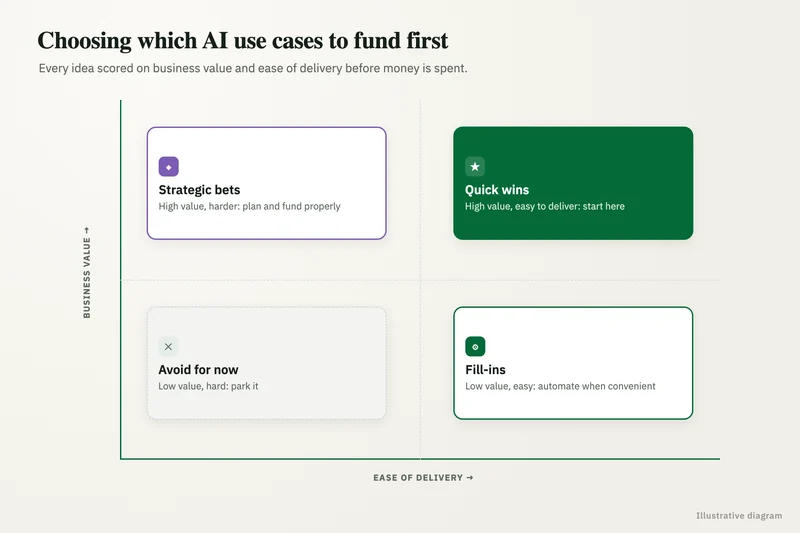
- Write one sentence naming the business outcome, such as lower cost per invoice or more booked appointments, not 'use AI in finance'.
- Measure the baseline for two to four weeks and get the process owner to sign it off.
- Estimate total one-time and recurring cost, including review hours, before approving the build.
- Agree the decision rule in advance: for example, scale if cost per item falls 30% or more with error rate no worse than baseline after eight weeks; stop if it falls less than 10%.
- Decide what happens to saved hours: which backlog, project or hiring plan absorbs them.
- Run the pilot on real volume with logging of every AI output, confidence score and human correction.
- Report monthly on the primary metric, costs to date and the share of items needing review.
- At the decision date, apply the rule you agreed. Scale, fix a named problem with a new date, or stop.
Common mistakes that inflate or hide AI ROI
Most inflated ROI figures come from the same few shortcuts, and finance teams have learned to spot them.
- Estimating the baseline after launch from memory, which nearly always overstates the old effort.
- Counting hours saved at full salary when nobody's workload or headcount changed.
- Leaving out review time, prompt maintenance and model usage growth as volume rises.
- Measuring a hand-picked set of easy cases in the pilot, then assuming the same results on all volume.
- Crediting AI for revenue changes driven by pricing, seasonality or a new salesperson.
- Reporting adoption (logins, licenses, prompts sent) as if it were return.
What if the value is real but hard to put in dollars?
Some benefits, such as faster reporting, fewer compliance misses or better customer response times, are real but do not map neatly to cost savings. Measure them anyway, in their own units, and agree a value with the budget owner. A missed renewal has a known average value; a late compliance filing has a known penalty range; a report that arrives on Monday instead of Thursday may let a decision happen a week earlier.
Our own case studies use this approach: for an insurance brokerage, the measured result was report preparation time falling from 4 to 5 hours to under 5 minutes and reporting accuracy rising from about 75% to 99%. Those operational numbers are what a buyer can verify; the dollar value then depends on what the business does with the time and the accuracy.
How we help companies measure AI ROI
Greenwolf Tech Labs builds ROI measurement into every engagement. In an AI readiness assessment or strategy project we measure baselines for candidate use cases, estimate full costs including monthly running costs, and rank use cases by payback before anything is built. In a build, we log outputs, confidence scores and corrections so the numbers are available without a separate reporting project.
Every phase is quoted at a fixed price after a free review, and you own the accounts, code, prompts and data. If you want an independent check on an AI project already running, or a business case before approving one, contact us at info@aiconsultingservicesusa.com.
Case study · Insurance brokerage, Australia
Automation and dashboarding
Policy data arrived as spreadsheets from several insurers, each in a different structure, and every client report took hours of manual cleanup. An automated pipeline that standardizes every insurer's file and feeds a single reporting dashboard.
- Report time cut from 4-5 hours to under 5 minutes
- Reporting accuracy up from about 75% to 99%

FAQ
Frequently asked questions
What is a good ROI for an AI project?
There is no universal benchmark, so set your own threshold before the pilot. A practical rule is a payback target agreed with finance, for example under 12 months for a single workflow. The more important test is whether the project beats the next best use of the same budget and staff time.
How long does it take to see ROI from AI?
A single back-office workflow can show measurable results within the first two or three months on real volume, once review rates settle. Payback takes longer, depending on the one-time cost. Broad programs across departments take longer still, because adoption and process changes drive the result.
How do you calculate ROI on Microsoft 365 Copilot or ChatGPT licenses?
Pick a defined set of tasks, time them before and after for a pilot group and compare with a group without licenses. Multiply the time saved on those tasks by the share of time that is redeployed and the loaded hourly cost, then compare with license cost. License counts and user sentiment are not ROI.
Should hours saved count as AI ROI?
Only when they turn into something of value: avoided hiring, reduced overtime or contractors, a cleared backlog or new work taken on. Hours that vanish into the day are real for staff but do not show up in the accounts, so count them separately.
What costs do companies forget when calculating AI ROI?
The usual omissions are staff time reviewing AI outputs, prompt and integration maintenance, model usage that grows with volume, monitoring and logging, and the internal time spent on the project. Include all of them, or the ROI figure will not survive a finance review.
Why do so many AI projects show no ROI?
Mostly because value was never defined or measured. PwC's 2026 Global CEO Survey found 56% of CEOs saw no significant financial benefit from AI so far. Common causes are no baseline, pilots on easy cases only and saved time that is never redeployed.
Keep reading
Related pages
Get started
Tell us where AI should pay back
Describe the work that eats your team's time and the systems you run. We reply within one business day with the use cases we would test first, the risks to plan for and a fixed-price proposal.
- Free 30-minute AI review
- Fixed quote before any work starts
- Advice that is vendor-neutral, in plain English
Prefer email? info@aiconsultingservicesusa.com
Book a free AI review
Two lines is enough to start.