

AI governance guide
ISO 42001 vs NIST AI RMF: which one a US company should adopt first
ISO 42001 vs NIST AI RMF comes down to one question: do you need to prove your AI governance to someone outside the company? The NIST AI RMF is a free, voluntary US framework for managing AI risk that you adopt and attest to yourself, while ISO/IEC 42001 is a certifiable management system standard that an accredited auditor checks and certifies. This guide is for owners, COOs, CTOs and compliance leads at US companies of roughly 50 to 1,000 staff who have been asked by a customer, insurer or board which framework they follow.
Book a free AI review
Two lines is enough. A specialist replies within one business day.
Executive summary
What is the difference between ISO 42001 and NIST AI RMF?
The NIST AI RMF is a free, voluntary US framework organized into four functions (Govern, Map, Measure, Manage) that tells you how to identify and reduce AI risk. ISO/IEC 42001 is an international standard for an AI management system that an accredited body can audit and certify. NIST guides the risk work; ISO 42001 proves the system exists.
What to take away
- NIST AI RMF is free and self-attested; ISO 42001 is audited and certified by a third party.
- Most mid-size US firms should start with NIST AI RMF and certify only when buyers ask.
- Strac's 2026 breakdown puts first-year ISO 42001 costs at $20,000 to $70,000 or more.
- NIST publishes a crosswalk, so NIST work carries straight into an ISO 42001 program later.
ISO 42001 vs NIST AI RMF: what is the core difference?
The core difference is assurance. The NIST AI Risk Management Framework tells you what good AI risk management looks like and leaves it to you to decide how far to go. ISO/IEC 42001 tells you what an AI management system must contain and gives an outside auditor a set of requirements to test you against. One is a method, the other is a certifiable structure.
NIST released AI RMF 1.0 on January 26, 2023 and describes it as intended for voluntary use. It is organized around four functions: Govern (roles, policy and accountability), Map (the context and inventory of each AI use), Measure (testing, accuracy and bias checks) and Manage (controls, monitoring and incident response). NIST added a companion Playbook and, on July 26, 2024, a Generative AI Profile (NIST AI 600-1) that covers risks such as fabricated answers and data leakage. Everything is free to download.
ISO/IEC 42001 was published in December 2023 and is described by Schellman, writing for the Cloud Security Alliance, as the first international standard focused on managing AI responsibly. It follows the same management-system pattern as ISO 27001: leadership commitment, an AI policy, defined scope, risk and impact assessments, documented controls chosen through a Statement of Applicability, internal audits, management review and continual improvement. Its Annex A lists AI-specific controls. Unlike NIST, it ends in a certificate issued by an accredited certification body.
How do they compare side by side?
The table below compares the two on the points buyers ask about most. Cost and timeline figures come from the named third-party sources and are not our prices.
| Factor | NIST AI RMF | ISO/IEC 42001 |
|---|---|---|
| Publisher | US National Institute of Standards and Technology | ISO and IEC (international) |
| Status | Voluntary guidance, released January 2023 | Certifiable standard, published December 2023 |
| Structure | Four functions: Govern, Map, Measure, Manage, with subcategories and a Playbook | Management system clauses plus Annex A controls chosen in a Statement of Applicability |
| Proof you can show | Self-assessment and your own documentation | Certificate from an accredited certification body |
| Cost of the document | Free | Paid standard, plus audit fees |
| Typical first-year spend | Mostly internal time and any advisory help | $20,000 to $70,000 or more (Strac, October 2026) |
| Ongoing obligation | None beyond what you choose to maintain | Annual surveillance audits; certificate valid three years (Schellman via CSA, 2025) |
| Best for | Building the risk method, internal governance, US-centric buyers | Selling to enterprises or EU customers who ask for certified assurance |
Which framework should a mid-size US company adopt first?
For most US companies of 50 to 1,000 staff, start with the NIST AI RMF and decide on ISO 42001 certification only when a customer, contract or market requires it. NIST costs nothing to adopt, fits the way US regulators and insurers already talk about AI risk, and produces the inventory, risk tiers and controls that ISO 42001 would ask for anyway.
Certification becomes worth it when an outside party will act on it. That usually means enterprise procurement questionnaires that ask for an AI management system certificate, EU customers preparing for the EU AI Act, or a product where AI is the thing you sell. Use the table below to place your company.
| Your situation | Recommended path | Why |
|---|---|---|
| You use AI tools internally (Copilot, ChatGPT, Claude) and no customer has asked | NIST AI RMF only | You need working rules, not a certificate |
| Enterprise customers send AI security questionnaires but do not require certification | NIST AI RMF, documented well enough to answer questionnaires | Good evidence answers most questionnaires without audit fees |
| A key customer or RFP requires ISO 42001 certification | NIST first for the risk method, then ISO 42001 certification | The NIST crosswalk carries your work into ISO controls |
| You already hold ISO 27001 | Extend into ISO 42001 | Strac estimates the incremental cost at roughly $10,000 to $30,000 |
| You sell an AI product into the EU | ISO 42001, with NIST as the internal risk method | Certified assurance supports EU buyer due diligence |
| You make consequential decisions about people in Colorado | NIST AI RMF controls mapped to SB 26-189, with counsel | The law focuses on notice, explanation and human review |
What does ISO 42001 certification cost in 2026?
Published 2026 estimates put first-year ISO 42001 certification at about $20,000 to $70,000 or more for a typical scope, rising well past $100,000 when consulting help and staff time for a company that builds its own AI are counted. The range is wide because the audit days a certification body calculates depend on your scope, and because some companies do most of the work themselves.
Strac's October 2026 breakdown lists a readiness or gap assessment at $8,000 to $25,000, AI management system documentation at $5,000 to $20,000, the Stage 1 and Stage 2 certification audit at $15,000 to $40,000, governance or security lead time at $10,000 to $35,000, and annual surveillance audits at $5,000 to $15,000. It places mid-market first-year totals at about $35,000 to $55,000.
CertBetter's June 2026 guide is higher because it counts full consulting support and internal salaries. It cites Schellman at $20,000 to $40,000 for year-one Stage 1 and Stage 2 audits and $13,000 to $20,000 a year for surveillance, consultant fees of $20,000 to $80,000 for full implementation support, and 200 to 400 internal hours. Its worked examples total about $73,000 in year one for a 30-person company using third-party AI tools and about $185,000 for a 120-person company building proprietary AI systems.
The NIST AI RMF has no license or audit fee. Its cost is the staff time to build the inventory, risk tiers, controls and monitoring, plus any outside advice you choose to buy. Our AI consultant cost guide collects published advisory rates if you want to benchmark that help.
How long does each take?
A working NIST AI RMF program for a mid-size company usually takes weeks, while ISO 42001 certification usually takes months because of the formal audit cycle. NIST has no external gate, so the timeline depends only on how many AI use cases are in scope and how quickly owners answer questions.
For ISO 42001, Schellman's guide for the Cloud Security Alliance describes a Stage 1 audit of about one to two days that reviews documentation and the design of the AI management system, a gap of typically four to twelve weeks before Stage 2 (and no more than six months), and a Stage 2 audit of three to nine or more days that tests whether controls actually operate. Surveillance audits then run two to five or more days a year. SecureW2 reports that implementations starting from scratch take five to nine months, and three to five months for companies that already hold ISO 27001.
Can you use NIST AI RMF and ISO 42001 together?
Yes, and that is the most efficient route for companies that expect to certify eventually. NIST's AI Resource Center publishes a crosswalk that maps each AI RMF subcategory to the ISO/IEC 42001 clauses and annex controls it supports, so work done under NIST is not wasted when you move to certification.
In practice the split looks like this. NIST's Map and Measure functions give you the method for risk and impact assessments, eval sets, accuracy thresholds and bias checks. ISO 42001 gives you the management system around them: a documented scope, a Statement of Applicability, internal audits, management reviews and corrective actions. A company that runs NIST well for six months typically has most of the evidence an ISO auditor asks for; what is missing is usually the formal internal audit and management review records.
Worked example: a 250-person company with five AI use cases
Here is how we would sequence the work for a typical client. The figures are illustrative planning assumptions, not quotes or benchmarks.
Assume a 250-person US services firm uses Microsoft 365 Copilot across the company, a Claude-based assistant that answers staff questions from SharePoint policies, an AI tool that drafts proposals from HubSpot data, an invoice extraction workflow feeding NetSuite and an AI screening step in recruiting. One enterprise customer has added AI questions to its annual security review but does not require certification.
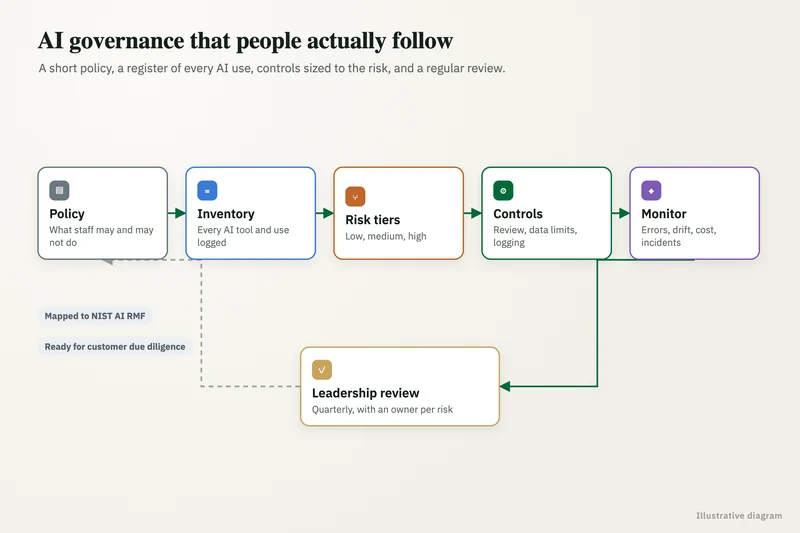
Phase one follows NIST. Build an inventory of all five uses with owner, data types and vendor terms. Tier them: Copilot and proposal drafting are medium risk, the SharePoint assistant is medium, invoice extraction is medium because it touches payments, and recruiting screening is high because it affects people's jobs and could fall under Colorado SB 26-189 if any candidates are in Colorado. Set controls by tier: retrieval with citations and an eval set for the assistant, confidence thresholds and a human-review queue for invoices, and a person making every hiring decision with a written explanation process. Write the acceptable-use policy and log prompts and outputs for production tools.
Phase two is a decision point at about six months. If the enterprise customer later requires certification, map the existing controls to ISO 42001 using NIST's crosswalk, close the gaps (usually internal audit, management review and formal impact assessment records) and book a certification body. On Strac's 2026 mid-market range, the external spend would sit around $35,000 to $55,000 in year one, much of it avoided if the customer never asks.
How do these frameworks relate to US and EU AI laws?
Neither framework is a law, and adopting either does not by itself make you compliant with one. They are useful because they produce the records and controls that laws ask for.
In Colorado, SB 26-189, signed May 14, 2026 and effective January 1, 2027, replaced the original Colorado AI Act with a narrower notice-based law on automated decision-making in consequential decisions such as employment, lending, healthcare, housing, insurance and education. It gives consumers an explanation of adverse outcomes, human review and data correction, which line up with NIST's Manage function. The EU AI Act, as amended by the 2026 Digital Omnibus, applies to US firms whose AI systems are placed on the EU market or whose output is used in the EU; Article 50 transparency duties apply from August 2, 2026 and high-risk obligations for Annex III uses moved to December 2, 2027. An ISO 42001 certificate is often what EU buyers ask to see. This is not legal advice; confirm how either law applies to you with counsel.
Common mistakes and when not to certify
The most common mistake is buying a certificate before the governance works. A company that certifies a thin AI management system spends the audit fees and then has to keep the paperwork alive every year without having reduced any real risk. Get the inventory, tiers and human-review steps running first.
Other mistakes we see often:
- Scoping ISO 42001 to the whole company when only one AI product needs certification, which multiplies audit days.
- Treating NIST as a checklist to tick once rather than a cycle of measuring and adjusting controls.
- Ignoring the AI tools staff already use on personal accounts, which never appear in the inventory.
- Writing policies no one reads instead of one-page rules with examples of allowed and blocked uses.
- Skipping certification when a major customer's contract requires it, then rushing the audit under deadline.
- Do not certify if no customer, regulator or contract asks for it and AI is a support tool rather than your product; NIST alone is the better use of the money.
How we help with NIST AI RMF and ISO 42001 readiness
We are not a certification body and do not issue certificates. Our AI governance consulting builds the program that either framework expects: an AI inventory, risk tiers, an acceptable-use policy, vendor checks, prompt and output logging, human-review rules and a monthly governance report, structured on the NIST AI RMF functions. If you later pursue ISO 42001, we map that work to the standard using NIST's crosswalk and prepare the evidence your chosen certification body will ask for.
We start with a free review of your AI use and any customer or regulatory requests you face, then quote a fixed price for the first phase with the deliverables listed. You own every document, and we work alongside your counsel on anything legal.
Case study · Logistics company, UK
Route planning automation
Dispatch typed every address into Google Maps, which optimizes only 25 stops and cannot add time at each stop. A Python tool that loads addresses automatically, adds buffer time per stop and optimizes the full route.
- Manual address entry eliminated
- Delivery estimates customers could rely on

FAQ
Frequently asked questions
Is ISO 42001 better than NIST AI RMF?
Neither is better; they do different jobs. The NIST AI RMF is a free method for managing AI risk, while ISO 42001 is a certifiable management system that proves governance to outsiders. Many companies use NIST internally and add ISO 42001 only when customers require a certificate.
Can you get certified in NIST AI RMF?
No. NIST does not certify organizations against the AI RMF, which is voluntary guidance. Some firms offer NIST AI RMF assessments or attestations, but these are opinions from that firm, not a NIST certification. ISO 42001 is the certifiable option.
How much does ISO 42001 certification cost?
Strac's October 2026 breakdown puts first-year costs at about $20,000 to $70,000 or more, with surveillance audits of $5,000 to $15,000 a year. CertBetter's June 2026 examples, which include consultants and staff time, total about $73,000 for a 30-person company and $185,000 for a 120-person AI developer.
How long does ISO 42001 certification take?
SecureW2 reports five to nine months from scratch and three to five months for companies that already hold ISO 27001. The audit itself has two stages separated by typically four to twelve weeks, according to Schellman's guide for the Cloud Security Alliance.
Is the NIST AI RMF mandatory for US companies?
No. NIST describes it as intended for voluntary use, and no general US law requires private companies to adopt it. It is widely used because customers, insurers and auditors recognize its four functions, and NIST is revising it under the White House AI Action Plan.
Does ISO 42001 make us compliant with the EU AI Act?
Not on its own. ISO 42001 gives you a documented management system and evidence that supports EU buyer due diligence, but the EU AI Act has its own specific obligations and dates. Check your obligations with counsel; this is not legal advice.
Do we need ISO 42001 if we already have SOC 2 or ISO 27001?
Those cover information security, not AI-specific risks such as model accuracy, bias and impact on people. If you hold ISO 27001, Strac estimates adding ISO 42001 costs roughly $10,000 to $30,000 more, because the management system structure is shared.
Keep reading
Related pages
Get started
Tell us where AI should pay back
Describe the work that eats your team's time and the systems you run. We reply within one business day with the use cases we would test first, the risks to plan for and a fixed-price proposal.
- Free 30-minute AI review
- Fixed quote before any work starts
- Advice that is vendor-neutral, in plain English
Prefer email? info@aiconsultingservicesusa.com
Book a free AI review
Two lines is enough to start.