

Compliance guide
EU AI Act for US companies: what applies to you, and when
The EU AI Act for US companies is not a European problem you can ignore: it applies to any US firm that places an AI system on the EU market or whose AI output is used in the EU, with no EU office required. After the 2026 Digital Omnibus, the heavy high-risk duties moved to December 2027 and August 2028, but transparency duties have applied since August 2, 2026. This guide is for US owners and operations leaders who need to know, in plain terms, whether they are in scope, which role they play and what to do first.
Book a free AI review
Two lines is enough. A specialist replies within one business day.
Executive summary
Does the EU AI Act apply to US companies?
Yes, if your AI system is sold or offered in the EU, or its output is used there. A US company with no EU office can still be in scope as a provider or a deployer. Transparency duties under Article 50 apply from August 2, 2026; high-risk duties for Annex III uses now apply from December 2, 2027.
What to take away
- Scope follows where AI output is used, not where your company is incorporated.
- Annex III high-risk duties moved to December 2, 2027 under the 2026 Digital Omnibus.
- Chatbot disclosure and deepfake labeling duties under Article 50 already apply from August 2, 2026.
- Most mid-size US firms are deployers, whose duties are lighter but still enforceable.
Does the EU AI Act apply to US companies?
It applies whenever there is an EU connection, regardless of where you are headquartered. The Act covers US firms that place AI systems on the EU market and firms whose AI output is used in the EU. Holland & Knight's April 2026 analysis puts it simply: coverage turns on where the impact lands, not where the company sits.
In practice, three situations pull a US company in. You sell or license software with AI features to customers in the EU. You use AI to make or support decisions about people in the EU, such as screening applicants for a role in your Dublin office or scoring credit for EU customers. Or your AI produces content that EU residents see, such as a website chatbot that answers visitors from Germany or synthetic images in a campaign that runs in France.
If none of those apply, for example a Texas distributor that uses AI only to process US supplier invoices for US customers, the Act does not reach you today. Keep a note of that reasoning, because it changes the day you open an EU sales channel or hire your first EU employee.
What changed with the 2026 Digital Omnibus?
The Digital Omnibus delayed the high-risk rules but left the structure of the Act intact. According to Gibson Dunn's analysis of the omnibus agreement, the main changes for a US business are the following.
- The AI literacy duty was softened: providers and deployers must now support the development of AI literacy rather than guarantee a level of it, per Gibson Dunn.
- Several high-ranking articles still describe August 2, 2026 as the high-risk deadline. Those pages were written before the omnibus was finalized; check the date on anything you rely on.
| Obligation | Original date | Date after the 2026 Digital Omnibus | Who it hits |
|---|---|---|---|
| Prohibited practices (Article 5) | February 2025 | Unchanged, already in force | Everyone |
| Transparency: tell people they are talking to AI, label deepfakes (Article 50) | August 2, 2026 | Unchanged, applies from August 2, 2026 | Providers and deployers of chatbots and generative tools |
| Machine-readable marking of AI-generated content (Article 50(2)) for systems already on the market | August 2, 2026 | December 2, 2026 | Providers of generative AI systems |
| High-risk systems listed in Annex III (hiring, credit, education, essential services, biometrics) | August 2, 2026 | December 2, 2027 | Providers and deployers |
| High-risk AI inside regulated products under Annex I (machinery, medical devices, vehicles) | August 2, 2027 | August 2, 2028 | Product makers and their AI suppliers |
| New ban on systems that generate non-consensual intimate imagery or child abuse material | Not in the original text | Transition until December 2, 2026 | Providers of image and video generators |
Provider or deployer: which role does a US company play?
Your duties depend on your role, and most mid-size US companies are deployers, not providers. A provider develops an AI system, or has one developed, and places it on the market under its own name. A deployer uses an AI system under its own authority in the course of business. If you bought Microsoft Copilot, ChatGPT Enterprise or an AI hiring tool and use it internally, you are a deployer of that system.
The line moves when you build. A US software company that adds an AI feature to a product sold to EU customers is a provider of that feature. A company that takes an open-weight model, fine-tunes it and offers it to EU clients under its brand is also a provider. Providers carry the heavy load for high-risk systems: risk management, technical documentation, conformity assessment, registration and, for non-EU providers, an authorized representative in the EU, as Holland & Knight's 2026 summary notes.
Use the table below as a first pass. It reflects how the roles usually fall for the companies we advise; your counsel should confirm the classification for anything near the high-risk line.
| Typical US use case | Usual role | Likely risk tier | What it means |
|---|---|---|---|
| Website chatbot that EU visitors can use | Deployer (provider if you built it and sell it) | Transparency (Article 50) | Tell users they are talking to AI at first interaction |
| AI-generated images or video in EU marketing | Deployer | Transparency (Article 50) | Disclose deepfakes; providers must machine-mark outputs |
| AI resume screening for EU job openings | Deployer of the vendor's tool | High-risk (Annex III, employment) | Human oversight, logs, worker notice by December 2, 2027 |
| Credit scoring of EU consumers | Deployer or provider | High-risk (Annex III, credit) | Full high-risk duties by December 2, 2027 |
| Internal drafting with Copilot or ChatGPT, no EU subjects | Deployer | Minimal | Literacy support and acceptable use policy; little else |
| SaaS product with AI features sold to EU customers | Provider | Depends on the feature | Documentation, transparency, possibly high-risk duties |
What must a deployer of a high-risk system actually do?
Article 26 sets six concrete duties for deployers of high-risk AI, and none of them require you to rebuild the vendor's model. They are operational controls that a company can put in place with clear ownership and some logging. From December 2, 2027 for Annex III systems, a deployer must:
- Use the system according to the provider's instructions and assign human oversight to people with the competence, training and authority to override it.
- Make sure any input data you control is relevant and sufficiently representative for the intended purpose.
- Monitor the system in operation and tell the provider, and then the market surveillance authority, about risks or serious incidents without delay.
- Keep the logs the system generates automatically for a period appropriate to its purpose and at least six months, unless another law says otherwise.
- Inform workers and their representatives before using a high-risk system in the workplace.
- Tell people when a high-risk system is used to make, or help make, decisions about them.
What do the Article 50 transparency rules require today?
Article 50 is the part of the EU AI Act for US companies that is already live, and it is the one most likely to touch a typical mid-size business. Providers must design AI systems that interact with people so users know they are dealing with AI, unless that is obvious from the context. Providers of systems that generate synthetic audio, images, video or text must mark outputs in a machine-readable, detectable way.
Deployers have their own duties. If you publish deepfakes, meaning AI-generated or manipulated images, audio or video that look real, you must disclose that they are artificial; artistic and satirical work gets a lighter-touch disclosure. If you publish AI-generated text on matters of public interest, you must disclose it unless a person reviewed it and holds editorial responsibility. Deployers of emotion recognition or biometric categorization must inform the people exposed. The information has to be given at the latest at the first interaction or exposure.
For most companies this means three practical changes: a short line in the chatbot greeting, a labeling rule in the marketing approval process, and a check that your generative tools keep the vendor's content credentials intact.
What are the fines, and is there relief for smaller companies?
Article 99 sets three fine tiers. Prohibited practices can draw up to EUR 35 million or 7% of worldwide annual turnover. Breaches of most operator duties, including the deployer duties in Article 26 and the transparency rules in Article 50, can draw up to EUR 15 million or 3%. Supplying incorrect or misleading information to authorities can draw up to EUR 7.5 million or 1%.
For large companies the higher of the fixed amount and the percentage applies. For small and medium-sized enterprises, including startups, Article 99 says the lower of the two applies. That makes the exposure for a 200-person US company very different from the headline figures, though a 3% fine on global turnover is still material and the reputational cost of an enforcement action in a market you are trying to enter is harder to price.
How does the EU AI Act compare with US rules you already face?
The EU rules overlap heavily with what US frameworks already ask for, so one set of controls can serve both. The NIST AI Risk Management Framework, released in January 2023, is voluntary and organizes work into four functions: Govern, Map, Measure and Manage. Colorado's SB 26-189, signed May 14, 2026 and effective January 1, 2027, is a notice-based law on automated decisions in employment, lending, housing, insurance, healthcare and education; it gives consumers an explanation of adverse outcomes, human review and data correction.
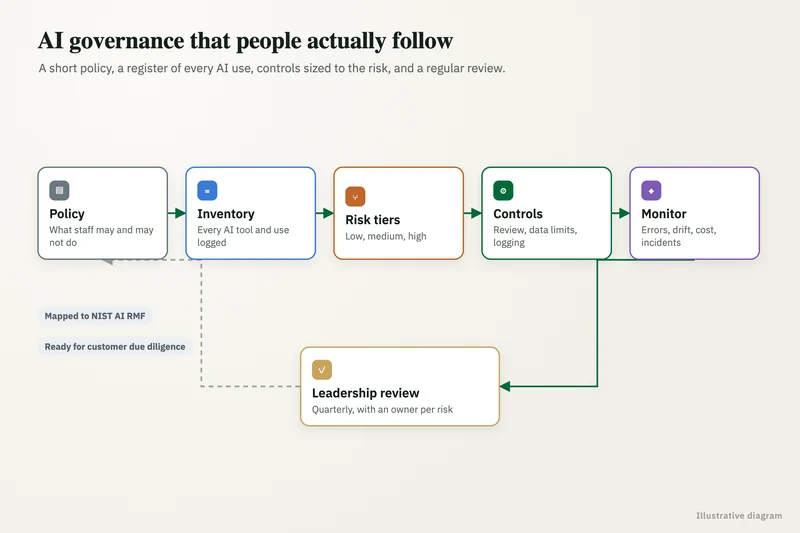
The common core is the same: an inventory of AI systems, a named owner for each, human review on decisions about people, logs you can produce on request and clear notices. A US company that builds those controls once, mapped to NIST, is most of the way to deployer readiness in Colorado and the EU. A December 11, 2025 US executive order sought a national AI policy framework and set up a DOJ task force to challenge state AI laws, so the US state picture may keep moving; the EU text is now settled until the next review. This is not legal advice; confirm your obligations with counsel.
A 90-day EU AI Act plan for a mid-size US company
You do not need a large program to get ahead of the 2027 deadline. Ninety days of focused work is enough to know your exposure and close the gaps that already apply.
- Days 1 to 15: build an AI inventory. List every tool and feature that uses AI, who owns it, which vendor supplies it and whether any EU customer, employee or visitor touches it. Include shadow use found in expense reports and browser extensions.
- Days 16 to 30: classify each item as prohibited, high-risk, transparency or minimal, and record whether you are provider or deployer. Flag anything in hiring, credit, education or access to essential services.
- Days 31 to 45: fix Article 50 gaps now. Add AI disclosure to chatbots, add a deepfake label rule to content approval and confirm generative tools keep their machine-readable marks.
- Days 46 to 75: for each high-risk item, assign a human overseer, set log retention to at least six months, draft the worker and individual notices, and ask the vendor for its instructions for use and its compliance roadmap.
- Days 76 to 90: write it down. A short AI policy, the inventory, a classification memo per system and an incident process. Map each control to NIST AI RMF so the same file serves Colorado and the EU.
Common mistakes, and when you do not need outside help
The most common mistake is planning to old dates. Teams that budgeted for an August 2026 high-risk deadline either rushed work they could have phased or, worse, concluded the whole Act was postponed and missed that Article 50 went live on schedule. The second mistake is assuming the vendor carries everything. Providers carry the design duties, but oversight, logging, notices and incident reporting sit with you as the deployer.
The third is over-scoping. A company whose only EU touchpoint is an internal drafting assistant does not need a conformity program. If your inventory shows no EU-facing use, or only minimal-risk tools, an acceptable use policy and an annual review are usually enough, and you should not pay a consultant for more.
Outside help earns its fee when you have high-risk uses, act as a provider for an EU-facing product, or need one control set to satisfy the EU, Colorado and your enterprise customers' questionnaires at the same time. That is the work our AI governance consulting covers: inventory, classification, policy, logging and human review, scoped after a free review and delivered at a fixed price, with legal questions routed to your counsel.
Case study · Logistics company, UK
Route planning automation
Dispatch typed every address into Google Maps, which optimizes only 25 stops and cannot add time at each stop. A Python tool that loads addresses automatically, adds buffer time per stop and optimizes the full route.
- Manual address entry eliminated
- Delivery estimates customers could rely on

FAQ
Frequently asked questions
Does the EU AI Act apply to US companies without an EU office?
Yes. The Act applies when a US company places an AI system on the EU market or when the system's output is used in the EU. Having no EU office, staff or entity does not take you out of scope.
When does the EU AI Act take effect for high-risk systems?
Under the 2026 Digital Omnibus, high-risk duties for Annex III uses such as hiring, credit and education apply from December 2, 2027. High-risk AI embedded in regulated products under Annex I follows on August 2, 2028.
Was the whole EU AI Act delayed by the Digital Omnibus?
No. The omnibus delayed the high-risk rules but kept the Act's structure. Prohibited practices have applied since February 2025, and Article 50 transparency duties such as telling users they are talking to AI applied from August 2, 2026.
What are the EU AI Act fines for a small or mid-size company?
Article 99 caps fines at EUR 35 million or 7% of turnover for prohibited practices, EUR 15 million or 3% for most other duties, and EUR 7.5 million or 1% for misleading information. For SMEs and startups, the lower of the fixed amount and the percentage applies.
Do US companies need an EU authorized representative?
Non-EU providers of high-risk AI systems must appoint an authorized representative established in the EU, as Holland & Knight's 2026 analysis explains. A US company that only deploys AI tools built by others generally does not need one for those tools.
Is using ChatGPT or Copilot at work covered by the EU AI Act?
Internal drafting and research with general assistants is usually minimal risk, so the main duties are supporting AI literacy and having sensible usage rules. Using the same tools to make decisions about EU job candidates or customers can change the classification.
How is the EU AI Act different from the NIST AI RMF?
The EU AI Act is binding law with fines. The NIST AI Risk Management Framework is voluntary guidance built on four functions: Govern, Map, Measure and Manage. Many US companies use NIST to structure the controls that the EU Act and Colorado's SB 26-189 require.
Keep reading
Related pages
Get started
Tell us where AI should pay back
Describe the work that eats your team's time and the systems you run. We reply within one business day with the use cases we would test first, the risks to plan for and a fixed-price proposal.
- Free 30-minute AI review
- Fixed quote before any work starts
- Advice that is vendor-neutral, in plain English
Prefer email? info@aiconsultingservicesusa.com
Book a free AI review
Two lines is enough to start.