

Governance guide
AI acceptable use policy: a practical template for US companies
An AI acceptable use policy is a short set of rules that tells employees which AI tools they may use for work, what data they may put into them, and when a person must check the output. This guide gives US small and mid-size companies a copyable clause list, a data-tier table, rules by department, the laws that shape the policy and a 30-day rollout plan that works without an enterprise security team.
Book a free AI review
Two lines is enough. A specialist replies within one business day.
Executive summary
What should an AI acceptable use policy include?
An AI acceptable use policy should name the approved AI tools, classify which data may and may not be entered, require human review before AI output reaches customers or money decisions, ban personal accounts for company work, set a process for requesting new tools, explain how incidents are reported and state the consequences of breaking the rules.
What to take away
- Keep the policy to two pages so staff actually read and sign it.
- A data-tier table does more work than any list of banned tools.
- Give people an approved business tool, or they will keep using personal accounts.
- Enforce with SSO and admin settings you already own before buying security software.
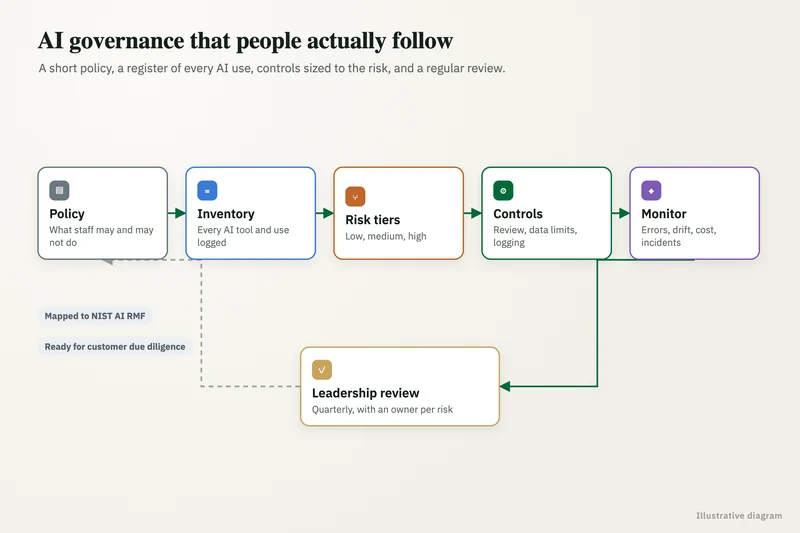
What is an AI acceptable use policy and why do you need one now?
An AI acceptable use policy sets the rules for how employees, contractors and any automated agents use AI tools at work. It sits alongside your existing IT acceptable use and data protection policies, but it covers risks those were never written for: staff pasting client data into a chatbot, confident answers that are wrong, AI-written content sent to customers without checking, and tools connected to company systems without IT knowing.
The pressure is not theoretical. TrustedTech's 2026 Shadow AI in the Workplace report, covered by Help Net Security in May 2026, found that 65% of decision-makers use AI tools their organization has not approved, against 31% of other employees. In other words, the people most likely to break an unwritten rule are the ones who would normally write it. The same report found that around 44% of respondents believe their organization lacks training on safe and secure AI use.
A written policy turns that quiet risk into a set of clear choices, and it is the first document a client, auditor or insurer will ask for when they want to know how you govern AI.
AI acceptable use policy template: the clauses to copy
Use the clauses below as the skeleton of your policy. Replace the bracketed parts, delete what does not apply, and keep the finished document to about two pages. Long policies get signed and ignored.
Have your employment counsel review the final text, especially the consequences clause and anything touching monitoring of employees, since rules on workplace monitoring vary by state. This guide is not legal advice.
- Purpose: This policy sets how [Company] staff may use AI tools so we gain the benefits while protecting client, employee and company data.
- Scope: It applies to all employees, contractors and interns, on company or personal devices, whenever the work is for [Company].
- Approved tools: Only the tools on the approved list, used through company-managed accounts with single sign-on, may be used for company work. The list is kept by [owner] at [link].
- Personal accounts: Personal or free AI accounts must not be used for company work or with company data.
- Data rules: Data may be entered into an AI tool only as allowed by the data-tier table in this policy. Restricted data must never be entered.
- Human review: A named person must review AI output before it is sent to a client, published, used in a financial or employment decision, or committed to production code.
- Disclosure: Tell clients or the public when content or a conversation is AI-generated wherever law, contract or this policy requires it.
- New tools and integrations: Requests for a new AI tool, browser extension, plugin or connection to company systems go to [owner] and are answered within [5] business days.
- Incidents: Report any suspected data exposure, harmful output or misuse to [contact] within [24] hours. Good-faith reports will not be punished.
- Consequences: Breaches are handled under the existing disciplinary policy, scaled to intent and harm.
- Review: [Owner] reviews this policy every six months and when laws or approved tools change.
Which data can employees put into AI tools?
The data-tier table is the most useful part of any AI acceptable use policy, because it answers the question staff actually have: can I paste this in? Four tiers are enough for most companies. Map your existing data categories onto them rather than inventing new ones.
| Tier | Examples | Approved business AI tool | Personal or unapproved AI tool |
|---|---|---|---|
| Public | Published website copy, press releases, public filings | Allowed | Allowed, but prefer approved tools |
| Internal | Internal SOPs, meeting notes without client names, draft marketing | Allowed | Not allowed |
| Confidential | Client documents, contracts, pricing, financials, employee records | Allowed only in tools with signed data terms, with human review | Never |
| Restricted | Protected health information, card numbers, Social Security numbers, passwords, keys | Only in a tool covered by a specific agreement such as a HIPAA BAA, and only for an approved use | Never |
What should the rules look like for each department?
Generic rules leave people guessing. Short department examples make the policy usable on day one and show staff you understand their work. Add two or three lines per team to an appendix.
- Sales: AI may draft emails and call summaries in the approved tool. Do not paste full prospect lists or another company's confidential terms. A person sends every email.
- Marketing: AI may draft copy and images. Never create reviews or testimonials; the FTC's Consumer Reviews and Testimonials Rule, announced August 14, 2024, bans fake reviews including AI-generated reviews from people who do not exist. Follow platform rules on labeling realistic AI content.
- Finance: AI may explain variances and draft commentary from summarized figures. Do not upload bank details or unreleased results to unapproved tools, and do not let AI approve payments.
- HR and hiring: Do not use AI to screen, rank or reject candidates or employees without approval from [owner], since automated employment decisions are regulated in some states.
- Customer support: AI may draft replies from the knowledge base. A person approves anything involving refunds, legal claims or account changes.
- Engineering: Use approved coding assistants only. Never paste secrets or keys, and review AI-written code like any other pull request.
Which US and EU rules should your AI policy reflect?
No single federal law requires an AI acceptable use policy, but several existing rules shape what yours must say. Check which apply to you with counsel; this is not legal advice.
Health data is the clearest case. Any AI vendor handling protected health information needs a signed Business Associate Agreement, and major model vendors sign BAAs only on certain API or enterprise tiers, not consumer plans. Your policy should name which tools, if any, are covered.
Colorado's SB 26-189, signed May 14, 2026 and effective January 1, 2027, is a notice-based law on automated decision-making in consequential decisions such as employment, lending, housing, insurance, education and healthcare. If AI touches those decisions for Colorado residents, your policy should route that use through approval. Our Colorado AI Act compliance guide covers the detail.
If you sell into Europe, the EU AI Act's Article 50 transparency duties have applied since August 2, 2026, including telling people when they are talking to an AI and labeling synthetic media. The disclosure clause in the template is where that requirement lives. For a broader structure, the voluntary NIST AI Risk Management Framework places policies like this one under its Govern function.
How do you enforce an AI policy without enterprise security tools?
Most mid-size companies can enforce the core of the policy with tools they already pay for. Security vendors that rank for this topic sell browser and endpoint products, which can help larger firms, but they are not the first step.
The single most effective control is giving people a good approved tool. Staff turn to personal accounts mainly when the company offers nothing, so a managed business plan from OpenAI, Anthropic, Google or Microsoft removes most of the reason for shadow AI. Our Claude vs ChatGPT for business guide compares the two most common choices.
- Put every approved AI tool behind single sign-on so access ends when someone leaves.
- In Google Workspace or Microsoft 365 admin settings, restrict which third-party apps can connect to company accounts, so AI add-ons need approval.
- Turn off or limit AI features you have not approved inside tools you already use.
- Review the AI tool's usage or audit logs monthly where the plan provides them.
- Ask finance to flag expense claims for personal AI subscriptions and offer a business seat instead.
- Add AI tools to the vendor review checklist used for any new software.
How to roll out your AI acceptable use policy in 30 days
A policy launched by email and never mentioned again changes nothing. This four-week plan works for companies of 20 to 1,000 people.
- Week 1: Run a short anonymous survey on which AI tools people use and for what. Expect more than you think, and do not punish honest answers.
- Week 2: Choose the approved tool or tools, set up single sign-on, and draft the policy with the data-tier table and department rules.
- Week 3: Review with leadership, HR and counsel. Prepare a 30-minute training session with real examples from each team.
- Week 4: Launch with the training, collect signed acknowledgments, publish the approved list and the request form, and set the six-month review date.
Common mistakes that make AI policies fail
Most failed policies share the same few problems, and all of them are avoidable.
- Banning AI outright. Use moves to personal phones and accounts, where you have no visibility at all.
- Copying a 15-page enterprise template. Nobody reads it, and half of it describes controls you do not have.
- No approved alternative. A policy that only says no is a policy people work around.
- No owner. Requests for new tools sit unanswered and staff stop asking.
- Vague data rules. Telling people to avoid sensitive data without examples leaves every judgment to them.
- Never updating it. Tools, prices and laws change every few months, so a policy from early 2025 is already out of date.
Do you need an AI governance consultant to write the policy?
A 50-person company with one approved tool and no regulated data can write a sound AI acceptable use policy in house using this guide. Outside help pays off when you handle health, financial or employee data, sell into the EU or Colorado-regulated decisions, are connecting AI to core systems, or have clients and insurers asking for evidence of AI controls.
Our AI governance consulting service writes the policy with you, sets the data tiers against your real systems, configures the approved tools and runs the staff training, then hands you a review calendar. It is scoped after a free review and delivered at a fixed price. If you are not sure where you stand, an AI readiness assessment is a lighter first step.
Case study · Logistics company, UK
Route planning automation
Dispatch typed every address into Google Maps, which optimizes only 25 stops and cannot add time at each stop. A Python tool that loads addresses automatically, adds buffer time per stop and optimizes the full route.
- Manual address entry eliminated
- Delivery estimates customers could rely on

FAQ
Frequently asked questions
What is an AI acceptable use policy?
It is a short company policy that says which AI tools staff may use for work, what data may go into them, when output must be reviewed by a person and how to request new tools. It works alongside your existing IT and data protection policies.
Is an AI acceptable use policy legally required in the US?
No single federal law requires one. Existing rules such as HIPAA, state laws on automated decisions like Colorado's SB 26-189, and FTC rules on fake reviews still apply to how staff use AI, and a written policy is the simplest way to show you manage them. This is not legal advice.
Should we ban ChatGPT and other AI tools at work?
Outright bans rarely work, because staff move to personal devices and accounts where you have no visibility. A better approach is to approve one or two business tools with proper data terms and single sign-on, and ban personal accounts for company work.
How long should an AI acceptable use policy be?
About two pages for the main policy, plus a short appendix with the approved tool list and department examples. Longer documents tend to be signed without being read.
Who should own the AI policy in a mid-size company?
Usually the COO, CIO or head of IT, with HR and legal as reviewers. Name one person who approves new tools and answers questions within a set number of days, or the request process will stall.
How often should we update our AI acceptable use policy?
Review it every six months and whenever you add an approved tool or a relevant law changes. AI tools, plans and regulations have changed several times a year since 2024.
Does an AI policy cover AI agents and automations, not just chat tools?
It should. Any agent or automation that reads company data or acts in your systems needs an owner, an approval and the same data-tier rules as a person. Higher-risk automations also need human review queues and logging.
Keep reading
Related pages
Get started
Tell us where AI should pay back
Describe the work that eats your team's time and the systems you run. We reply within one business day with the use cases we would test first, the risks to plan for and a fixed-price proposal.
- Free 30-minute AI review
- Fixed quote before any work starts
- Advice that is vendor-neutral, in plain English
Prefer email? info@aiconsultingservicesusa.com
Book a free AI review
Two lines is enough to start.