

Pricing guide
AI governance consulting cost in 2026: what US companies pay and what they get
AI governance consulting cost in the US runs from under $10,000 for a fixed-fee policy package to $500,000 or more for a Big Four program, and most mid-size companies land somewhere in the low to mid tens of thousands for a first framework. This guide compares published prices, separates the consulting fee from the internal and tooling costs that sit beside it, and works through a budget for a 250-person company.
Book a free AI review
Two lines is enough. A specialist replies within one business day.
Executive summary
How much does AI governance consulting cost?
AI governance consulting cost ranges from about $9,500 for a fixed-fee policy and supervision package (WorkWise Solutions' published price) to roughly $35,000 for a diagnostic assessment and $500,000 to $2 million for a Big Four program over 18 to 24 months, according to Elevate Consult's April 2026 cost guide.
What to take away
- Published fixed fees for focused governance packages start around $9,500 and run to about $35,000.
- Big Four governance programs are quoted at $500,000 to $2 million over 18 to 24 months.
- The consulting fee is only one line: staff time, tooling and vendor reviews continue every year.
- Pay for controls that run in your systems, not a policy binder that sits in a folder.
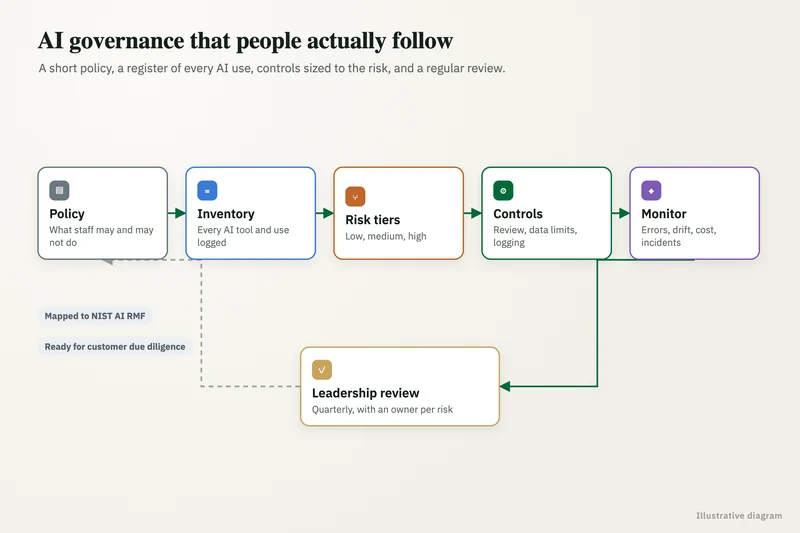
How much does AI governance consulting cost in 2026?
Most US small and mid-size companies should expect a first governance engagement in the five figures, delivered over a few weeks to a few months. Firms that sell to one regulated niche publish fixed prices at the low end, while large consultancies price multi-year programs in six and seven figures. The table mixes prices that individual firms publish with market bands from one cost analysis, so you can test a quote against both.
These are third-party figures, not our prices; we quote a fixed fee after a free review. WorkWise Solutions sells mainly to investment firms, so its packages are built around SEC exams and investor due diligence questionnaires, and a manufacturer or a clinic would need a different scope. Elevate Consult's bands are observed ranges and in places include platform and staffing costs, not only advisory fees, so read them as total program budgets rather than consulting quotes.
| Option | Price | Time | Source |
|---|---|---|---|
| Quarterly governance refresh (policy pack and vendor files kept current) | $2,500 per quarter | Ongoing | WorkWise Solutions pricing page |
| Fixed-fee AI governance package (policy, supervision approach, due diligence answers) | $9,500 | 1 to 2 weeks | WorkWise Solutions pricing page |
| Exam-ready governance documentation for investment firms | $17,500 | 2 to 3 weeks | WorkWise Solutions pricing page |
| NIST AI RMF compliance, all-in average | About $15,000 | About 45 days with an outside firm | Elevate Consult, April 2026 |
| Diagnostic governance assessment (start of a phased program) | About $35,000 | Not stated | Elevate Consult, April 2026 |
| Boutique strategic advisory, first year | $195,000 to $235,000 | 12 months | Elevate Consult, April 2026 |
| Big Four design and build of an AI risk management framework | EUR 80,000 to 250,000 | Not stated | Elevate Consult, April 2026 |
| Big Four AI governance program | $500,000 to $2 million | 18 to 24 months | Elevate Consult, April 2026 |
What do you get at each price point?
The deliverable list tells you which tier you are buying, because the same word, governance, covers a two-page policy and a two-year operating model. Groovy Web's July 2026 guide makes the useful point that the real difference between quotes is how much of the work changes your systems and how much only produces documents.
Its four building blocks are a good checklist for any proposal: an inventory of AI systems with a risk class for each, a map of controls to a named framework such as the NIST AI Risk Management Framework, the evidence and logging that prove those controls run, and an operating model that keeps it all current as tools and rules change. A cheap package usually covers the first two. A program priced in six figures should cover all four, across every business unit.
- Policy package (roughly $2,500 to $17,500 published): acceptable use policy, approved tool list, data rules, supervision approach and answers for customer or investor questionnaires.
- Framework build (tens of thousands): AI inventory, risk tiers, control map to NIST AI RMF or ISO/IEC 42001, vendor review process, human review rules and a gap list with owners.
- Operating program (six figures and up): all of the above across business units, plus monitoring, evidence collection, training, audit support and a standing governance committee.
What drives AI governance consulting cost up or down?
Scope and regulatory exposure drive the price far more than the hourly rate. A company running two approved chat tools and one internal assistant is a short job. A lender using AI in credit decisions, or a clinic whose AI vendor handles protected health information, needs legal mapping, vendor contract review and testing, and the quote rises accordingly.
These are the variables that most often separate a $10,000 quote from a $100,000 one.
- Number of AI systems in scope, including the ones staff use without approval.
- Consequential decisions: Colorado SB 26-189, effective January 1, 2027, covers automated decisions in education, employment, lending, healthcare, housing and insurance.
- EU exposure: the EU AI Act's Article 50 transparency duties apply from August 2, 2026, and high-risk obligations for uses such as employment and credit move to December 2, 2027.
- Regulated data: HIPAA requires a signed Business Associate Agreement with any AI vendor handling protected health information.
- Evidence depth: writing a logging requirement is cheap; wiring prompt and output logs into your systems takes engineering time.
- Certification goals: preparing for an ISO/IEC 42001 audit costs more than aligning loosely with NIST AI RMF, which is voluntary.
Which costs sit outside the consulting fee?
The consulting invoice is only one part of what governance costs over several years, and proposals rarely show the rest. Budget for four other lines before you compare quotes.
First, your own people. Someone has to own the AI inventory, approve new tools and review flagged outputs, and that is a few hours a week in a mid-size company even when the framework is well designed. Second, tooling: logging, data loss prevention rules in Microsoft 365 or Google Workspace, and possibly a governance platform once the number of AI systems grows. Third, vendor reviews, since every new AI product needs its contract, data retention terms and model training terms checked. Fourth, upkeep, because laws, vendor terms and your own systems change every quarter, which is why fixed-price refresh retainers exist.
There is also a cost of doing nothing, and it can be measured. IBM's 2025 Cost of a Data Breach report found that a high level of shadow AI, meaning staff using unapproved AI tools, added about $670,000 to the average breach cost. Governance is partly insurance against that line.
Worked example: budgeting AI governance for a 250-person company
Take a hypothetical US insurance agency with 250 staff in three offices. It uses Microsoft 365 Copilot, has a ChatGPT business workspace for marketing, is piloting an AI assistant that drafts certificate of insurance requests from Applied Epic data, and knows that some producers paste client details into personal chatbot accounts. It has no AI policy and its carriers have started asking about AI controls in their questionnaires.
That is four AI systems, insurance data and Colorado exposure through one office, so it sits above a simple policy package but far below a Big Four program. A sensible first phase is a framework build: inventory and risk tiers for the four systems, an acceptable use policy, a vendor review of Microsoft and OpenAI business terms, human review rules for the certificate assistant and a control map to NIST AI RMF. Against the published figures above, a quote in the range of the $15,000 NIST compliance average to the $35,000 diagnostic figure is reasonable; a quote of $150,000 would need a clear reason, such as multi-state legal analysis, and a quote of $3,000 would need checking for whether anyone will look at the systems at all.
Then add the agency's own costs. Assume an operations manager spends four hours a week as the AI owner, IT spends two days setting data loss prevention rules and logging, and a quarterly review takes a day of the leadership team's time. Price those hours at loaded salary and add them to the budget: at this size they can rival the consulting fee within the first year. A quarterly refresh retainer, published at $2,500 a quarter by one firm, is the outside-help version of that upkeep.
Fixed fee, retainer or hourly: how should governance work be priced?
A fixed fee per phase is usually best for the first engagement, because the deliverables (inventory, policy, control map, review rules) can be listed and the firm carries the risk of underestimating. Groovy Web notes that hourly and day-rate work is efficient only when the need is precisely defined, because otherwise the scoping happens on your bill.
A retainer fits after the framework exists, when the work becomes reviewing new tools, updating policy for new laws and answering customer questionnaires. Keep retainers small and specific: a named number of vendor reviews per quarter, a policy update cycle and a response time. A retainer that simply buys access, with no listed outputs, is hard to judge and easy to keep paying for after it stops adding value. For the broader market rates behind these models, see our AI consultant cost guide.
When should you not pay for AI governance consulting?
Skip or shrink the engagement when the risk is small and the answer is obvious. Paying a firm to write a long framework for a company that uses one approved chat tool is the most common way governance budgets are wasted.
- You have fewer than about 30 staff, no regulated data and only business-tier chat tools: start with an acceptable use policy and an approved tool list, which you can draft yourself.
- You are not yet using AI in any customer, hiring, lending or health decision: a light policy now and a fuller review before the first such use is enough.
- The firm sells a governance software platform: its framework will tend to require that platform.
- Nobody will own the framework after the consultants leave: the money is better spent first on naming and training an internal owner.
- You already have a mature security and privacy program: extend it to AI rather than buying a separate structure.
What should an AI governance consulting quote include?
Ask for these items in writing before you sign. A proposal that cannot answer them is priced on guesswork, and you will pay for that through change requests or a thin deliverable.
- A fixed fee or firm cap per phase, and what counts as a change in scope.
- The AI systems, business units and laws in scope, named individually.
- The named framework the controls map to, such as NIST AI RMF or ISO/IEC 42001.
- Which controls will be configured in your systems (logging, access, data loss prevention) and which will only be documented.
- How unapproved AI use will be found, not just prohibited on paper.
- Hours needed from your staff, and from whom.
- Who owns the framework, templates and inventory at the end (it should be you).
- A statement that legal conclusions come from your counsel; this guide is not legal advice either.
How does Greenwolf Tech Labs price AI governance consulting?
We do not publish rates. After a free review we agree which AI systems, teams and laws are in scope and quote one fixed price per phase, with the deliverables listed, so the AI governance consulting cost you approve is the amount you pay. Our work maps to NIST AI RMF, includes a search for unapproved AI use and sets up the logging and review steps in your own Microsoft 365, Google Workspace or line-of-business systems rather than leaving them as recommendations.
You own every policy, inventory and template we produce, and a person stays in the loop on anything touching money, customers or regulated data. If an acceptable use policy and a short review would cover your risk, we will say so before proposing anything larger.
FAQ
Frequently asked questions
How much does AI governance consulting cost for a small business?
Published fixed fees for focused packages start around $9,500 (WorkWise Solutions, for investment firms) and $17,500 for fuller exam-ready documentation. Elevate Consult's April 2026 guide puts all-in NIST AI RMF compliance at about $15,000. Very small firms with only business-tier chat tools can often start with a self-written acceptable use policy.
How much does a Big Four AI governance engagement cost?
Elevate Consult's April 2026 guide puts Big Four AI governance programs at $500,000 to $2 million over 18 to 24 months, and design and build of an AI risk management framework at EUR 80,000 to 250,000. Those programs usually cover many business units and an ongoing operating model.
How long does an AI governance consulting engagement take?
Published fixed-fee packages take one to three weeks, and Elevate Consult cites about 45 days for NIST AI RMF work with an outside firm. Multi-unit programs at large consultancies run 18 to 24 months. Your own team's time should be planned alongside the consultant's.
Is there ongoing cost after AI governance consulting?
Yes. Someone internal has to own the AI inventory and approve new tools, vendor terms need reviewing as you add products, and policies need updating as laws change. One published refresh retainer costs $2,500 a quarter, and staff time usually costs more than that.
Do I need AI governance consulting to comply with the Colorado AI law?
Not necessarily, but you need a clear view of where AI touches consequential decisions. Colorado SB 26-189, effective January 1, 2027, requires notice, explanation of adverse outcomes, human review and data correction for automated decisions in areas such as employment, lending and insurance. Confirm your obligations with counsel.
What is the difference between AI governance consulting and an AI audit?
Governance consulting designs the rules, roles and controls for how your company chooses and uses AI. An audit checks whether those controls exist and work. Many first engagements combine a light audit of current AI use with the framework build.
Keep reading
Related pages
Get started
Tell us where AI should pay back
Describe the work that eats your team's time and the systems you run. We reply within one business day with the use cases we would test first, the risks to plan for and a fixed-price proposal.
- Free 30-minute AI review
- Fixed quote before any work starts
- Advice that is vendor-neutral, in plain English
Prefer email? info@aiconsultingservicesusa.com
Book a free AI review
Two lines is enough to start.