

Industry guide
AI consulting for engineering firms: where to start and what to avoid
AI consulting for engineering firms helps civil, structural, MEP, environmental and multidiscipline firms decide where AI should recover billable time, which tools to trust with project files, and how to keep every sealed deliverable under an engineer's responsible charge. This guide is for principals, COOs and operations leaders at US firms with roughly 30 to 1,000 staff who want a plan that pays back, not another pilot.
Book a free AI review
Two lines is enough. A specialist replies within one business day.
Executive summary
What can AI consulting do for an engineering firm?
AI consulting for engineering firms identifies the non-design work that eats senior time, such as proposals, specifications, RFIs, submittals and project reporting, and puts AI to work there first under review rules. It also sets policy for client data and confirms that licensed engineers keep responsible charge of anything they seal.
What to take away
- Deltek's 2026 A&E study found AI use at 70% but measurable impact at only 38%.
- Start with proposals, specs, RFIs and reporting, not design calculations or sealed drawings.
- Licensed engineers stay responsible for AI-assisted work, so review steps are a design requirement.
- Measure success in utilization and write-offs, not in hours saved on paper.
Why do engineering firms need AI consulting now?
Most engineering firms are already using AI, but few can show what it returned. Deltek's 47th Annual Clarity Architecture and Engineering Industry Study, released May 12, 2026 from a survey of 896 A&E firms in the US and Canada, found AI adoption rose from 53% to 70% in a year, while only 38% of respondents reported a measurable positive business impact. Another 39% said it was too early to tell or that they were still piloting.
The same study named the top AI challenges as knowing where and how to apply it (62%), integrating AI systems (56%) and data and cybersecurity (52%). Those are exactly the problems an AI consulting engagement is meant to solve: choosing the use cases, connecting them to the firm's systems, and setting rules for client data. Capacity adds pressure, with Deltek reporting staff growth of only 1.2% and turnover above 13%, so firms are looking for ways to free senior engineers from administrative work rather than hire their way out.
The ACEC Research Institute's Q1 2026 Engineering Business Sentiment study, published February 27, 2026 from 628 executive responses, described the same shift: more firms are writing AI strategies than in prior years, and more than half report investing in AI-focused talent. Strategy is no longer optional; the open question is which work to point AI at first.
How is AI consulting for engineering firms different from other industries?
Three things make engineering firms different from a typical professional services client. First, the business model is utilization: revenue comes from billable hours on projects, so the value of AI is measured in hours moved from overhead or write-offs to billable work, or in more proposals submitted with the same marketing team.
Second, licensure. A professional engineer who seals a drawing or report is responsible for it regardless of the tools used. NSPE's position statement on artificial intelligence (No. 03-1774, last revised February 2026) calls for rigorous verification and validation, testing and continuous monitoring of AI systems that affect public safety. NCSEA's guidance for structural engineers states that AI use does not change a licensed engineer's legal responsibilities and that engineers must still exercise responsible charge and validate all outputs. An AI plan that does not design for engineer review is not usable.
Third, client confidentiality across many projects. Firms hold drawings, models and reports for many clients at once, often under contracts that limit how files are used. Any AI tool that searches project files must respect project-level permissions, and public-sector or critical infrastructure clients may restrict which cloud services can see their data at all. This is not legal advice; check your contracts and your state board's guidance.
Which AI use cases pay back first for engineering firms?
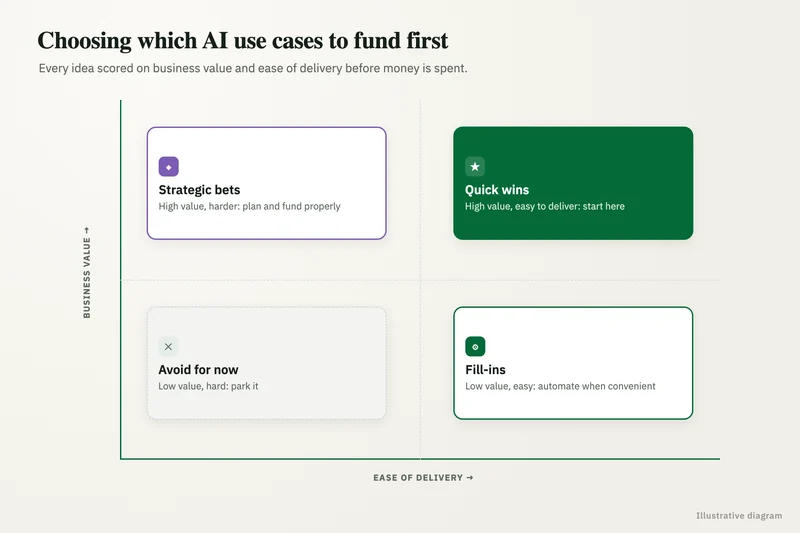
The fastest returns are in document-heavy work around the design, not in the design itself. The table ranks common candidates by value and by how much engineering judgment the output carries, which drives the amount of review needed.
| Use case | Where the time goes today | Engineering risk | Typical first step |
|---|---|---|---|
| Proposals and qualifications (including SF 330 for federal work) | Marketing and principals rewriting resumes, project sheets and approach sections | Low: reviewed before submission | Retrieval over past proposals and project descriptions with draft sections |
| Specification drafting and checks | Editing master specs for each project, catching outdated sections | Medium: engineer reviews every change | Compare project specs against office masters and flag mismatches |
| RFI and submittal triage | Engineers reading long submittals to find what needs a response | Medium: engineer decides the response | Summaries and checklists against the spec, with page references |
| Project reporting and earned value | Project managers compiling status from Deltek Vantagepoint, Ajera or BST | Low | Automated weekly reports and budget alerts |
| Knowledge search across past projects | Staff asking colleagues where a past detail or calc lives | Low to medium | Search over SharePoint, ProjectWise or Autodesk Docs with citations |
| Design calculations and sealed drawings | Core billable engineering | High: sealed work | Keep under engineer control; use only vetted, validated tools |
What does an AI consulting engagement for an engineering firm include?
A good engagement produces decisions and a working first use case, not a slide deck. For an engineering firm, the deliverables should include the items below.
- A use-case inventory scored by recovered billable hours, review burden and data access, built from interviews with principals, project managers, marketing and accounting.
- A systems and data map: ERP and project accounting (Deltek Vantagepoint, Ajera, BST Global, Unanet), document control (ProjectWise, Autodesk Docs, SharePoint, Newforma), CRM and proposal libraries.
- An AI acceptable use policy that names approved tools, banned inputs such as client models under restrictive contracts, and the review rule for anything that leaves the firm.
- A model and platform recommendation: Microsoft 365 Copilot if you are a Microsoft shop, or OpenAI, Claude or Gemini business tiers, with data terms checked against client contracts.
- A review design for each use case: who checks the output, what the confidence threshold is, and how the check is recorded in the project file.
- A 90-day roadmap with one use case live, a running-cost estimate per month, and the metric that decides whether to scale it.
Worked example: a 220-person civil and structural firm
Take a hypothetical regional firm with 220 staff, about 60% of them billable, using Deltek Vantagepoint for project accounting and SharePoint for project files. Principals say they spend evenings on proposals, and marketing submits fewer pursuits than leadership wants.
Discovery finds three candidates. Proposal drafting consumes an estimated 25 hours of principal and senior engineer time per pursuit. Weekly project status reports take each project manager about two hours. Specification edits generate repeat review comments because old master sections get copied forward. Proposal drafting scores highest: high hours, low engineering risk, and the content already exists in past proposals and resumes.
The first build is retrieval over the proposal library and project database, producing draft project descriptions, team resumes tailored to the pursuit, and an approach outline for the principal to edit. If the draft cuts principal time per pursuit from 25 hours to 15, and the firm submits 80 pursuits a year, that is 800 hours returned to senior staff who can bill or pursue more work. These are illustrative numbers; the engagement would measure the real baseline before building.
The status report automation comes second, because it depends on clean project data in Vantagepoint. Specification checks come third, after the firm agrees who owns the master specs. Design calculations stay out of scope.
What should an engineering firm's AI policy cover?
An engineering AI policy should be short enough that every engineer reads it. It should answer five questions: which tools are approved and on which account tier, which project data may never be entered (for example, files from clients whose contracts prohibit third-party processing), what review is required before AI-assisted content leaves the firm, how AI use is recorded in the project file, and who approves new tools.
Map the policy to the NIST AI Risk Management Framework so it holds up when a public-sector client or insurer asks how you govern AI. The framework is voluntary and organizes work into four functions: Govern, Map, Measure and Manage. Before scaling, also ask your professional liability carrier whether AI-assisted work changes anything in your coverage or reporting duties.
A 90-day AI plan for an engineering firm
Ninety days is enough to go from scattered experiments to one governed use case in daily use.
- Days 1 to 20: interviews, systems map, inventory of current AI use across the firm (including personal accounts), and a scored use-case list.
- Days 21 to 35: policy approved by principals, platform chosen, data access set up with project-level permissions, baseline metrics measured for the first use case.
- Days 36 to 70: build and test the first use case with a small group, such as two principals and the marketing team, using real pursuits and a recorded review step.
- Days 71 to 90: roll out to the wider group, compare against the baseline, and decide whether to scale, change or stop. Pick the second use case from the list.
How to choose an AI consultant for an engineering firm
Look for a firm that understands project-based businesses, can both advise and build, and talks about review and responsibility before it talks about models. Ask how they would handle permissions in ProjectWise or SharePoint, what the monthly running cost will be, and who owns the prompts, code and data afterwards.
Be wary of anyone promising to automate design or sealed drawings in the first engagement, or who cannot explain how an engineer would verify an output. Relevant experience matters: we built a central supplier database with automated research and side-by-side comparison for a procurement firm in nuclear engineering in Europe, saving about 30 hours a month; details are in our case studies.
When should an engineering firm not hire an AI consultant?
Hold off if your project data is not reliable yet. If timesheets are late, project numbers are inconsistent between Vantagepoint and SharePoint, or nobody owns the master specs, fix those first, because AI will repeat the mess faster. Also hold off if principals have not agreed that AI deserves time and budget; a short strategy workshop is a cheaper way to get that agreement.
Small firms of under 20 people using AI only for writing and research may not need a consultant at all. Business accounts, a one-page policy and a review habit may be enough until the work touches several systems.
How Greenwolf Tech Labs works with engineering firms
We start with a free review of your workflows, systems and current AI use, then quote a fixed price for each phase. We design every use case with an engineer review step, keep sealed work out of automated scope, and you own the accounts, code, prompts and data. Our team has 8+ years of experience and works remotely with US firms in US time zones.
Case study · Procurement firm, nuclear engineering, Europe
Supplier intelligence tool
Supplier details lived in many Excel files, and every evaluation meant hours of manual research. A central supplier database with automated research, side-by-side comparison and filterable profiles.
- About 30 hours a month saved
- Reports in under 15 minutes instead of 4-5 hours
FAQ
Frequently asked questions
How are engineering firms using AI in 2026?
Deltek's 2026 A&E study found AI adoption at 70% of firms, up from 53% a year earlier, and generative AI use at 78%. Only 38% reported a measurable business impact, which is why many firms are moving from experiments to a written strategy.
Can engineers use AI for stamped drawings and calculations?
AI can assist, but the licensed engineer remains responsible for anything sealed. NCSEA's guidance says AI use does not change a licensed engineer's legal responsibilities, and NSPE calls for rigorous verification and validation of AI systems. Check your state board's rules; this is not legal advice.
What is the best first AI project for an engineering firm?
Proposal and qualifications drafting is often the best first project, because it uses existing content, carries low engineering risk and frees principal time. Project status reporting from Deltek Vantagepoint, Ajera or BST is another strong candidate if project data is clean.
Is it safe to put project files into ChatGPT, Claude or Copilot?
Only on business or enterprise tiers whose data terms exclude training on your inputs, and only for projects whose client contracts allow it. Personal free accounts should be banned for client files, and search tools must respect project-level permissions.
How much does AI consulting cost for an engineering firm?
It depends on the number of use cases, systems and offices involved. Our AI consultant cost guide collects published third-party rates. We quote a fixed price per phase after a free review, so the first phase has a known cost.
Will AI reduce billable hours at engineering firms?
It can reduce hours on some tasks, but most firms aim to move recovered time to billable design work or more pursuits. With Deltek reporting turnover above 13% and staff growth of 1.2%, many firms are short of capacity rather than work.
Keep reading
Related pages
Get started
Tell us where AI should pay back
Describe the work that eats your team's time and the systems you run. We reply within one business day with the use cases we would test first, the risks to plan for and a fixed-price proposal.
- Free 30-minute AI review
- Fixed quote before any work starts
- Advice that is vendor-neutral, in plain English
Prefer email? info@aiconsultingservicesusa.com
Book a free AI review
Two lines is enough to start.