

Industry guide
AI consulting for media companies: what to automate, what to protect
AI consulting for media companies helps publishers, broadcasters, studios and content networks decide where AI saves real hours, where it puts rights or reputation at risk, and how to roll it out with editors still in charge. This guide is for owners, COOs and editorial or content leaders at US media businesses of roughly 20 to 1,000 staff who want a plan, not a pitch.
Book a free AI review
Two lines is enough. A specialist replies within one business day.
Executive summary
What does AI consulting for media companies include?
AI consulting for media companies covers choosing the use cases that pay back (archive search, transcription, metadata, versioning, ad and subscription operations), settling who owns AI-assisted content, setting labeling and editorial review rules, picking vendors and models, and writing a phased plan with costs. Good consultants also tell you which ideas to drop.
What to take away
- Media has the highest AI use of any US sector in Census Bureau survey data.
- Start with back-office and archive work, not AI-written stories or synthetic voices.
- Prompts alone do not make AI output copyrightable, so ownership needs a plan.
- Synthetic media you publish in the EU must be labeled since August 2, 2026.
What does AI consulting for media companies actually cover?
It covers four decisions: which work to give to AI, which work must stay human, which tools and vendors to use, and what rules govern the result. A media business differs from most clients because its product is the content itself, so a mistake is not an internal error but something an audience, an advertiser or a rights holder sees.
The pressure to decide is real. The US Census Bureau's Business Trends and Outlook Survey put AI use in the Information sector, which includes publishing, broadcasting and motion pictures, at 39.7% of firms in May 2026, the highest rate of any sector it measured. Many media teams are already using AI tools informally; the consulting job is to turn that scattered use into an approved, measured and defensible way of working.
A typical engagement produces a ranked list of use cases with expected hours saved, a rights and disclosure position signed off by counsel, an editorial AI policy, a vendor shortlist, and a phased plan with a fixed price for each phase.
Which AI use cases pay back for media companies?
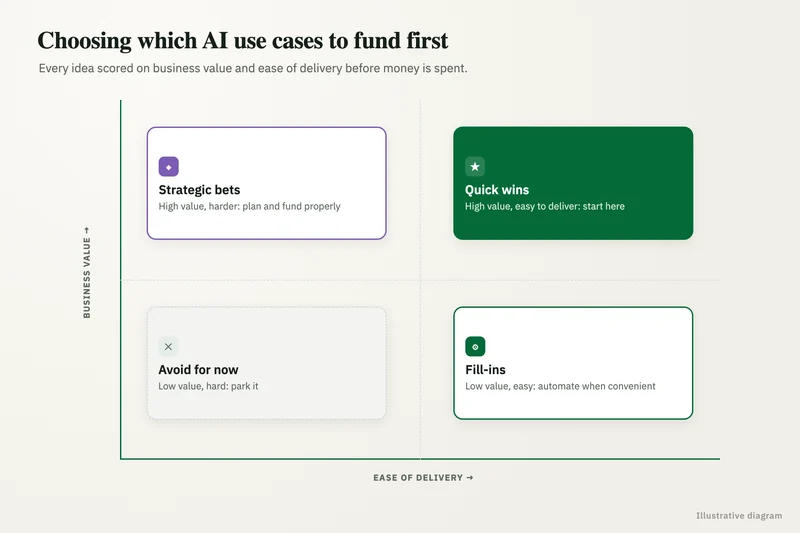
The fastest returns usually come from work around the content rather than the content itself: finding, tagging, transcribing, versioning and packaging what you already own. These use cases save hours every week, are easy to check and rarely put your name on something a machine wrote.
The table below ranks common media use cases by the risk they carry and the human check each one needs. Treat it as a starting shortlist to score against your own volumes, not a promise of results.
| Use case | Where it fits | Risk to brand or rights | Human check needed |
|---|---|---|---|
| Transcription and captions for video and podcasts | Broadcast, podcast networks, video publishers | Low | Spot-check names, numbers and quotes before publishing |
| Archive search with cited sources | Publishers and broadcasters with large back catalogs | Low | Reporter confirms the cited source before reuse |
| Metadata, tagging and SEO fields | Any CMS-based publisher | Low | Editor reviews tags on high-traffic pieces |
| Headline and social copy variants | Digital publishers, newsletters | Medium | Editor picks and edits; never auto-publish |
| Versioning content for formats and languages | Studios, B2B media, trade publishers | Medium | Native reviewer for every translated piece |
| Rights and licensing lookups | Studios, photo and music libraries | Medium | Rights team confirms before clearance |
| Ad operations and sales proposal drafts | Ad-supported publishers | Medium | Sales lead approves anything sent to a buyer |
| AI-written news or reviews | Any publisher | High | Usually not recommended as a first project |
| Synthetic voices or likenesses of real people | Audio, video, advertising | High | Written consent, contracts and legal review first |
Who owns AI-generated content at a media company?
Ownership is the question media leaders most often get wrong. The US Copyright Office's report on copyrightability, released January 29, 2025 as Part 2 of its AI series, concluded that prompts alone do not give a user enough control to be the author of AI-generated output under current technology. Human selection, arrangement and substantial editing can still be protected, but raw output generally cannot.
For a media company, that has three practical effects. First, content you want to license or defend should have meaningful human authorship, and your workflow should record it (drafts, edits, who changed what). Second, contracts with freelancers, agencies and talent should say whether AI may be used and who carries the risk if it is. Third, vendor terms matter: check whether a tool may use your archive or uploads to train its models, and choose business or API plans whose terms say it will not.
The Copyright Office also published Part 1 on digital replicas in July 2024 and a pre-publication Part 3 on generative AI training in May 2025. If your plans involve cloning a voice or likeness, or feeding licensed material into a model, involve counsel before any pilot. This is not legal advice.
Do media companies have to label AI-generated content?
If your content reaches people in the EU, yes, in many cases. The EU AI Act applies to US firms whose AI output is used in the EU, and its Article 50 transparency duties, which include labeling synthetic media and telling people when they are talking to an AI, have applied since August 2, 2026. A US publisher with European readers, a streaming catalog sold into Europe or a chatbot on a site with EU visitors should map where these duties bite.
In the US there is no single federal labeling law for media content, but the major video and social platforms set their own disclosure rules for realistic AI content, and advertiser contracts may add their own terms. The practical answer for most media companies is a written disclosure standard: what gets labeled, where the label appears, and who signs off. Our guide to the EU AI Act for US companies covers the wider obligations. This is not legal advice.
How should a newsroom or content team govern AI?
Governance for media is mostly editorial policy written down and enforced in the tools. The aim is that every reader, viewer and advertiser can trust that a named person stands behind what you publish, whether AI helped or not.
- Approved tools only, through business accounts with single sign-on, so drafts and uploads do not sit in personal accounts.
- A rule that AI never publishes directly to the CMS; a person approves every item that goes live.
- Fact checks on every name, number, quote and date in AI-assisted copy, since these are where generated text most often goes wrong.
- No AI-generated quotes, sources, reviews or images presented as real.
- A corrections process that records whether AI was involved, so you can see patterns and fix the workflow.
- Prompt and output logging for any automated step, so you can show what the system did if a rights holder or advertiser asks.
- A named owner for the policy and a six-month review date.
Which systems does media AI work have to connect to?
Most of the value, and most of the cost, sits in the connections. A useful AI step reads from and writes back to the systems your team already lives in, rather than adding another tab people must remember to open.
For publishers that usually means the CMS (WordPress, Arc XP or a custom system), the digital asset management library, the archive or search index, the newsletter platform and the analytics stack. Broadcasters and studios add media asset management, rights and contracts databases, and captioning workflows. Ad-supported businesses add the ad server and CRM, often Google Ad Manager with HubSpot or Salesforce. A consultant should map these before recommending any tool, because the same use case can be cheap in one stack and expensive in another.
For archive search we favor retrieval with citations: the system answers from your own content and links to the exact article, clip or document it used, so a reporter can confirm before reusing anything. Models from OpenAI, Anthropic, Google or open-weight options can all sit behind that design; the choice depends on data terms, cost per query and how well each handles your formats.
What does the first 90 days of a media AI program look like?
A sound program starts small, measures honestly and expands only what works. This is the sequence we use for a media business of 50 to 500 staff.
- Weeks 1 to 2: interview editorial, production, ad sales and finance; survey which AI tools staff already use; collect volumes (stories, hours of video, episodes, archive size).
- Weeks 3 to 4: score use cases on hours saved, risk and ease; agree the rights, disclosure and editorial position with leadership and counsel.
- Weeks 5 to 6: choose approved tools and set up business accounts, single sign-on and data terms; publish the AI policy and train staff.
- Weeks 7 to 10: pilot one low-risk use case, such as archive search or transcription, on real work with human review on every output.
- Weeks 11 to 13: measure hours saved, error rate and staff adoption against the baseline; decide to scale, adjust or stop; schedule the next use case.
What does AI consulting for media companies cost?
Cost depends on the number of use cases, the systems involved and how much rights and policy work you need, more than on company size. A focused engagement for one or two use cases costs far less than a company-wide program across newsroom, production and sales.
Published market rates for AI consultants, from freelancers to the largest firms, are collected in our AI consultant cost guide. Whoever you hire, ask for a fixed price per phase, a list of deliverables, and a monthly running-cost estimate for model usage, transcription minutes and any platform fees, since those continue after the consultant leaves.
When should a media company not hire an AI consultant?
Not every media business needs outside help. Skip it, or keep it to a short review, in these situations.
- You only need transcription or captions, and an off-the-shelf tool with business terms already does the job.
- Your team is under 20 people, uses one approved AI tool and handles no licensed or regulated material.
- You want AI to replace reporting or create synthetic people, and leadership has not yet agreed whether that fits the brand. Settle that first.
- Your archive and CMS data are in such poor shape that a cleanup project has to come before any AI step.
How we help media companies with AI
We are Greenwolf Tech Labs, working remotely with US clients in US time zones. We run the use-case review, the rights and policy workstream with your counsel, vendor and model selection and the 90-day pilot plan, and we can build the first use case as well, such as archive search with citations or automated transcription and tagging feeding your CMS.
Every engagement is scoped after a free review and delivered at a fixed price. You own the accounts, code, prompts and data, and an editor stays in the loop on anything that reaches your audience. Start with our AI strategy consulting service, or ask for an AI readiness assessment if you first want to know where you stand.
FAQ
Frequently asked questions
How are media companies using AI in 2026?
The most common uses are transcription and captions, archive search, metadata and tagging, headline and social copy variants, translation and versioning, and ad sales support. The US Census Bureau found the Information sector had the highest AI use of any sector in May 2026, at 39.7% of firms.
Can a media company copyright content made with AI?
Only the human-authored parts. The US Copyright Office concluded in January 2025 that prompts alone do not make a user the author of AI output, though human selection, arrangement and substantial editing can be protected. Record human edits in your workflow and ask counsel about anything you plan to license. This is not legal advice.
Should a newsroom let AI write articles?
Most newsrooms should not start there. AI-written stories carry the highest risk of errors and reputational damage, while archive search, transcription and tagging save time with far less exposure. If AI drafts any copy, a named editor should check every name, number and quote before it publishes.
Does the EU AI Act affect US publishers?
It can. The Act applies to US firms whose AI output is used in the EU, and its Article 50 duties to label synthetic media and disclose AI interactions have applied since August 2, 2026. Publishers with European audiences should check which content and chat features are in scope. This is not legal advice.
Will AI tools train on our archive?
That depends on the plan and terms you sign. Consumer accounts often allow vendors to use inputs, while business and API plans from the major vendors typically offer terms that exclude your data from training. Check the terms before uploading licensed or unpublished material.
What is the best first AI project for a media company?
Usually archive search with cited sources or automated transcription and tagging. Both use content you already own, save hours every week, are easy to check and do not put AI-written words in front of your audience.
How long does an AI consulting engagement take for a media business?
A focused plan with one pilot typically fits in about 90 days: two weeks of discovery, two weeks of scoring and policy, two weeks of setup and training, then a pilot and a decision. Company-wide programs across newsroom, production and sales take longer.
Keep reading
Related pages
Get started
Tell us where AI should pay back
Describe the work that eats your team's time and the systems you run. We reply within one business day with the use cases we would test first, the risks to plan for and a fixed-price proposal.
- Free 30-minute AI review
- Fixed quote before any work starts
- Advice that is vendor-neutral, in plain English
Prefer email? info@aiconsultingservicesusa.com
Book a free AI review
Two lines is enough to start.