

Operating guide
AI center of excellence: how a mid-size company builds one without a new department
An AI center of excellence is a small group that decides which AI projects a company funds, sets the rules every team follows and measures whether the results are real. Most guides assume an enterprise with 15 to 30 dedicated staff; this one is for US companies with roughly 100 to 1,000 employees that need the same control with part-time roles, a clear intake process and a first measured win inside 90 days.
Book a free AI review
Two lines is enough. A specialist replies within one business day.
Executive summary
What is an AI center of excellence?
An AI center of excellence (AI CoE) is a cross-functional group that owns AI priorities, standards and measurement for the whole company. It approves use cases, maintains the list of approved tools and data rules, supports teams building AI into their work and reports results to leadership. In a mid-size company it is usually four to six people working part-time.
What to take away
- Mid-size companies rarely need dedicated CoE staff; four to six part-time roles usually cover it.
- A virtual or hub-and-spoke model fits most firms between 100 and 1,000 staff.
- The intake scorecard matters more than the org chart: it decides what gets funded.
- Measure the CoE on business numbers it moved, not on pilots launched.
What does an AI center of excellence do in a mid-size company?
It does five jobs: decides which AI projects get time and money, keeps a short list of approved tools and data rules, gives teams a repeatable way to build and test, tracks every AI system in use, and reports results to the leadership team. It does not build every project itself. In a company of a few hundred people the CoE is a decision and standards body that lets departments move faster, not a gate they wait behind.
The need is real. RSM's Middle Market AI Survey 2025, which polled 966 US and Canadian middle market leaders in early 2025, found that 70 percent of firms using generative AI recognized they needed outside support to get full value from it. That gap shows up as scattered pilots, duplicate subscriptions and nobody able to say which projects paid back. A CoE is the structure that closes it, whether it is staffed internally, externally or with a mix.
- Priorities: one ranked backlog of AI use cases across departments, reviewed monthly.
- Standards: approved tools, data rules, an acceptable use policy and a testing checklist.
- Enablement: templates, training and office hours so teams can build small things safely.
- Inventory: a register of every AI system in use, its owner, data access and risk tier.
- Measurement: a baseline and a scorecard for each project, reported to leadership each quarter.
Does your company need an AI center of excellence?
You need one when AI use has spread faster than anyone's ability to govern or measure it. Three or more of the signs below usually mean it is time.
You probably do not need one yet if fewer than about 100 people work at the company, AI use is limited to a business-grade chat tool and one or two automations, or a single owner already makes every technology decision. In that case an acceptable use policy and a named AI owner are enough; a full CoE adds meetings without adding value.
- Several departments are paying for overlapping AI tools, and finance cannot list them all.
- Staff use personal chatbot accounts for work because no approved option exists.
- Pilots have launched but nobody can say which ones saved time or money.
- A customer, auditor, insurer or lender has asked how you govern AI and the answer took a week.
- You operate in, or sell into, the EU, Colorado or another place with AI rules taking effect in 2026 or 2027.
- Leadership wants an AI roadmap but no one person has the time or skills to own it.
Which AI center of excellence model fits a mid-size company?
Pick the model by headcount and by how independent your departments are. Centralized models give the most control but need dedicated staff. Hub-and-spoke models put a small core team in charge of standards while each department has a named AI lead. Virtual models are part-time committees with clear decision rights, and they fit most companies under 500 staff.
| Model | Best fit | How it is staffed | Strength | Weakness |
|---|---|---|---|---|
| Virtual CoE | 100-500 staff, one main business line | 4-6 people part-time, often led by a fractional Chief AI Officer | Low cost, fast to start | Stalls if no one has protected time |
| Hub-and-spoke | 300-1,000 staff, several departments or sites | Small core (1-2 people, part or full time) plus a named AI lead in each department | Standards stay central, ideas come from the business | Needs a clear intake process or spokes go their own way |
| Centralized | 1,000+ staff or heavily regulated work | Dedicated team that builds and approves most AI work | Strong control and consistency | Becomes a bottleneck; costly for mid-size firms |
| No CoE, named owner | Under 100 staff | One leader with an acceptable use policy and a vendor list | Simple | Breaks down as use spreads |
Who should be on an AI CoE, and how much time does each role take?
Five roles cover most mid-size companies, and only the lead needs a meaningful share of the week. The hours below are the planning ranges we use for a company of 200 to 600 staff in its first year; adjust them for your volume of projects.
| Role | Usually filled by | Time in year one | Owns |
|---|---|---|---|
| CoE lead | COO, CIO or a fractional Chief AI Officer | 1-2 days a week | Backlog, standards, leadership reporting |
| Executive sponsor | CEO or COO | 1-2 hours a month | Budget decisions, tie-breaks, removing blockers |
| Data and systems owner | IT manager or senior analyst | 4-8 hours a week | Access, integrations, approved tools, logging |
| Risk and compliance owner | Legal, compliance or finance lead | 2-4 hours a week | Policy, vendor terms, risk tiers, regulator questions |
| Department AI leads | One respected operator per department | 2-4 hours a week each | Bringing use cases, running pilots, training peers |
How to build an AI center of excellence in 90 days
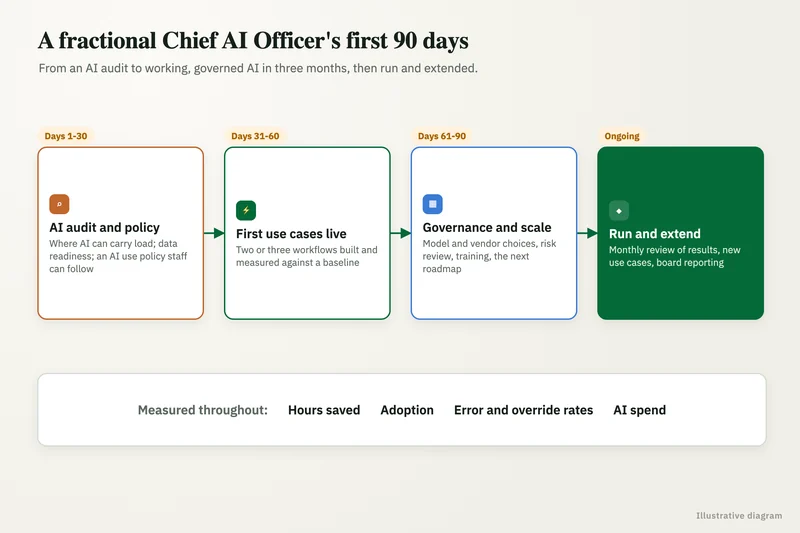
A mid-size company can stand up a working CoE and finish one measured pilot in about 90 days. The sequence matters more than the speed: inventory before policy, policy before pilots, baseline before build.
Days 1 to 30 are about facts. Name the sponsor and lead, write a one-page charter that states decision rights and budget, and run an inventory of every AI tool and feature in use, including those inside Microsoft 365, Google Workspace, Salesforce, HubSpot and the chatbots staff use on their own. Publish an interim acceptable use policy and an approved tool so people stop using personal accounts.
Days 31 to 60 are about choices. Collect use cases from every department through one intake form, score them with the scorecard below and pick one pilot that is low risk, measurable within six weeks and visible to leadership. Measure its baseline for two weeks before anything is built. Set the testing checklist: an evaluation set of real examples, human review on anything touching money, customers or regulated data, logging of prompts and outputs and a cost cap per task.
Days 61 to 90 are about proof. Run the pilot on real work with people reviewing outputs, report the result against the baseline and decide whether to scale, change or stop it. Then publish the next three items on the backlog. A CoE that finishes its first quarter with one honest result and a ranked backlog has done more than one that launched ten pilots.
How should an AI CoE decide which projects to approve?
Use one scorecard for every request so decisions are consistent and departments can see why a project was ranked where it was. Score each item from 1 to 5 on the criteria below, weight value and data readiness most heavily, and send anything scoring high on risk to the compliance owner before it moves forward.
Two rules keep the scorecard honest. First, no project enters the backlog without a named business owner who will report the result. Second, every approved project must state the number it is meant to move, such as hours per week, days to close, error rate or response time, and that number is measured before the build starts.
- Value: hours saved, revenue protected or errors removed per month, with the assumption written down.
- Data readiness: is the data the project needs accessible, reasonably clean and permitted for this use?
- Effort: systems to connect, people involved and weeks to a first working version.
- Risk: does the output touch customers, money, employment decisions, health or other regulated data?
- Reuse: will the work create a pattern, connector or dataset other teams can use?
- Owner: is there a named person who will run the pilot and report the result?
A worked example: a 300-person distributor
Consider a US distributor with 300 staff, an ERP, a CRM, a shared drive full of supplier price lists and a customer service team answering order-status questions by email. Sales, finance and customer service each bought an AI tool in the past year. The figures here are illustrative planning assumptions, not client results.
The company sets up a virtual CoE. The COO sponsors it, a fractional Chief AI Officer leads it at about one and a half days a week, the IT manager owns data and systems, the controller owns risk and each of the three departments names an AI lead. The inventory finds seven AI subscriptions, three of which overlap, and two teams pasting customer data into personal chatbot accounts. The interim policy and one approved business-grade assistant fix the second problem within two weeks; cancelling the overlapping tools pays for part of the CoE's first-year cost.
Twelve use cases come through intake. The top score goes to standardizing supplier price lists into the ERP, because the data exists, the risk is low and the purchasing team estimates it spends about 25 hours a week on manual updates. The pilot measures that baseline for two weeks, runs for six and reports hours saved and price errors caught. Customer-facing order-status answers rank second but wait for the testing checklist, because they touch customers. Work of this shape is familiar to us: for a procurement firm we built a central supplier database with automated research that saved about 30 hours a month, as described in our case studies.
How do you measure whether an AI center of excellence is working?
Judge it on business results and on control, not on activity. A CoE that reports pilots launched, prompts written or people trained is reporting effort. Report these instead each quarter, and use our guide to measuring AI ROI for the per-project calculation.
- Measured value: hours, cost or errors removed by AI projects in production, against their baselines, net of running costs.
- Time to decision: days from an intake request to an approve, change or decline answer.
- Pilot to production rate: share of pilots that went live or were stopped on purpose with a reason.
- Coverage: share of AI tools in use that are in the register with an owner and risk tier.
- Spend: total AI subscription and usage cost, and duplicates removed.
What mistakes kill an AI CoE?
The most common failure is a CoE that only approves things. Departments learn to route around it, and AI use goes back into the shadows. Gartner predicted in June 2025 that over 40 percent of agentic AI projects will be canceled by the end of 2027 because of cost, unclear value or weak risk controls; a CoE exists to catch those problems before money is spent, not after.
Other patterns repeat: a lead with no protected hours, so the backlog stalls; a charter with no budget, so every decision goes back to the CEO; pilots without a baseline, so no result can be defended; a policy so strict that staff keep using personal accounts; and a team that tries to build everything itself instead of setting standards and letting departments build within them.
Should you staff an AI CoE internally or with outside help?
Use internal people for the sponsor, the department leads and the data owner, because they know the work and will be there in two years. The lead role is the one most mid-size companies cannot fill internally: it needs someone who can rank use cases, judge vendors, write standards and run pilots, and a full-time hire with that range is expensive. Our Chief AI Officer salary guide compares the full-time cost with fractional options.
A fractional Chief AI Officer can lead the CoE for the first 6 to 12 months, set up the charter, intake, standards and scorecard, run the first pilots and train an internal successor. That is the model we offer. We scope it after a free review and quote a fixed fee for each phase, you own every account, prompt, workflow and document, and a person stays in the loop on anything touching money, customers or regulated data.
Case study · Logistics company, UK
Route planning automation
Dispatch typed every address into Google Maps, which optimizes only 25 stops and cannot add time at each stop. A Python tool that loads addresses automatically, adds buffer time per stop and optimizes the full route.
- Manual address entry eliminated
- Delivery estimates customers could rely on
FAQ
Frequently asked questions
What is an AI center of excellence?
It is a cross-functional group that owns AI priorities, standards and measurement for a company. It approves use cases, keeps the list of approved tools and data rules, supports teams building with AI and reports results to leadership. In mid-size companies it is usually staffed part-time.
How many people do you need for an AI center of excellence?
A company of 100 to 1,000 staff can usually run one with four to six people working part-time: a lead, an executive sponsor, a data and systems owner, a risk owner and one AI lead per department. Only the lead typically needs one to two days a week.
What is the difference between an AI CoE and an AI governance committee?
A governance committee mainly sets rules and reviews risk. An AI CoE does that and also ranks use cases, supports teams building AI and measures results. In smaller companies the two are often the same group with a broader charter.
How long does it take to set up an AI center of excellence?
A mid-size company can set up a working CoE and complete one measured pilot in about 90 days: 30 days for the charter, inventory and interim policy, 30 for intake and pilot selection with a baseline, and 30 to run and report the pilot.
Who should lead an AI center of excellence?
Someone with authority across departments and enough AI knowledge to judge use cases and vendors. In mid-size companies that is often the COO or CIO with a fractional Chief AI Officer doing the day-to-day work, then handing over to an internal lead once the process runs.
Does a small company need an AI center of excellence?
Usually not below about 100 staff. A named AI owner, an acceptable use policy, one approved business-grade tool and a short list of measured projects give most small companies the same control without the overhead.
Keep reading
Related pages
Get started
Tell us where AI should pay back
Describe the work that eats your team's time and the systems you run. We reply within one business day with the use cases we would test first, the risks to plan for and a fixed-price proposal.
- Free 30-minute AI review
- Fixed quote before any work starts
- Advice that is vendor-neutral, in plain English
Prefer email? info@aiconsultingservicesusa.com
Book a free AI review
Two lines is enough to start.