

Template
AI business case template: the fields, a worked example and the CFO test
An AI business case template is a short decision document with eight parts: the problem and its measured baseline, the proposed scope, one-time and running costs, benefits in three scenarios, risks and controls, a pilot with kill criteria, ownership, and the decision you are asking for. Below you get each field ready to copy, a fully worked example for a customer service inbox and the questions finance will ask before signing.
Book a free AI review
Two lines is enough. A specialist replies within one business day.
Executive summary
What should an AI business case include?
An AI business case should include a measured baseline for one process, the scope of the AI change, one-time and monthly running costs, benefits under conservative, expected and stretch assumptions, the main risks and controls, a time-boxed pilot with written stop and scale rules, a named owner and a specific decision request.
What to take away
- Anchor every AI business case to one process with a baseline measured before launch.
- Show three scenarios, not one optimistic number, and name the assumption driving each.
- Ask for approval of a time-boxed pilot with written stop and scale rules.
- Count running costs and review time, which most templates leave out.
What is an AI business case and when do you need one?
An AI business case is the document that turns an idea such as using AI in customer service into a funded decision with a budget, an owner and a test. You need one whenever the spend crosses the limit a manager can approve alone, when the change touches customers, money or regulated data, or when a previous AI pilot stalled and leadership wants proof before trying again.
The bar is higher for AI than for most software. MIT NANDA reported in 2025 that 95% of organizations saw no measurable P&L return from generative AI, and BCG found in October 2025 that 60% of companies reported no material value. Finance teams have read those headlines. A business case that shows its assumptions and builds in a way to stop early is far easier to approve than one that promises a large return.
What should an AI business case template include?
Eight sections cover what an approver needs, and the whole document should fit on four to six pages plus a one-page summary. The table lists each section, what goes in it and the evidence a finance lead will expect to see.
| Section | What to write | Evidence the approver expects |
|---|---|---|
| 1. Decision requested | The exact approval: amount, scope, dates | One sentence a busy executive can say yes or no to |
| 2. Problem and baseline | One process, its volume, time per item, error rate, cost | Two to four weeks of measured data signed off by the process owner |
| 3. Proposed change | What the AI does, what people still do, which systems it touches | A simple before-and-after flow, named systems such as HubSpot, NetSuite or Zendesk |
| 4. Costs | One-time costs and monthly running costs, listed separately | Fixed quotes where possible, usage estimates per item for model and platform fees |
| 5. Benefits in three scenarios | Conservative, expected and stretch results with the assumption behind each | Assumptions tied to the baseline, not to vendor marketing |
| 6. Risks and controls | Data, accuracy, adoption, vendor and compliance risks | Human review on anything touching money, customers or regulated data |
| 7. Pilot plan and kill criteria | Length, sample size, metrics, scale and stop rules | Rules written before the pilot starts |
| 8. Ownership | Business owner, technical owner, who absorbs the saved time | Names, not departments |
The AI business case template, field by field
Copy these fields into a document and fill them in order. If a field cannot be completed, that gap is the first thing to fix, not something to paper over.
- Decision requested: We ask for approval of [amount] to run a [number]-week pilot of [AI change] in [team], with a scale decision on [date].
- Process: [Name of process], owned by [person]. Monthly volume: [number]. Measured time per item: [minutes]. Error or rework rate: [percent]. Loaded hourly cost: [amount].
- Current monthly cost: volume x minutes per item / 60 x loaded hourly cost = [amount].
- Proposed change: The AI will [draft, extract, classify, summarize] [item]. A person will [review, approve, correct] before [action]. Systems involved: [CRM, ERP, helpdesk, document store].
- One-time costs: discovery and design [amount], build and integration [amount], testing on real cases [amount], training [amount].
- Running costs per month: model usage at [cost per item] x volume, platform and tool plans [amount], monitoring and maintenance [amount], human review time [hours x rate].
- Benefits: minutes saved per item in each scenario [conservative / expected / stretch]; share of saved hours turned into real value [percent], and how (backlog cleared, hire avoided, new work taken on).
- Risks and controls: [risk] controlled by [confidence threshold, review queue, logging, rollback, data rule].
- Pilot: [weeks] on at least [number] real items. Scale if [metric] reaches [value] with errors no worse than baseline. Stop if [metric] is below [value].
- Owners: business owner [name], technical owner [name], person who decides how saved time is used [name].
Worked AI business case example: a customer service inbox
The numbers below are assumptions chosen to show the method, not client results or a price list. A 200-person B2B supplier receives 2,400 customer emails a month about orders, delivery dates and invoices. The support lead measured 9 minutes per email over three weeks, mostly spent looking up the order in the ERP and writing the reply. At a loaded cost of $45 an hour that is 360 hours, or $16,200 a month.
The proposed change: AI reads each email, pulls the order status from the ERP, drafts a reply and flags anything about refunds, complaints or legal terms for a person. Every reply is still reviewed and sent by an agent. Assume a fixed one-time cost of $35,000 for design, integration, testing and training, and $700 a month in running costs for model usage, the helpdesk add-on and monitoring.
The scenarios differ on two assumptions: minutes saved per email and the share of saved hours that turn into real value. In the conservative case, agents save 2 minutes and only half of those hours are put to use. In the expected case they save 3.5 minutes and three quarters are used. In the stretch case they save 4.5 minutes and the team absorbs growth without a planned hire, so all of it counts.
The expected case pays back in under nine months and the stretch case in under five. The conservative case takes more than two and a half years, which is the honest warning in this AI business case: the project only works if the time saved is actually redeployed. So the request is not the full $35,000 at once but an eight-week pilot on at least 1,000 real emails. Scale if measured savings reach 3 minutes per email with reply errors no worse than the baseline; stop if savings are below 1.5 minutes.
| Conservative | Expected | Stretch | |
|---|---|---|---|
| Minutes saved per email | 2 | 3.5 | 4.5 |
| Hours saved per month (2,400 emails) | 80 | 140 | 180 |
| Share of hours turned into value | 50% | 75% | 100% |
| Monthly value at $45 an hour | $1,800 | $4,725 | $8,100 |
| Net monthly benefit after $700 running cost | $1,100 | $4,025 | $7,400 |
| Payback on $35,000 one-time cost | About 32 months | About 8.7 months | About 4.7 months |
| Net after year one | -$21,800 | $13,300 | $53,800 |
| Net after three years | $4,600 | $109,900 | $231,400 |
How do you test the numbers before the CFO does?
Run a simple sensitivity check: change one assumption at a time and see which one moves the answer most. In the example, each extra minute saved per email is worth about $1,350 a month in the expected case (2,400 emails, 75% realized, $45 an hour). Doubling the running cost to $1,400 a month only stretches expected payback from about 8.7 to about 10.5 months. The business case therefore lives or dies on minutes saved and on whether the hours are used, so that is what the pilot must measure.
Write that conclusion into the document. An approver who sees that you already know the weakest assumption, and have designed the pilot around it, trusts the rest of the numbers more. For the formulas behind payback and ROI, and how to measure them after launch, see our guide on how to measure AI ROI.
- Vary minutes saved per item by plus and minus 50%.
- Vary the share of saved hours turned into value from 25% to 100%.
- Double the running cost and add 20% to the one-time cost.
- Cut volume by a third to model a slow season.
- If the expected case still pays back within the budget owner's limit under each change, the case is sturdy.
What questions will finance ask about an AI business case?
Expect these, and answer them in the document rather than in the meeting. Each one maps to a field in the template, which is why the template asks for it.
- Who measured the baseline, over what period, and did the process owner sign it?
- What happens to the saved hours: fewer overtime hours, a hire not made, or a backlog cleared?
- What does it cost per month to run at today's volume, and at double the volume?
- Who owns the accounts, code, prompts and data if the vendor relationship ends?
- What does a person still check, and how much of their time does that take?
- What is the most we can lose if the pilot fails, and when will we know?
- Is there an off-the-shelf product, or a feature in software we already pay for, that does this?
Common mistakes that get AI business cases rejected
Most rejected AI business cases fail on credibility rather than on the idea. These are the patterns approvers spot fastest.
- A single optimistic figure with no scenarios, which signals the author has not considered failure.
- A baseline estimated from memory instead of measured, which nearly always overstates the current effort.
- Benefits copied from vendor case studies or industry reports rather than built from your own volumes.
- No running costs, or running costs without human review time.
- Asking for the full rollout budget up front instead of a pilot with a decision date.
- Several processes bundled into one case, so a weak use case hides behind a strong one.
- No named owner for the saved time, which turns hours saved into hours that simply disappear.
When is an AI business case the wrong tool?
Skip the full template for small, reversible experiments. If a team wants to test a feature already included in your Microsoft 365 Copilot, ChatGPT, Claude or Gemini business plan, a one-paragraph note with a usage check after a month is enough; the governance step that matters is the data rule, not a financial model.
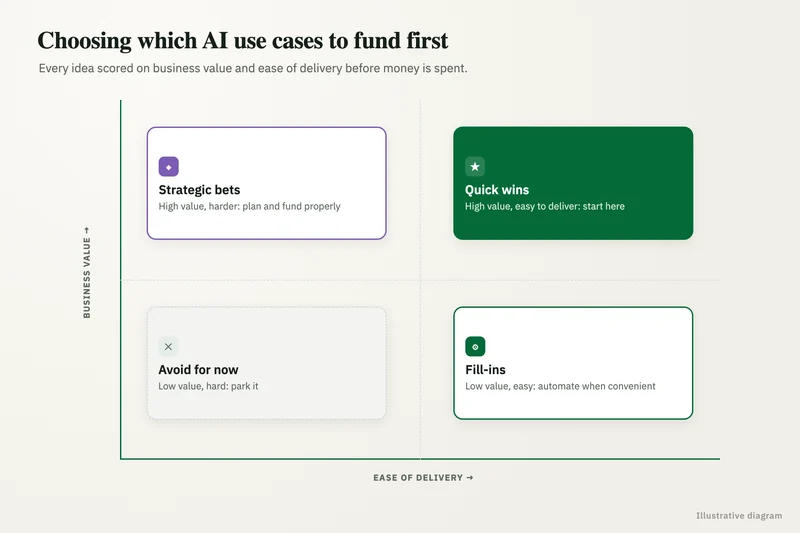
It is also the wrong starting point when you do not yet know which process to target. A business case written for a vague goal produces vague numbers. Start with a use-case shortlist ranked by value and ease, or a readiness assessment of your data and systems, then write one business case per selected use case. And if leadership has already decided to proceed for strategic reasons, write a shorter pilot charter with metrics and owners rather than a case built to justify a decision already made.
How we build AI business cases with clients
In our AI strategy consulting engagements, a business case is written for each use case on the roadmap. We measure the baseline with the process owner, get fixed quotes or usage-based estimates for every cost line, model the three scenarios with you and design the pilot so it tests the assumption the case depends on most. You keep the model and the document, and you own any accounts, code, prompts and data from the build.
Every phase is scoped after a free review and delivered at a fixed price. If you already have a draft AI business case, we can review it before it goes to your CFO or board and tell you plainly where the numbers are weak. Contact us at info@aiconsultingservicesusa.com.
Case study · Insurance brokerage, Australia
Automation and dashboarding
Policy data arrived as spreadsheets from several insurers, each in a different structure, and every client report took hours of manual cleanup. An automated pipeline that standardizes every insurer's file and feeds a single reporting dashboard.
- Report time cut from 4-5 hours to under 5 minutes
- Reporting accuracy up from about 75% to 99%

FAQ
Frequently asked questions
How long should an AI business case be?
Four to six pages plus a one-page summary is enough for most mid-size company decisions. The summary should state the decision requested, the expected payback, the worst-case loss and the pilot decision date. Detail on assumptions can sit in an appendix.
How do you calculate ROI for an AI business case?
Measure the current cost of the process, estimate the time or errors removed in three scenarios, subtract running costs to get a net monthly benefit, then divide the one-time cost by that figure for payback. Only count saved hours that will be redeployed. Our guide on measuring AI ROI covers the formulas in detail.
What is a realistic payback period for an AI project?
It depends on volume and how much of the saved time is used. In our illustrative customer service example, payback ranged from under five months to more than two and a half years across scenarios. A focused process with high volume and a measured baseline will usually show the clearest payback.
Should an AI business case ask for a pilot or the full budget?
Ask for a pilot first in most cases. A time-boxed pilot on real volume, with scale and stop rules agreed in advance, limits the loss if assumptions are wrong and gives finance measured numbers for the full decision.
Who should write the AI business case?
The business owner of the process should own it, with help from finance on costs and from IT or an outside adviser on the technical scope and running costs. A business case written only by a vendor or only by IT tends to miss either the operational reality or the cost detail.
What risks belong in an AI business case?
Include accuracy risk (wrong outputs), data risk (what information goes where), adoption risk (people not using it), vendor risk (pricing or product changes) and any compliance duties. For each, name the control, such as a human-review queue, a data-use rule, logging or a rollback plan.
Keep reading
Related pages
Get started
Tell us where AI should pay back
Describe the work that eats your team's time and the systems you run. We reply within one business day with the use cases we would test first, the risks to plan for and a fixed-price proposal.
- Free 30-minute AI review
- Fixed quote before any work starts
- Advice that is vendor-neutral, in plain English
Prefer email? info@aiconsultingservicesusa.com
Book a free AI review
Two lines is enough to start.