

Buyer guide
AI strategy workshop: what a good one covers, costs and produces
An AI strategy workshop is a structured session, usually half a day to two days, where a company's leadership team agrees which AI opportunities to pursue first, what they will cost and who owns them. This guide is for CEOs, COOs and department heads at US companies with 20 to 1,000 staff who are comparing workshop options. It covers formats and published prices, a sample agenda, the pre-work that makes the day useful and the written outputs you should insist on.
Book a free AI review
Two lines is enough. A specialist replies within one business day.
Executive summary
What happens in an AI strategy workshop?
In an AI strategy workshop, leaders review where time and money go in the business, list candidate AI use cases, score each on value, effort and risk, and pick two or three to pilot. A good workshop ends with a written roadmap naming owners, budgets, success measures and the governance rules for using AI tools.
What to take away
- Published prices range from about $1,000 a seat to $4,500 a day.
- Pre-work interviews and process data decide whether the day produces decisions.
- Demand a written roadmap with owners, budgets and measures within a week.
- A workshop is the wrong buy if no leader will own the follow-through.
What is an AI strategy workshop and who is it for?
An AI strategy workshop turns a scattered set of AI ideas into a short, ranked list the leadership team has agreed on. It is different from AI training. Training teaches people to use tools such as Copilot, ChatGPT or Gemini in their daily work. A strategy workshop decides where the company should spend money and attention, in what order and under what rules.
It suits companies in a few common situations: staff are already using AI tools informally and leaders want a plan before usage gets ahead of policy; several departments have pitched AI projects and there is no way to compare them; a board or owner has asked what the company's AI plan is; or a large vendor contract is on the table and leaders want to know what problem it is meant to solve.
The format works best with five to twelve senior people in the room. Smaller groups miss perspectives; larger ones turn into presentations rather than decisions.
How much does an AI strategy workshop cost?
Published prices vary with format, group size and how much work happens before and after the session. Most consulting firms do not list prices, so the figures below come from the providers that do. They are not our prices; we quote a fixed fee after a free review.
The key difference is between open-enrolment courses and private workshops. A course such as the one at Arizona State University's W. P. Carey School teaches frameworks to leaders from many companies; it does not produce a plan for yours. A private workshop is built around your processes, data and constraints, and its value depends on the pre-work and the written output, so compare what is delivered, not the hours in the room.
| Provider and format | Published price | Duration and group | Source |
|---|---|---|---|
| ASU W. P. Carey, AI and Digital Futures (open enrolment, in person) | $1,500 standard; $1,200 early bird | 1.5 days, 12 contact hours | W. P. Carey program page, Nov 2026 |
| Betra Works, Adopting AI for Leaders (open enrolment, in person, Kentucky) | $1,000 per seat | Half day, twelve seats | Event listing on Luma, Nov 2026 |
| chatgpt.ca, private half-day workshop (Canadian provider, remote) | $2,500 | 3.5 hours plus pre-work, up to 8 attendees | chatgpt.ca workshop page, Nov 2026 |
| chatgpt.ca, private full-day workshop | $4,500 | 6 to 7 hours, up to 12 attendees | chatgpt.ca workshop page, Nov 2026 |
| chatgpt.ca, workshop plus first build | From $6,500 | Workshop plus 2 to 4 weeks | chatgpt.ca workshop page, Nov 2026 |
| Pythian, AI Strategy Workshop for Executives (private) | Not published | 1 to 3 days | Pythian workshop page, Nov 2026 |
What should an AI strategy workshop agenda include?
A useful agenda moves from facts to options to decisions, and leaves time at the end to assign owners. Here is a sample for a one-day private workshop with eight leaders. A half-day version keeps the same order but arrives with use cases already shortlisted from the pre-work.
- 9:00 to 9:45, goals and constraints: what the business needs in the next 12 months (margin, capacity, response times, growth), the budget range and the risks leaders will not accept.
- 9:45 to 10:45, where the time goes: findings from pre-work interviews, showing the processes that consume the most hours, cause the most errors or slow customers down.
- 11:00 to 12:00, what AI can and cannot do here: short, specific demonstrations on the company's own document types and workflows, not generic vendor demos.
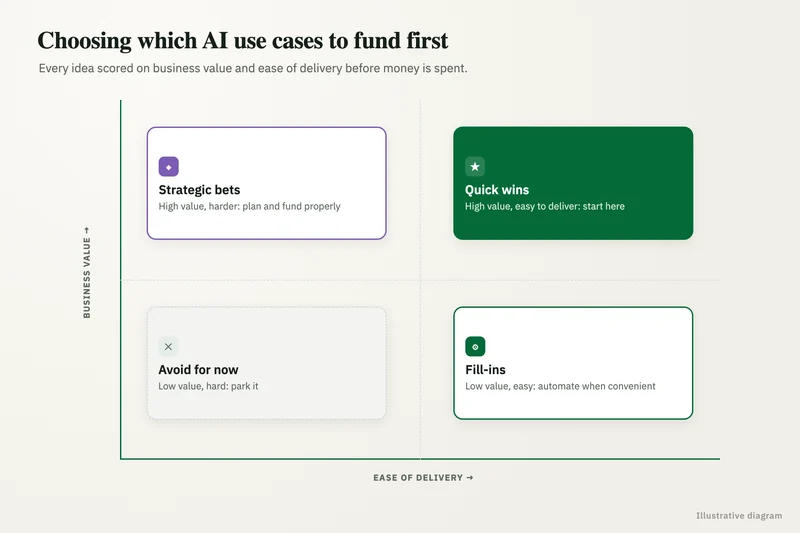
- 13:00 to 14:30, use-case scoring: each candidate scored on value, effort, data readiness and risk, then placed on a value and ease matrix.
- 14:45 to 15:45, buy, build or wait: for the top candidates, decide whether an existing tool covers it, a custom workflow is needed or it should wait until data or processes improve.
- 15:45 to 16:30, rules and owners: interim AI use rules for staff, an owner and success measure for each chosen pilot, and the date of the first review.
What pre-work makes the workshop worth the money?
Pre-work decides whether the day ends in decisions or a list of ideas. Without it, the first half of the workshop is spent discovering facts that a few interviews could have gathered in advance. The chatgpt.ca offer, for example, includes pre-work interviews in both its half-day and full-day prices, and Pythian lists a diagnostic readiness survey among its deliverables.
Ask any provider what they will collect before the session. A good answer includes 30 to 45 minute interviews with each department head, a short survey of how staff already use AI tools, samples of the documents and reports that consume the most time, and a list of the main systems (CRM, ERP, accounting, helpdesk, document storage) and who controls the data in each.
- Org chart and the names of the people attending, with their decision rights.
- Rough hours spent each week on the three to five most manual processes per department.
- Current AI subscriptions and any policy already in place.
- Systems list: for example HubSpot or Salesforce, NetSuite or QuickBooks, SharePoint or Google Drive, Zendesk.
- Known constraints: client contracts, HIPAA or financial regulations, data that cannot leave the US.
How are AI use cases scored in a workshop?
Scoring gives a room of senior people a shared way to compare ideas that come from different departments. A simple method works better than a complex one: score each candidate from one to five on four questions, multiply value by ease, and treat risk as a filter rather than a score.
Value asks how many hours, errors or lost sales the use case could remove each month, in numbers. Effort asks how many systems it touches and how much the process would need to change. Data readiness asks whether the inputs exist in a usable form today. Risk asks whether the output touches money, customers or regulated data, and if so, what human review it needs.
The result is usually a short list of quick wins (high value, low effort, low risk), one or two larger bets worth a scoped pilot, and a set of ideas parked until data or processes improve. Our guide to AI use cases for business lists common candidates by department if your team needs a starting point.
What outputs should you get from an AI strategy workshop?
The deliverable is a written document, not the slides from the day. Ask for it within a week, while decisions are fresh, and make sure it is specific enough that someone who missed the workshop could act on it.
- A ranked list of use cases with the scores and the reasons behind them.
- Two or three pilots, each with an owner, a success measure, a budget range and a decision date.
- A buy, build or wait recommendation for each pilot, naming the tools considered.
- Interim AI use rules for staff, covering approved tools and what data may not be entered.
- Open questions and the data or approvals needed to answer them.
- A 90-day calendar with the review points.
Workshop, readiness assessment or full strategy engagement?
These three purchases overlap, and choosing the wrong one wastes money. A workshop is the right choice when leaders need to align quickly and the company already has a reasonable sense of its processes and data. It is fast and relatively cheap, but it relies on what people in the room know.
An AI readiness assessment goes deeper on facts: it reviews systems, data quality, security and skills over several weeks and tells you what is possible before you choose. It is the better first step when nobody is sure whether the data can support AI at all.
A full AI strategy engagement combines both and adds business cases, vendor selection and a 12-month roadmap. It suits companies planning significant spend across several departments. Many companies start with a workshop and commission the deeper work only for the use cases the workshop selects.
| Option | Best when | Main output | Typical length |
|---|---|---|---|
| AI strategy workshop | Leaders need to agree priorities quickly | Ranked use cases, pilots and owners | Half day to two days plus pre-work |
| AI readiness assessment | Data and systems are an unknown | Readiness scores and gaps to fix | Several weeks |
| Full AI strategy engagement | Spend will span several departments | Business cases and 12-month roadmap | Several weeks to a few months |
When is an AI strategy workshop the wrong purchase?
Skip the workshop if no senior person will own the follow-through. Workshops produce energy and a document; without an owner with time and budget, both fade within a month. Name the owner before you book the session.
It is also the wrong buy when you already know the use case. If the problem is clear, such as month-end reporting that takes days or a support inbox that is always behind, a scoped pilot will teach you more than a day of discussion. And if the real need is skills, because leaders have agreed a direction but staff do not know how to use the tools, employee AI training is the better spend.
Finally, be wary of a free workshop offered by a vendor or builder. It is often a sales step designed to end in the build they sell. If you want an independent view, pay for the workshop as a separate deliverable you can take to any provider.
How we run AI strategy workshops
Our AI strategy workshops are part of our AI strategy consulting and run remotely in US time zones, with pre-work interviews, a session shaped around your own processes and systems, and a written roadmap delivered within a week. We quote a fixed price after a free review, and the roadmap is yours to take to any builder, including us if you choose.
Team members bring experience from top consulting firms, and because we also build AI systems, the effort and cost estimates in the roadmap are grounded in delivery rather than slides. If a smaller step would answer your question, such as a readiness assessment or a single pilot, we will recommend that instead.
FAQ
Frequently asked questions
How long is an AI strategy workshop?
Most run from a half day to two days, plus one to two weeks of pre-work interviews. Pythian lists its executive workshop at one to three days, while chatgpt.ca lists a 3.5-hour half-day and a 6 to 7 hour full-day option. Half-day formats work when use cases are shortlisted in advance.
Who should attend an AI strategy workshop?
The CEO or owner, the COO, finance and the heads of the departments with the most manual work, plus whoever runs IT or data. Five to twelve people is the useful range. Include at least one person who will own the follow-through.
Can an AI strategy workshop be run remotely?
Yes. Remote workshops work well when the session is split into shorter blocks, scoring is done in a shared document and pre-work is thorough. Several providers list remote formats, including the chatgpt.ca half-day option.
What is the difference between an AI workshop for executives and AI training?
An executive workshop decides priorities, budgets, owners and rules for AI across the company. Training teaches staff how to use approved tools in their daily work. Most companies need the workshop first and training after, so people learn on the use cases leaders chose.
Do we need clean data before an AI strategy workshop?
No. A workshop will surface where data is a blocker and park those use cases until it is fixed. If leaders suspect data is the main problem, an AI readiness assessment before or after the workshop gives a clearer picture.
What should we do in the 30 days after the workshop?
Publish the interim AI use rules, confirm owners and budgets for the chosen pilots, gather the sample data each pilot needs and set a review date. The first pilot should be scoped and started within a month, or momentum is usually lost.
Keep reading
Related pages
Get started
Tell us where AI should pay back
Describe the work that eats your team's time and the systems you run. We reply within one business day with the use cases we would test first, the risks to plan for and a fixed-price proposal.
- Free 30-minute AI review
- Fixed quote before any work starts
- Advice that is vendor-neutral, in plain English
Prefer email? info@aiconsultingservicesusa.com
Book a free AI review
Two lines is enough to start.