

Wealth management
AI consulting for wealth management: a 2026 guide for RIA owners and COOs
AI consulting for wealth management helps an RIA or wealth firm decide which advisor, operations and compliance tasks to give to AI, which vendor features to accept, and how to document every use so it holds up in an SEC exam. This guide is for US firms with roughly 5 to 150 advisors that are being pitched AI notetakers, CRM add-ons and planning tools and want an independent plan before they sign another contract.
Book a free AI review
Two lines is enough. A specialist replies within one business day.
Executive summary
What does AI consulting for wealth management include?
AI consulting for wealth management typically includes a map of advisor and operations workflows, an inventory of AI already inside your CRM, custodian, planning and archiving tools, a use-case list ranked by hours saved and compliance risk, an AI policy and vendor diligence pack that fits Regulation S-P, and one supervised pilot with a clear go or stop decision.
What to take away
- SEC examiners in 2026 are reviewing AI risk controls and the accuracy of firms' AI claims.
- Amended Regulation S-P now applies to every RIA, including vendor oversight for AI tools.
- Fund meeting notes and service tasks first; leave anything touching investment advice for last.
- An exam-ready AI file matters more than which model or notetaker you pick.
Why wealth management firms are hiring AI consultants in 2026
RIAs are bringing in outside help because AI is arriving faster than their compliance programs can absorb it. Advisors sign up for meeting notetakers on their own, CRM and planning vendors switch on AI features in routine updates, and clients start asking whether their data is going into ChatGPT. Most firms end up with several AI tools in use and no single list of them.
Spending is rising at the same time. Cerulli Associates' white paper on the state of wealth management AI adoption, published September 9, 2026 and based on 68 RIA firms representing about $1.2 trillion in assets, reports that AI-specific spend is projected to nearly double by the end of 2026, and that governance structure and data organization were the factors most closely tied to adoption progress. In other words, the firms moving fastest are not the ones with the most tools. They are the ones that decided who owns AI and cleaned up the data first.
That is the job of a short advisory engagement: decide what the firm will and will not use AI for, put the evidence in one file, and prove one use case on real work before buying more.
What SEC and FINRA rules apply to AI at an RIA?
There is no AI-specific rule for investment advisers. The SEC withdrew its proposed predictive data analytics rule on June 12, 2025, along with 13 other pending proposals. What applies instead is the existing framework: fiduciary duty, the marketing rule, books-and-records requirements, compliance policies and procedures, and the amended Regulation S-P.
Two developments make that framework bite. First, the SEC Division of Examinations released its 2026 priorities on November 17, 2025, and said it will pay particular attention to how firms identify and mitigate AI risks, review the accuracy of firms' statements about their AI capabilities and look at automated tools used in investment decisions. Second, amended Regulation S-P became mandatory for smaller advisers (under $1.5 billion in AUM) on June 3, 2026, after larger firms on December 3, 2025. It requires a written incident response program, oversight of service providers that hold customer information, notice from those providers within 72 hours of a breach, and customer notification within 30 days.
Every AI notetaker, CRM assistant or document reader that sees client data is a service provider under that rule. Dual registrants also answer to FINRA, whose Regulatory Notice 24-09 (June 27, 2024) says its rules are technology neutral and that supervision and communications rules apply to generative AI exactly as they do to any other tool. This is not legal advice; bring your CCO and counsel into any decision about client-facing or advice-related AI.
| Rule or action | Date | What it means for AI at a wealth firm |
|---|---|---|
| SEC settled AI-washing cases against Delphia and Global Predictions | March 18, 2024 | $400,000 in combined civil penalties for false or misleading claims about AI use; marketing claims must be accurate |
| FINRA Regulatory Notice 24-09 | June 27, 2024 | Supervision and communications rules apply to generative AI the same way they apply to any other technology |
| SEC withdraws predictive data analytics proposal | June 12, 2025 | No dedicated AI conflicts rule; fiduciary duty and existing rules carry the load |
| SEC 2026 examination priorities | Released November 17, 2025 | AI risk identification and mitigation, accuracy of AI representations and automated investment tools are review areas |
| Amended Regulation S-P, smaller advisers | Compliance by June 3, 2026 | Incident response program, service provider oversight, 72-hour vendor breach notice, 30-day customer notice |
What does AI consulting for wealth management include?
A useful engagement hands over decisions and documents first and a tested pilot second. When you compare proposals from AI consultants for wealth management firms, check which of these items each one will actually deliver.
- Workflow map: client meetings and follow-up, onboarding and account opening, money movement requests, quarterly reviews and reporting, financial plan updates, client service email, marketing review and compliance testing, each with monthly volume and staff hours.
- AI inventory: every AI feature in your CRM (Salesforce Financial Services Cloud, Redtail, Wealthbox), portfolio and reporting platform (Orion, Black Diamond, Addepar, Tamarac), planning software (eMoney, MoneyGuide), custodian portals, archiving tool and Microsoft 365 or Google Workspace, plus the tools advisors adopted on their own.
- Ranked use cases: each candidate scored on hours saved, client impact, effort and compliance risk, with simple workflow fixes separated from real AI work.
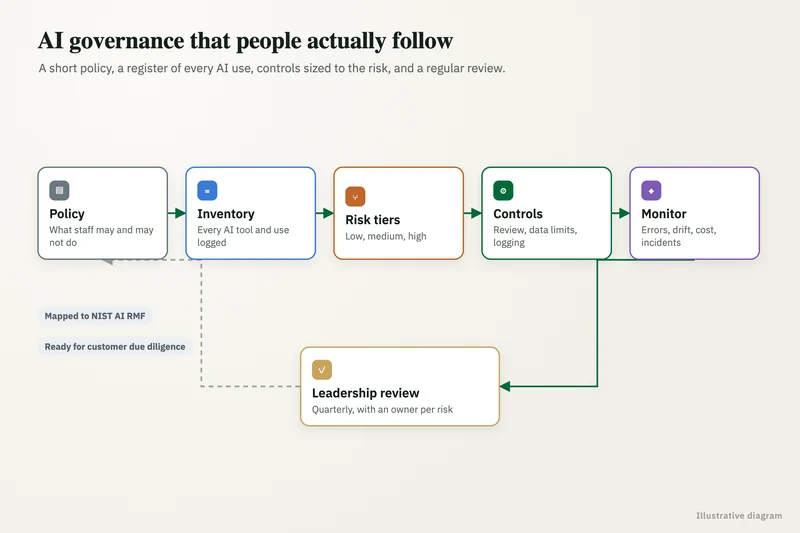
- AI policy and risk tiers: an acceptable-use policy that names approved tools and banned data, review rules by tier, and how AI use is reflected in the compliance manual and annual review, mapped to the NIST AI Risk Management Framework.
- Vendor diligence pack: questions, contract terms and monitoring steps for each AI vendor that touches client data, built to sit inside your Regulation S-P service provider oversight.
- One supervised pilot: a single use case run on real client work in the firm's own accounts, with an advisor or associate approving every output and a baseline measured before it starts.
- Exam-ready AI file: inventory, policy, diligence answers, pilot logs, training records and the exact wording of any AI claims in your marketing and Form ADV, in one place.
Which AI use cases should an RIA fund first?
Start with work an advisor or associate already reviews before anything reaches a client, move to service and operations next, and treat anything that shapes investment advice, suitability or trading as the last and most heavily tested step. Internal, reviewed tasks show results within a quarter and build the supervision habits examiners will look for.
This order is a default, and your volumes and existing contracts can change it.
| Use case | What AI does | Systems | Compliance risk | Order |
|---|---|---|---|---|
| Meeting notes and follow-up tasks | Drafts the meeting summary, action items and CRM notes for the advisor to correct and approve | Zoom or Teams, CRM, archiving | Medium: recording consent, retention of notes, client data at a vendor | First |
| Client service email drafts | Drafts replies to routine requests from the CRM record for staff to edit and send | Outlook or Gmail, CRM | Low to medium: staff approve every message; archiving applies | First |
| Onboarding and paperwork checks | Reads account forms and statements, flags missing signatures or fields before submission to the custodian | Custodian forms, document storage, CRM | Medium: KYC duties stay with staff | Second |
| Quarterly review prep | Pulls performance, cash flows and open tasks into a draft review agenda | Orion, Black Diamond, Addepar or Tamarac, CRM | Medium: figures must tie to the system of record | Second |
| Policy and procedure assistant | Answers staff questions from the compliance manual and procedures with a citation to the source | SharePoint or Google Drive | Low: staff read the source before acting | Second |
| Marketing and social content drafts | Drafts posts and newsletters for compliance review | Content tools, archiving, review workflow | Medium to high: marketing rule, testimonials, AI capability claims | Third |
| Financial plan narrative drafts | Turns planning software output into a plain-language summary for the advisor | eMoney or MoneyGuide, CRM | High: reads as advice; advisor owns every statement | Third |
| AI in portfolio or trading decisions | Suggests allocations, rebalancing or trades | Rebalancing and trading tools | Highest: fiduciary duty, conflicts, automated-tool exam focus | Last |
Worked example: sizing an AI meeting notes pilot
The figures below are assumptions for illustration, not a client result. Replace them with your own baseline before putting them in a business case.
Take a firm with 8 advisors who each hold about 40 client meetings a month, or 320 meetings in total. Today an advisor or associate spends about 30 minutes after each meeting writing notes, logging tasks in the CRM and drafting the follow-up email, which is 160 hours a month. If a pilot shows that reviewing and correcting an AI draft takes about 10 minutes, the total falls to roughly 53 hours, a saving of about 107 hours a month.
At an assumed blended cost of $60 an hour for advisor and associate time, 107 hours is worth about $6,400 a month. Running costs come off the top: notetaker seats for 8 advisors, any archiving add-on, and around 6 hours a month of compliance time spot-checking notes and testing retention. If those total $1,600 a month, the net is about $4,800 a month, or roughly $58,000 a year, before one-time consulting and setup.
Two tests decide whether that number is real. Measure the correction rate on live meetings for several weeks, because a draft that advisors rewrite half the time saves far less than a demo suggests. And decide in advance where the hours go, such as more review meetings per advisor or a later hire, or the saving will not show up anywhere you can point to.
How should an RIA vet AI vendors under Regulation S-P?
Treat every AI tool that touches client information as a service provider under your amended Regulation S-P program, and get written answers before the tool goes live. Store the answers in the vendor file your CCO already keeps.
- Which AI features are in our current plan, and which were turned on without our request?
- Will you notify us within 72 hours of a breach involving our clients' information, and is that in the contract?
- Is any client data or recording used to train or tune models for us or anyone else, and can we opt out in writing?
- Which model providers and subprocessors handle our data (OpenAI, Anthropic, Google, Microsoft, AWS or open-weight models), and where is it stored?
- How long are recordings, transcripts and drafts kept, and can they be deleted or sent to our archiving provider on our schedule?
- Can we export inputs, outputs, edits, approver names and timestamps if an examiner asks?
- How do we switch the feature off for one advisor or the whole firm, and what notice do we get before models, terms or prices change?
A 90-day AI plan for a wealth management firm
The first engagement should end with a decision, a budget and an AI file your CCO is comfortable showing an examiner. This is how we would sequence AI consulting for wealth management at a firm with no formal AI program, with the CCO and operations lead involved from week one.
| Weeks | Work | Approved at the end |
|---|---|---|
| 1-3 | Interview advisors, associates, operations, client service and compliance; collect volumes and hours; list every AI tool and vendor feature in use | AI inventory and 8-12 candidate use cases |
| 4-5 | Score candidates; draft the AI policy and review tiers; send diligence questions to CRM, reporting, planning and notetaker vendors | Ranked shortlist, draft policy, one pilot chosen |
| 6-7 | Measure the baseline (minutes per task, error rate, turnaround); set review rules and the pass mark | Baseline, success measure, fixed pilot budget |
| 8-11 | Run the pilot on live client work with a person approving every output; log corrections and time weekly | Weekly results against baseline |
| 12-13 | Model monthly running cost; update the compliance manual and procedures; assemble the AI file; brief the partners | Go, adjust or stop, plus a 12-month roadmap |
Independent AI consultant, tech vendor or compliance consultant?
Use an independent AI consultant when you need a plan across several vendors from someone with nothing to sell; let a tech vendor lead when the exact feature you need is already in your contract; use your outsourced compliance provider for policy wording, testing and mock exams; and keep work in-house only for narrow tasks one person can maintain. The first and third options often work well side by side.
| Option | Fits when | Risk to watch |
|---|---|---|
| Independent AI consultant | Several vendor pitches, mixed systems, a need for a ranked plan and governance the firm owns | Advice with no tested pilot; open hourly billing; quiet ties to one platform |
| CRM, reporting or notetaker vendor | The feature already exists in your edition and fits the workflow | Features switched on by default, unreviewed data terms, per-seat pricing that grows with headcount |
| Outsourced compliance consultant | You need the policy, procedures and testing to match SEC expectations | Strong on rules but may not assess workflows, data or running costs |
| In-house project | A capable operations lead with time and one narrow task | Key-person risk and unmaintained prompts when that person leaves |
Questions to ask before hiring an AI consultant for your RIA
Check that the firm understands advisory compliance and wealth tech, not only AI tools. For the broader vetting process, read our guide on how to choose an AI consulting firm. The questions below add the wealth management layer.
- How would you describe our AI use to an SEC examiner, and what would be in the file?
- How will you keep our marketing and Form ADV language about AI accurate?
- Which AI features in our current CRM, reporting and planning contracts would you turn on, and which would you leave off?
- How do recordings and AI drafts fit our books-and-records retention and archiving?
- What will the pilot cost per advisor per month to run after you leave?
- When you leave, does the firm keep every login, prompt, policy draft and audit log?
- Which of our ideas would you advise us not to fund?
When should a wealth firm not hire an AI consultant?
Skip it if you only need to approve one notetaker you have already chosen. A vendor diligence questionnaire, a policy update from your compliance provider and a four-week trial with a few advisors may be enough.
Wait if you are in the middle of a custodian transition, a CRM migration or a merger. Fields, forms and workflows are about to change, and AI work built around the old setup will need redoing.
And if the goal is simply safe use of Microsoft 365 Copilot or ChatGPT for writing, a short acceptable-use policy plus practical sessions through our AI training for employees can cover it without a wider program.
How Greenwolf Tech Labs approaches AI consulting for wealth management
We have no product to push: we do not resell a CRM, notetaker, planning tool or model, and no vendor pays us when you switch a feature on. Our team has built compliance trackers, reporting pipelines and data tools for regulated clients, and team members bring experience from top consulting firms.
Every engagement starts with a free review of your workflows, systems and vendor contracts, and each phase then gets its own fixed price. Your firm owns the accounts, prompts, policies and data, nothing an AI drafts reaches a client without a person approving it, and we model the monthly running cost before any pilot is approved. Third-party rate ranges for freelancers, agencies and large firms are collected in our AI consultant cost guide. If you also work with private equity owners, our private equity guide covers portfolio-level AI planning.
FAQ
Frequently asked questions
What is AI consulting for wealth management?
It is advisory work that helps an RIA or wealth firm decide where AI fits in advisor, operations and compliance work and how to supervise each use. A good engagement ends with an AI inventory, a ranked plan, vendor diligence, an updated policy and one use case tested on real client work.
Does the SEC have a rule on AI for investment advisers?
Not a dedicated one. The SEC withdrew its proposed predictive data analytics rule on June 12, 2025. Fiduciary duty, the marketing rule, books-and-records rules and amended Regulation S-P still apply, and the 2026 exam priorities name AI risk controls and AI claims as review areas.
Are AI notetakers allowed for financial advisors?
Firms do use them, but they need supervision. Recordings and notes may need to be retained and archived, clients may need to consent to recording depending on state law, and the vendor is a service provider under Regulation S-P. Check the setup with your CCO before rollout.
What is AI washing and why does it matter for RIAs?
AI washing means overstating how a firm uses AI. On March 18, 2024, the SEC settled charges against two advisers, Delphia and Global Predictions, for misleading AI claims, with $400,000 in combined penalties. Any AI language in your website, pitch decks or Form ADV should match what you actually do.
Does Regulation S-P apply to AI vendors?
Yes, when the vendor receives, maintains or processes customer information. Amended Regulation S-P requires oversight of those service providers, including notice within 72 hours of a breach. Smaller advisers, under $1.5 billion in AUM, had to comply by June 3, 2026.
What is the best first AI project for an RIA?
Usually meeting notes and follow-up tasks or client service email drafts, where an advisor or associate already approves every output. Volumes are steady, the time saved is easy to measure and no AI output reaches a client without review.
How much does AI consulting cost for a wealth management firm?
Price follows scope and the kind of firm you hire. A readiness review with one pilot costs far less than a firm-wide program at a large advisory firm. Our AI consultant cost guide collects third-party hourly and project ranges, and we quote a fixed price per phase after a free review.
Keep reading
Related pages
Get started
Tell us where AI should pay back
Describe the work that eats your team's time and the systems you run. We reply within one business day with the use cases we would test first, the risks to plan for and a fixed-price proposal.
- Free 30-minute AI review
- Fixed quote before any work starts
- Advice that is vendor-neutral, in plain English
Prefer email? info@aiconsultingservicesusa.com
Book a free AI review
Two lines is enough to start.