

Private equity
AI consulting for private equity: how to turn AI into value across a portfolio
AI consulting for private equity helps operating partners and portfolio company leaders pick the few AI use cases that move EBITDA inside the hold period, prove them in one company and repeat them across the fund. This guide is for operating partners, portfolio CEOs and CFOs at US mid-market companies who want a plan, a way to measure it and a clear view of what to buy from whom.
Book a free AI review
Two lines is enough. A specialist replies within one business day.
Executive summary
What does AI consulting for private equity include?
AI consulting for private equity usually covers three things: AI questions in due diligence, a 100-day AI plan for each portfolio company tied to the value creation plan, and a repeatable playbook that rolls proven use cases across the fund. Good advisers also set up portfolio-wide governance and a way to report AI value the investment committee can trust.
What to take away
- Start with one portfolio company and one EBITDA lever, then reuse the pattern across the fund.
- Back-office work such as finance close, reporting and procurement repeats across most portfolio companies.
- Baseline the metric before anything is built, or the value claim will not survive exit diligence.
- Portfolio-wide AI governance is a gap: few PE leaders feel ready for an AI audit.
Why private equity firms are buying AI consulting now
Private equity firms are buying AI consulting because AI has moved from a diligence talking point to a value creation lever that limited partners and buyers now ask about. The hold period puts a clock on it: a use case that pays back in year four helps the exit story, one that is still a pilot at exit does not.
Outside help is the default route. L.E.K. Consulting's PE Pulse 2026, a survey of 100 US buyout professionals published in July 2026, found that 68% rely on external advisors to support value creation initiatives. Model vendors have noticed. In May 2026 OpenAI launched The Deployment Company with $4 billion from 19 investors, led by TPG with Advent, Bain Capital and Brookfield, to send engineering teams into businesses including the portfolio companies of those firms, as CIO Dive reported.
That raises a practical question for every operating partner: which part of the AI work should a fund buy from a model vendor's team, which from a consulting firm, and which should the portfolio company own? The rest of this guide answers it from the portfolio company's side of the table.
What does AI consulting for private equity include?
AI consulting for private equity covers work at two levels: the fund and the individual portfolio company. A useful engagement names which level each deliverable serves, because fund-level slide decks rarely change how an accounts payable team works on Monday morning.
- Pre-deal AI diligence: test the target's AI claims, data quality and exposure to AI-driven disruption, and flag what the first 100 days should fix.
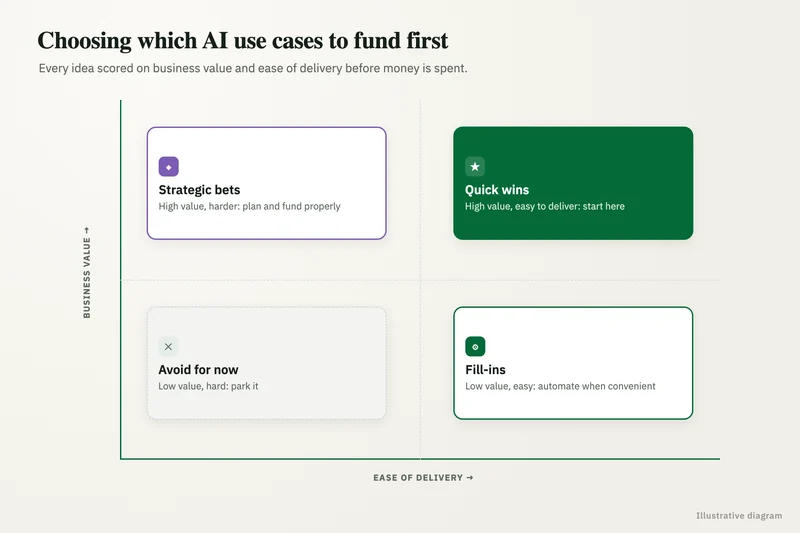
- Portfolio company AI assessment: map processes, systems and data in one company and rank use cases by EBITDA impact and ease.
- 100-day AI plan: one or two use cases tied to lines in the value creation plan, with owners, budgets and a baseline.
- Cross-portfolio playbook: turn a proven use case into a template other companies can adopt, with shared vendor terms and prompts.
- Governance: an AI use policy, a register of AI systems and review rules that work across companies of different sizes.
- Value reporting: a method for counting AI savings and revenue that holds up with the investment committee and with buyers at exit.
A 100-day AI plan for a portfolio company
A 100-day AI plan works best when it targets one measurable process and ends with a working system on real transactions, not a strategy document. The sequence below is how we would run it for a typical US portfolio company with 100 to 500 staff.
| Days | Work | Output the board sees |
|---|---|---|
| 1-15 | Interview the CEO, CFO and process owners; inventory systems (ERP, CRM, document stores) and existing AI tools and licences | Short list of 5-10 candidate use cases with rough value and effort |
| 16-30 | Pick one or two use cases; measure the baseline (hours, cycle time, error rate, cost per transaction); check data access and privacy constraints | Signed-off baseline and a fixed budget for the pilot |
| 31-75 | Build or configure the pilot in the company's own accounts; run it on live work with people reviewing every output | Weekly numbers against the baseline |
| 76-90 | Decide go, fix or stop; write the operating procedure, review rules and monthly running cost | Go or stop decision with evidence |
| 91-100 | Package what worked as a template for the next portfolio company | Playbook entry the operating team can reuse |
Which AI use cases repeat across portfolio companies?
The use cases that travel best across a portfolio are back-office processes that look similar in every company regardless of industry. Customer-facing AI and industry-specific models can pay off too, but they are harder to copy from one company to the next.
The repeatable ones share three traits: high volume, structured inputs such as invoices, spreadsheets or emails, and a clear before-and-after metric. The table shows the usual candidates and the systems they touch.
| Use case | Typical systems | Metric to baseline |
|---|---|---|
| Monthly reporting and board packs | NetSuite, QuickBooks, Excel, Power BI | Hours to produce the pack, error count |
| Accounts payable and invoice capture | ERP, shared inbox, document store | Cost per invoice, exceptions per 100 |
| Procurement and supplier research | Spreadsheets, supplier databases, email | Hours per sourcing request |
| Sales follow-up and CRM hygiene | HubSpot, Salesforce | Response time, share of leads followed up |
| Customer service triage | Zendesk, shared inbox | First response time, tickets per agent |
| Internal knowledge search | SharePoint, Google Drive | Time to answer common staff questions |
How to measure and report AI value to the investment committee
Report AI value as a change against a measured baseline, converted into money with assumptions the CFO signs, and net of running costs. Anything else will be discounted, first by the investment committee and later by the buyer's diligence team.
In practice that means four rules. Measure the baseline before the build, on the same volume of work. Separate hours freed from cost removed: freed hours only become EBITDA if headcount, overtime or contractor spend actually changes, or if the time goes to work that earns revenue. Subtract model usage, platform fees and the staff time spent reviewing outputs. Keep diligence-stage estimates in a separate column from post-close results, so nobody mistakes a thesis for a delivered number.
A worked example shows the shape. Suppose a portfolio company's finance team spends a fixed number of hours each month building the board pack by hand. If an automated pipeline cuts that to minutes, the defensible claim is the hours removed multiplied by the loaded hourly cost, minus the monthly running cost, and only counted as EBITDA once the team's overtime or contractor spend falls. One of our case studies, for an insurance brokerage, cut report preparation from 4 to 5 hours to under 5 minutes and lifted reporting accuracy from about 75% to 99%; the accuracy gain mattered as much to management as the time.
What AI questions belong in private equity due diligence?
AI due diligence for private equity should test two things: whether the target's own AI claims are real, and whether AI changes the target's market or cost base during the hold. When a target describes itself as AI-enabled, the burden of proof belongs with management.
- Which AI features or tools are live in production today, and how many customers or staff use them each week?
- Who owns the models, prompts, data and vendor accounts, and can the contracts transfer on a change of control?
- What customer, employee or health data flows to outside AI vendors, under what terms, and is there a Business Associate Agreement where HIPAA applies?
- Does the company use AI in hiring, lending, insurance, housing or healthcare decisions that new state laws, such as Colorado's SB 26-189 from January 1, 2027, will cover?
- Which of the target's services could a customer replace with an AI tool, and how fast?
- What would it cost to bring the target's reporting and back office up to the portfolio's AI playbook?
How to govern AI across a whole portfolio
Portfolio AI governance should set a common floor for every company and leave the detail to each management team. A fund-wide floor usually covers an approved tools list, rules on what data may go into which tools, a register of AI systems in use, human review for anything touching money, customers or regulated data, and a named owner per company.
This is a weak spot today. Grant Thornton's 2026 private equity AI impact survey found only 9% of private equity leaders very confident they could pass an AI governance audit within 90 days, against 22% across industries. The NIST AI Risk Management Framework, with its Govern, Map, Measure and Manage functions, is a sensible common structure because it is voluntary, US-based and scales down to a 50-person company. Portfolio companies that sell into the EU should also check the EU AI Act transparency duties that applied from August 2, 2026. This is not legal advice; involve counsel for any company in a regulated sector.
Who should a PE firm hire: strategy firm, specialist boutique, vendor team or fractional CAIO?
Hire by the job, not the brand. Each provider type is strong at a different part of the work, and many funds use more than one.
| Provider | Best for | Watch for |
|---|---|---|
| Large strategy firm or Big Four | Fund-wide AI thesis, large platform companies, board-level credibility | Price, junior delivery teams, little hands-on build |
| Model vendor deployment team (for example OpenAI's Deployment Company) | Companies already committed to that vendor's platform | One vendor's tools by default; independence on model choice |
| Specialist AI consulting firm | Mid-market portfolio companies that need a plan and a working pilot at a fixed price | Depth in your industry; ask for named systems they have integrated |
| Fractional Chief AI Officer | Ongoing AI leadership across several companies without a full-time hire | Hours per month and who actually does the build |
| In-house hire at the portfolio company | Large companies with a long hold and steady AI workload | Time to hire and retention in a small team |
When not to buy AI consulting for a portfolio company
Skip or delay AI consulting when the basics are not in place. If the company is mid-way through an ERP migration, has no reliable monthly close or is about to be merged into an add-on platform, AI work will be rebuilt within a year. Fix the systems first.
Also hold off when the exit is less than a year away and no use case can show a measured result before the data room opens, or when the only goal is to put the word AI in the teaser. A buyer's diligence team can ask for usage and cost data, and a pilot with no numbers can hurt more than it helps.
Finally, do not pay for a fund-wide strategy before one portfolio company has a working result. A proven use case in one company is a far better starting point for a playbook than a ranked list of ideas.
How Greenwolf Tech Labs works with private equity owners
We work with portfolio company leadership on behalf of the owner, starting with a free review and a fixed price for each phase. The first phase is usually an AI readiness assessment of one company, followed by a fixed-price pilot on the highest-value use case and a playbook entry the operating team can reuse elsewhere. The company owns every account, prompt, workflow and piece of code, so nothing is lost at exit.
We advise on strategy and model choice independently of any single AI vendor, and we can build what we recommend: reporting pipelines, document extraction, supplier research tools and CRM automation. For funds that want continuity across several companies, a fractional Chief AI Officer arrangement gives one accountable lead without a full-time hire.
Case study · Insurance brokerage, Australia
Automation and dashboarding
Policy data arrived as spreadsheets from several insurers, each in a different structure, and every client report took hours of manual cleanup. An automated pipeline that standardizes every insurer's file and feeds a single reporting dashboard.
- Report time cut from 4-5 hours to under 5 minutes
- Reporting accuracy up from about 75% to 99%

FAQ
Frequently asked questions
How do private equity firms use AI in portfolio companies?
Most start with back-office work that repeats across companies: monthly reporting, invoice processing, procurement research, CRM follow-up and customer service triage. The common pattern is to prove one use case in one company, measure it against a baseline and then roll it out to the rest of the portfolio.
Do private equity firms hire outside AI consultants?
Most do. L.E.K. Consulting's PE Pulse 2026 survey of 100 US buyout professionals found 68% rely on external advisors for value creation initiatives. Many funds combine an outside firm for the plan and first pilot with an internal owner at each portfolio company.
What is the OpenAI Deployment Company?
It is a standalone business OpenAI launched in May 2026 with $4 billion from 19 investors led by TPG, with Advent, Bain Capital and Brookfield, according to CIO Dive. It sends engineering teams into companies to put OpenAI's tools into their workflows, including portfolio companies of its backers. It suits companies already committed to OpenAI, while independent advisers help when model choice is still open.
How long does an AI project take in a portfolio company?
A focused first use case can usually go from assessment to a measured pilot in about 100 days if data access is sorted early. Rolling the same use case into further portfolio companies is normally faster, because the design, prompts and vendor terms already exist.
How much does AI consulting for private equity cost?
It depends on scope: a single portfolio company assessment and pilot costs far less than a fund-wide programme. Published third-party rates by firm type are collected in our AI consultant cost guide. We quote a fixed price per phase after a free review.
Should AI savings be counted as EBITDA?
Only when they change cost or revenue. Hours freed by AI become EBITDA when overtime, contractor spend or hiring falls, or when the time goes to revenue-earning work. Report hours saved and cost removed separately, net of running costs.
What is an AI operating partner?
An AI operating partner is a person at the fund, or an outside adviser, who owns AI value creation across the portfolio. They set the playbook and governance floor, choose shared vendors and track results by company. Some funds fill the role with a fractional Chief AI Officer.
Keep reading
Related pages
Get started
Tell us where AI should pay back
Describe the work that eats your team's time and the systems you run. We reply within one business day with the use cases we would test first, the risks to plan for and a fixed-price proposal.
- Free 30-minute AI review
- Fixed quote before any work starts
- Advice that is vendor-neutral, in plain English
Prefer email? info@aiconsultingservicesusa.com
Book a free AI review
Two lines is enough to start.