

Startup guide
AI consulting for startups: when it pays, what to buy and what to skip
AI consulting for startups is worth paying for when a founder needs a specific AI decision made or a system shipped faster than the team can learn to do it, and it is wasted when it replaces finding product-market fit. This guide is for founders and operators at seed to Series B companies in the US. It covers which startups need outside AI help, how a consultant compares with a first ML hire, what to scope at each stage and the contract terms investors will look at later.
Book a free AI review
Two lines is enough. A specialist replies within one business day.
Executive summary
Do startups need an AI consultant?
Most startups do not need an AI consultant before they have paying customers. AI consulting for startups pays off at two points: when AI is becoming part of the product and the team must choose models, architecture and data handling it cannot easily reverse, and when growth makes manual operations the bottleneck. In both cases buy a short, fixed scope with clear deliverables.
What to take away
- AI-native startups need architecture and evaluation help; others need operations and tool choices.
- A two to six week fixed scope usually beats a retainer before Series A.
- Own every account, prompt, eval set and line of code so diligence stays clean.
- Cloud credit programs can cover early model costs; plan for the month they expire.
What does AI consulting for startups actually cover?
AI consulting for startups covers three kinds of work: product decisions for companies building AI into what they sell, operations decisions for companies that want AI to do internal work, and governance basics that customers and investors will ask about. A good engagement picks one of these, not all three.
For product work, a consultant helps choose between OpenAI, Claude, Gemini, Amazon Bedrock or open-weight models, designs retrieval over customer data, sets up an evaluation set so quality can be measured release to release, and estimates the model cost per user or per task. For operations work, the focus moves to support, sales follow-up, onboarding, finance admin and reporting, where workflow tools such as n8n, Make or Zapier connect AI steps to HubSpot, Salesforce, Zendesk or QuickBooks. Governance work at a startup is lighter than at an enterprise: a short acceptable-use policy, a data map showing what goes to which vendor, and answers ready for enterprise security questionnaires.
What it should not cover is building your core product for you indefinitely. If the AI is the product, the knowledge has to live inside the company by the time you raise your next round.
Which startups need an AI consultant, and which do not?
The deciding factor is not funding stage but whether a wrong AI decision would be expensive to undo. Use the table below to place your company.
| Your situation | Do you need outside AI help? | What to buy |
|---|---|---|
| Pre-product, still testing demand | Usually no | Use off-the-shelf tools; revisit after paying customers |
| AI is the product, no one on the team has shipped an AI system to production | Yes | Architecture review, model choice, eval set, cost-per-user model |
| AI is the product, strong ML lead already hired | Rarely | A one-off second opinion before a major architecture change |
| Traditional SaaS or services company, ops strained by growth | Often | Use-case selection and a fixed-scope build of one workflow |
| Selling to enterprises that send AI security questionnaires | Often | Data map, AI policy, vendor terms review |
| Raising a round where AI is central to the pitch | Sometimes | Technical diligence preparation and a written roadmap |
AI consultant vs first ML hire vs fractional AI lead
For a startup the real comparison is not consultant versus nothing; it is consultant versus a full-time hire versus a part-time senior leader. Each solves a different problem.
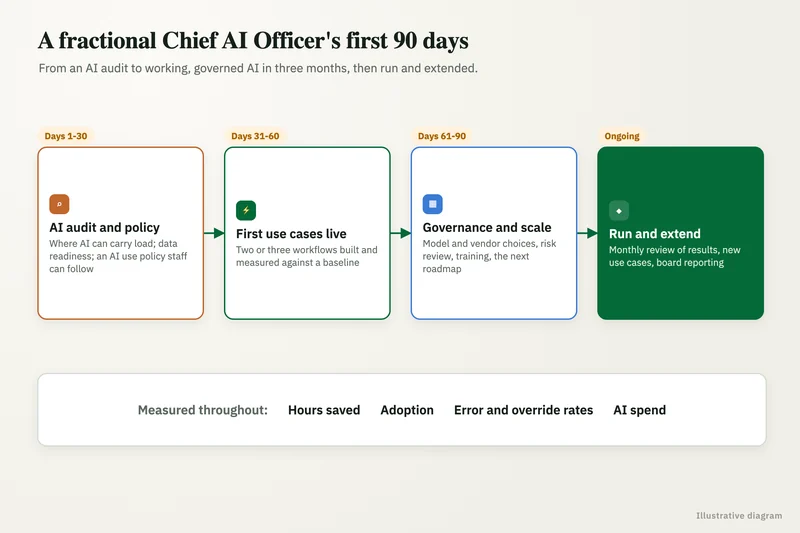
A full-time ML or AI engineer is the right call when AI is the core of the product and you will be iterating on it every week for years. The cost is salary, equity and a hiring process that often takes months, plus the risk that a first hire makes unreviewed architecture choices alone. A consultant is the right call for a bounded decision or build: choose the stack, ship the first version, set up evals, hand it over. A fractional Chief AI Officer sits between the two, giving a few days a month of senior judgement across product, vendors, policy and hiring, which suits companies that are hiring their first AI engineers and want someone to interview them and review their work.
Many startups use these in sequence: a short consulting scope to make the first decisions, a fractional lead through the first hires, then an internal head of AI once the team is large enough to need one. For published market rates for each option, see our AI consultant cost guide rather than relying on anecdotes from founder forums.
- Hire full-time when AI work will be continuous and central for the next two or more years.
- Use a consultant when the question has an end point: a decision, a first build or a review.
- Use a fractional AI lead when you need senior judgement weekly but not a full-time executive.
- Do it yourself when the use case is covered by a tool you already pay for, such as ChatGPT Team, Microsoft 365 Copilot or Google Workspace AI features.
What should an AI consulting engagement look like at each stage?
Scope should grow with the company. A pre-seed team needs a decision; a Series B team needs a system that survives scale and audits.
- Pre-seed and seed: a two to three week review that answers one question, such as which model provider and architecture to use for the first version, with a written cost-per-user estimate and an evaluation set of 50 to 200 real examples.
- Seed to Series A: one fixed-scope build, such as retrieval over customer documents with citations or an internal support workflow, delivered in your own accounts with handover documentation and a short training session.
- Series A to Series B: a roadmap across product and operations, an AI policy and data map for enterprise buyers, model cost controls (per-task caps, logging, fallbacks) and interview support for the first dedicated AI hires.
- Any stage: a pre-fundraise review that checks code ownership, data rights, vendor terms and whether the AI claims in the deck match what the system does.
What do investors ask about AI during diligence?
Investors increasingly test whether a startup's AI is defensible and whether the company actually owns it. A consultant's work should make these answers easy, not harder.
Expect questions about which model vendors you depend on and what happens if one raises prices or changes terms, whether customer data is used for training and under what contract, how you measure output quality and catch regressions, what the gross margin looks like once model costs are included, and who wrote the code. The last one matters more than founders expect. If a contractor built the core system under an agreement without a clear IP assignment, that becomes a diligence issue to fix before closing.
This is also where honest claims matter. Calling a product an agent when it is a single prompt behind a form invites hard questions. Gartner warned in June 2025 about agent washing and predicted that over 40% of agentic AI projects will be canceled by the end of 2027 due to cost, unclear value or weak risk controls. Investors read the same reports.
How can startups keep AI costs down?
The biggest saving is a narrow first scope. One workflow or one product feature, defined with real examples before the consultant starts, removes weeks of billable discovery. The second saving is reusing tools you already pay for before buying new ones.
Cloud credit programs can also cover early model and infrastructure costs. AWS lists up to $200,000 in Activate credits for pre-Series B startups founded in the last ten years, applicable to Amazon Bedrock, and up to $5,000 on its self-funded Founders tier (AWS Activate page, checked November 2026). Google and Microsoft run their own startup programs with different tiers and conditions, so check current terms directly. Credits shape architecture choices, which is reasonable, but model the cost per user at full price too. Credits expire, and a product whose margin only works on credits has a problem waiting for it.
Finally, keep everything in your own accounts. Paying a consultant's markup on API usage or platform fees adds cost every month, and moving systems out of someone else's account later is slow and risky.
Which contract terms should a startup insist on?
Startups have less negotiating power than enterprises but more to lose from bad terms, because the AI work may become core intellectual property. Ask for these in writing before any work starts.
- Full assignment of IP in code, prompts, evaluation sets, workflows and documentation to your company on payment.
- All model, cloud and workflow accounts opened in your company's name, with the consultant added as a user you can remove.
- No use of your data or customer data to train anyone's models, with vendor tiers chosen to match.
- A fixed price per phase, a written list of deliverables and a clear definition of what counts as a change.
- A handover session and written runbook so your team can operate the system without the consultant.
- A short notice period and no long minimum term before product-market fit.
Common mistakes startups make with AI consultants
Most failed startup AI engagements fail for the same handful of reasons, and almost none of them are about model quality.
- Hiring before there is a clear question, so the consultant spends the budget discovering what the founders meant.
- Skipping the evaluation set, which leaves the team arguing about whether the AI is good instead of measuring it.
- Letting the consultant become the only person who understands the system, then facing a crisis when they leave.
- Building custom what a mature product already does well, such as general meeting notes or basic support deflection.
- Ignoring the cost per user until the first large customer arrives and margins collapse.
- Treating a demo as a product: no logging, no fallback when the model fails and no human review where outputs reach customers.
When should a startup not hire an AI consultant?
Do not hire one to find your product-market fit, to write an AI strategy deck with no build attached, or to evaluate tools your team could trial in an afternoon. Do not hire one when you already have a strong AI lead who simply needs more engineers; hire the engineers. And do not sign a monthly retainer before you can name the decisions it will help you make.
There is evidence that outside help improves results when the scope is right. MIT NANDA reported in 2025 that AI projects bought from or built with specialist partners succeeded about 67% of the time versus about 33% for internal builds. The lesson for founders is not to outsource everything; it is to bring in experience for the decisions you will make once and live with for years.
How we work with startups
Greenwolf Tech Labs works remotely with US companies in US time zones, and our team brings 8+ years of experience and 100+ delivered projects across strategy, automation and AI builds. For startups we start with a free review of what you are building and where AI fits, then quote a fixed price for a narrow first phase with written deliverables. You own the accounts, code, prompts and data from day one, and a person stays in the loop anywhere outputs touch money, customers or regulated data.
If you need ongoing senior guidance rather than a project, our fractional Chief AI Officer service covers vendor choices, policy, hiring support and roadmap reviews on a part-time basis. Contact us at info@aiconsultingservicesusa.com to book the free review.
FAQ
Frequently asked questions
When should a startup hire an AI consultant?
Hire one when you face an AI decision that is expensive to reverse, such as model choice or architecture for an AI product, or when growth makes a manual process the bottleneck. Before you have paying customers, off-the-shelf tools are usually enough.
Is it better to hire an AI engineer or an AI consultant?
Hire an engineer when AI work will be continuous and central to the product for years. Use a consultant for bounded work with an end point, such as choosing a stack, shipping a first version or preparing for diligence. Many startups do the consulting scope first, then hire.
How much does AI consulting cost for a startup?
Cost depends on firm type and scope more than on company stage. Our AI consultant cost guide collects published third-party rates by provider type. For startups, a short fixed-price phase is usually better value than an open hourly arrangement or a retainer.
Who owns the code and IP when a consultant builds our AI?
You should, but only if the contract says so. Insist on full assignment of code, prompts, evaluation sets and documentation on payment, and keep all model and cloud accounts in your company's name. Missing IP assignment is a common diligence issue.
Can startup cloud credits pay for AI model usage?
Often yes. AWS states its Activate credits apply to Amazon Bedrock, with up to $200,000 for eligible pre-Series B startups. Google and Microsoft run their own programs, so check current terms, and always model costs at full price for when credits expire.
What is a fractional Chief AI Officer for a startup?
It is a senior AI leader who works a few days a month across product, vendors, policy and hiring. It suits startups hiring their first AI engineers that need experienced judgement without a full-time executive salary.
Do AI startups need an AI policy?
Yes, once you sell to larger companies. Enterprise buyers send security questionnaires asking how AI uses their data, which vendors you rely on and how outputs are reviewed. A short policy and data map answers most of them and takes days, not months.
Keep reading
Related pages
Get started
Tell us where AI should pay back
Describe the work that eats your team's time and the systems you run. We reply within one business day with the use cases we would test first, the risks to plan for and a fixed-price proposal.
- Free 30-minute AI review
- Fixed quote before any work starts
- Advice that is vendor-neutral, in plain English
Prefer email? info@aiconsultingservicesusa.com
Book a free AI review
Two lines is enough to start.