

Retail AI guide
AI consulting for retail: what store-based chains should fix first, and what to leave alone
AI consulting for retail is advisory work that picks the store, merchandising and back-office tasks worth handing to AI, checks what your POS, ERP and scheduling vendors already include, and proves the result in a few stores before a chain-wide rollout. This guide is for owners, COOs and operations leaders at US regional and specialty retailers with roughly 5 to 150 stores who are pitched AI tools every week and want a plan that pays back.
Book a free AI review
Two lines is enough. A specialist replies within one business day.
Executive summary
What does AI consulting for retail include?
AI consulting for retail covers an audit of how staff already use AI, a ranked list of store and head-office workflows by hours saved and risk, a check of what your POS, ERP and workforce tools already offer, a build or buy decision for each workflow, rules for customer and employee data, and a measured pilot in a few stores.
What to take away
- Store manager admin and head-office reporting usually pay back before customer-facing AI.
- Check what your POS, ERP and scheduling vendors already include before paying for custom work.
- Pilot in three to five stores with a baseline, then roll out on numbers.
- Facial recognition and AI hiring tools carry real legal risk in US stores.
What does AI consulting for retail actually cover?
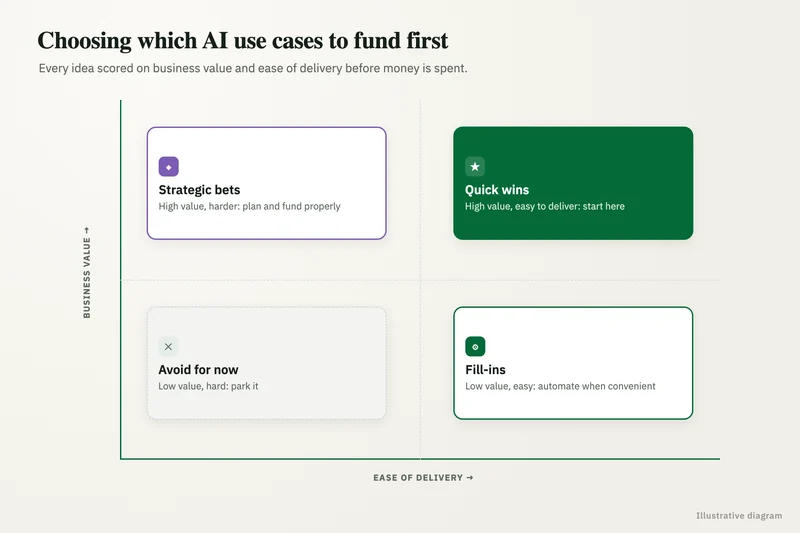
Good AI consulting for retail turns "we need an AI plan" into a short list of workflows, a tool decision for each and a way to measure results in real stores. The work is advisory first. Building assistants, reporting pipelines or vendor data tools comes later, and only for the workflows that earn it on numbers.
A complete engagement covers six pieces of work, each ending in a document or decision your team keeps.
- Current-use audit: which store managers, buyers and head-office staff already use ChatGPT, Claude, Gemini or Copilot, for what, and with which data.
- Workflow ranking: store, merchandising, supply and support tasks scored by hours spent, money at stake and customer or employee risk.
- Vendor check: what your POS, ERP, workforce management and loyalty platforms already include or have on their roadmap, so you do not pay twice.
- Build or buy decision for each workflow, with running costs per month.
- Data and policy rules: what customer, payment and employee data may go into which tools, and where a person must review output.
- Pilot design: which stores, which baseline, which measures and who decides on rollout.
Why are retailers hiring AI consultants in 2026?
Retail is behind other sectors, and the gap is mostly skills, not interest. The US Census Bureau's Business Trends and Outlook Survey found that about 14% of retail trade businesses used AI in the period to May 2026, against 17% to 20% across all US firms and 39.7% in the information sector. Larger grocers are moving faster: FMI's "The Food Retailing Industry Speaks 2026" report, released in July 2026, found 68% of food retailers surveyed use AI, up from 47% in 2025.
The constraint most retailers name is expertise. In the IBM Institute for Business Value study run with the National Retail Federation and published in January 2026, 51% of retail executives cited limited internal AI expertise. For a regional chain, that usually means nobody owns the question full-time, vendors each pitch their own AI add-on, and store managers are already pasting sales reports and staff schedules into personal AI accounts. An outside adviser earns a fee by sorting that into a plan, not by adding more tools.
Which retail workflows pay back first?
Start where hours are lost every week and a mistake is cheap to catch. For most store-based retailers that is store manager admin, head-office reporting and vendor paperwork, not customer-facing chat or dynamic pricing. The table ranks common candidates for a 5 to 150 store chain; your order will differ, which is the point of the assessment.
| Workflow | Systems involved | Typical approach | Risk if wrong |
|---|---|---|---|
| Weekly store and category sales commentary | POS, ERP, spreadsheets | Automated report with AI-written summary, reviewed by a planner | Low |
| Store associate answers on policy, returns and procedures | SharePoint or Google Drive SOPs, intranet | Assistant grounded in your documents, with citations | Low to medium |
| Vendor invoices, packing lists and cost changes | ERP, email, EDI or PDFs | Document extraction with a human-review queue for mismatches | Medium |
| Product data and descriptions for new SKUs | ERP or PIM, supplier spec sheets | AI drafts, merchandiser approves | Low |
| Phone questions on hours, stock and order pickup | Phone system, inventory lookup | AI receptionist with transfer to the store | Medium |
| Labor scheduling against forecast traffic | Workforce management tool, POS | Use the vendor's built-in forecasting first | Medium |
| Markdown and pricing recommendations | Merchandise planning, POS history | Buy a specialist tool only after data is clean | High |
How is AI for retail stores different from AI for ecommerce?
Store-based retail adds people, places and physical inventory that pure online brands do not have. The users are store managers and associates on shared devices and short shifts, so tools must work on a phone or a back-office PC in under a minute, with almost no training time. Data is spread across POS, a separate ecommerce platform, workforce tools and spreadsheets kept by district managers, so most projects start by joining store-level data that has never been in one place.
Rollout is also physical. A pilot has to run in a few stores that are representative of the chain (a high-volume store, a typical one and a small one), and success depends on district managers as much as on head office. If most of your revenue is online through Shopify or a similar platform, our guide to AI for ecommerce covers the online-first case instead.
Which systems does a retail AI project touch?
Name your systems before any AI conversation, because most retail AI value comes from connecting data that already exists. A typical mid-size chain runs a POS (Square, Lightspeed, Shopify POS or NCR Voyix are common), an ERP or accounting system such as NetSuite or Microsoft Dynamics 365 Business Central, a workforce management or scheduling tool, a loyalty or email platform such as Klaviyo, and a shared drive where store procedures live. Many also run a separate merchandise planning tool and an ecommerce platform.
Each of these vendors now sells AI features. Part of the consultant's job is to list what you already own, what is included in your current plan, what costs extra, and what overlaps. A retailer that buys a separate AI forecasting tool when its scheduling platform already forecasts traffic has paid twice for the same answer. The reverse also happens: a built-in feature that cannot see data from your other systems may be weaker than a small custom connection.
Worked example: a 30-store specialty retailer
The figures here are illustrative, to show how to size a pilot, not results from a client. A 30-store specialty chain has one district manager per ten stores and a four-person head office. Store managers spend Monday mornings pulling last week's sales from the POS into a spreadsheet and writing a short commentary for their district manager, about 90 minutes each. Head office then spends most of Tuesday combining 30 commentaries into one report.
The assessment ranks this first: high hours, low risk and data that already exists. The design pulls POS data into one weekly table, has an AI model draft each store's commentary against targets and last year, and asks the store manager to correct or add context in a short form. If store manager time falls from 90 to 20 minutes, that is 70 minutes times 30 stores, or 35 hours a week returned to the sales floor, plus most of a head-office day.
The second candidate is an associate assistant that answers return, layaway and price-match questions from the chain's own policy documents, with citations so a manager can check the source. The third is vendor invoice matching. The chain pilots the first two in five stores for six weeks, measures time and error rates against the baseline, and only then decides on rollout.
What US rules apply to AI in retail stores?
Most retail AI uses are low risk, but a few carry real legal exposure, and a consultant should flag them before any vendor demo. This section is a summary, not legal advice; confirm details with your counsel.
- Facial recognition: in December 2023 the FTC banned Rite Aid from using facial recognition for surveillance for five years after finding its system falsely flagged customers. Illinois' Biometric Information Privacy Act requires notice and written consent before collecting biometric data. Treat face-matching for loss prevention as high risk.
- Hiring tools: Colorado's SB 26-189, signed May 14, 2026 and effective January 1, 2027, requires notice, an explanation of adverse outcomes and human review when automated systems are used in consequential decisions, including employment. New York City requires bias audits for automated employment decision tools. Check any AI screening of store applicants.
- Texts and calls: the FCC ruled on February 8, 2024 that AI-generated voices count as artificial voices under the TCPA, so outbound AI-voice calls need prior express consent. Marketing texts already need consent; AI does not change that.
- Reviews: the FTC rule on consumer reviews and testimonials, announced August 14, 2024, bans fake reviews, including AI-generated reviews from people who do not exist.
- Payment data: keep card data out of AI tools entirely; nothing in a retail AI workflow needs it.
How to choose an AI consultant for retail
Pick a consultant who talks about your stores and systems in the first meeting, not about models. The useful questions are practical, and a good firm answers them plainly.
- Which retail workflows would you look at first for a chain our size, and why?
- What do our POS, ERP and scheduling vendors already include that we should use before building anything?
- How would you choose pilot stores, and what baseline would you measure?
- Who owns the code, prompts, data and accounts when the work ends?
- What will this cost to run each month after go-live?
- Which uses would you advise us not to pursue, and why?
When should a retailer not hire an AI consultant?
Skip the consultant if you run a handful of stores, have one clear task and a vendor that already solves it. A five-store boutique that wants better product descriptions or help writing social posts can use ChatGPT, Claude or a feature inside its POS or ecommerce platform with a short internal policy, and spend the fee on stock.
Also wait if your data is not ready for any decision. If store sales, inventory and labor data cannot be pulled into one table today, the first project is that connection, and a readiness assessment is a better first step than a full strategy. Outside advice pays when you have several stores, several systems, vendors pitching overlapping AI add-ons and no one inside with the time to compare them.
How we run AI consulting for retail
Greenwolf Tech Labs works with US companies remotely, in US time zones, and both advises and builds, so the plan we write is one we know how to deliver. We start with a free review of your stores, systems and the tasks that eat the most hours, then quote a fixed price for an assessment or a first pilot. You own the accounts, code, prompts and data, and a person on your side reviews anything that touches money, customers or employee decisions.
Our case studies include a sourcing and supplier quality consultancy where two tools find candidate suppliers and apply the client's screening rules automatically, cutting supplier scouting time by 85%; similar work applies to retailers developing private-label lines. To start, book a free review and tell us how many stores you run and which weekly tasks you would most like to stop doing by hand.
Case study · Sourcing and supplier quality consultancy
Supplier scouting automation
Analysts found and filtered suppliers by hand on Google for every client brief. Two tools that find candidate suppliers and apply the client's screening rules automatically.
- 85% time saving
- 91% cost saving
FAQ
Frequently asked questions
How is AI used in retail stores?
The most common store uses are automated sales reporting with written summaries, assistants that answer associate questions from company policy documents, labor forecasting inside scheduling tools, phone answering for hours and stock questions, and product data drafting. Loss prevention and pricing tools exist too, but carry more risk and need cleaner data.
How much does AI consulting for retail cost?
It depends on the number of stores, systems and workflows in scope. Published market rates for AI consultants by firm type are collected in our AI consultant cost guide. We quote a fixed price per phase after a free review, so you know the full cost of the first step before you commit.
Should a small retailer hire an AI consultant?
Usually not for a single store or a single task that an off-the-shelf tool already handles. A consultant earns the fee when you run several stores and systems, vendors pitch overlapping AI add-ons and nobody inside has time to compare them and measure a pilot.
What retail AI projects should come first?
Start with high-hour, low-risk work: weekly sales reporting, associate questions answered from your own policies, vendor paperwork and new product data. Customer-facing pricing, facial recognition and hiring tools come later, if at all, because the risk and data requirements are higher.
Is facial recognition legal for retail loss prevention?
It is legal in some places but heavily restricted and risky. The FTC banned Rite Aid from using it for five years in December 2023 after false matches, and Illinois requires written consent before collecting biometric data. Get legal advice before any pilot; this is not legal advice.
How long does a retail AI pilot take?
A focused pilot on one or two workflows in three to five stores usually runs six to eight weeks after the assessment, including a baseline period. That is long enough to see whether store teams keep using the tool once the launch attention fades.
Keep reading
Related pages
Get started
Tell us where AI should pay back
Describe the work that eats your team's time and the systems you run. We reply within one business day with the use cases we would test first, the risks to plan for and a fixed-price proposal.
- Free 30-minute AI review
- Fixed quote before any work starts
- Advice that is vendor-neutral, in plain English
Prefer email? info@aiconsultingservicesusa.com
Book a free AI review
Two lines is enough to start.