

Franchise AI guide
AI consulting for franchises: what franchisors should hire for, and what to leave to franchisees
AI consulting for franchises is advisory work that decides which AI tools a franchise system should provide centrally, which it should leave to franchisees, and how to prove the benefit in a few locations before rolling anything out. It covers franchise development, field support, operations reporting, marketing and customer contact, plus the brand-standard and employment-law questions that only franchise systems face. This guide is for franchisor CEOs, COOs, franchise development and operations leaders, and multi-unit franchisees across the US.
Book a free AI review
Two lines is enough. A specialist replies within one business day.
Executive summary
What does AI consulting for franchises include?
AI consulting for franchises includes an audit of how the brand and its franchisees already use AI, a ranked list of franchisor and unit-level workflows by hours and risk, a check of what your POS, CRM and franchise management software already offer, rules on brand voice and data, a review of employment-law exposure, and a measured pilot in a few units before system-wide rollout.
What to take away
- Split the plan: franchisor tools, recommended franchisee tools and what each location decides.
- Start with franchise development, field reporting and customer messages, not pricing or hiring.
- Keep AI out of franchisee hiring and scheduling decisions until counsel reviews joint-employer risk.
- Pilot in five to ten units with a measured baseline before writing AI into brand standards.
What does AI consulting for franchises cover?
Good AI consulting for franchises answers a question generic AI consultants rarely ask: who should own each AI tool, the franchisor or the franchisee? The answer changes cost, data access, liability and how fast the system can move. A strategy that ignores that split usually ends with a mandated tool franchisees resent or a patchwork of unit-level tools the brand cannot see or control.
A complete engagement produces six things you keep:
- Current-use audit: which teams at headquarters and which franchisees already use ChatGPT, Claude, Gemini or Copilot, on what accounts, and what brand, customer or employee data goes into them.
- Workflow ranking: franchisor and unit-level workflows scored by hours spent, revenue at stake, brand risk and data access.
- Stack review: what your POS, franchise management platform, CRM, marketing platform, learning system and accounting tools already include, and where unit-level data actually lives.
- Ownership map: for each workflow, whether the franchisor provides it, recommends it or leaves it to the franchisee, and what that means for the franchise agreement and operations manual.
- Rules: brand voice and content rules for AI-generated marketing, customer-data handling, review steps, and a list of decisions AI must not make.
- Pilot and measurement: a baseline in a small group of units, the same measure after the pilot, and a go or stop decision before system-wide rollout.
Why are franchise systems hiring AI consultants in 2026?
Franchise brands are under pressure to show AI results while adoption across systems is uneven. The IFA's 2026 Franchising Economic Outlook, produced with FRANdata and released February 19, 2026, projects US franchise establishments growing from 832,521 to 845,000 units this year, and the IFA's president credited investments in AI as one reason the sector is well positioned. That is a lot of locations being asked to adopt the same tools in the same way.
The adoption gap is real. Franchise Update Media's 2026 Annual Franchise Development Report, published August 11, 2026, found that every retail food franchise surveyed uses AI chatbots on its website, while only 33% of non-food retail franchises do. Many brands outside food have not yet applied AI even to their own franchise sales process, which is usually the easiest place to start.
Legal scrutiny is rising at the same time. Greenberg Traurig's May 2026 franchise market review notes that new and proposed laws in Colorado, California, Utah and other states set requirements for transparency, automated decision-making and AI in employment processes, and that many AI tools franchise systems use for franchisee recruitment, employee screening or customer interactions may fall within them. A franchisor needs a plan that is both useful and defensible.
Which franchise workflows should use AI first?
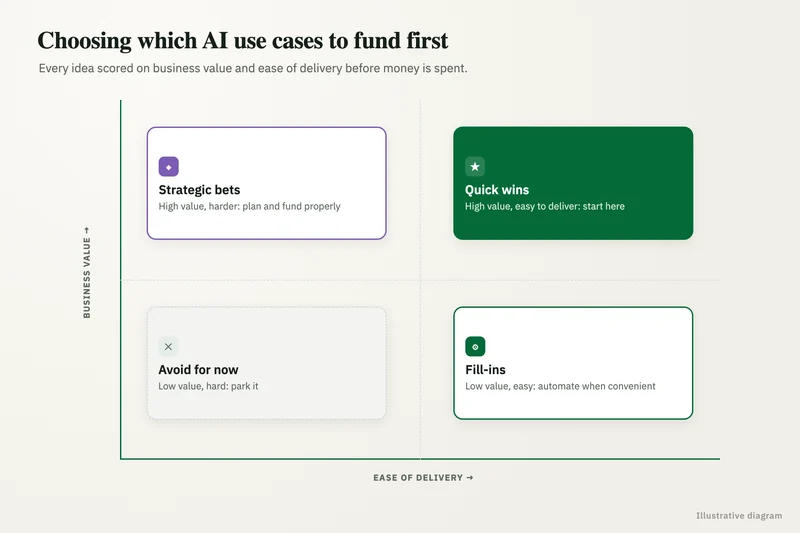
Start where the work is repetitive, the volume is high and a wrong answer is easy to catch before it reaches a customer. For most systems that means franchise development, field operations reporting and routine customer messages. Dynamic pricing, labor scheduling and hiring sound attractive, but they touch money, people and joint-employer questions, so they come later or stay with people.
The table shows a typical starting order. Your own ranking depends on your category, unit count and systems.
| Workflow | Who owns it | Systems touched | Risk | Typical first step |
|---|---|---|---|---|
| Franchise development lead follow-up | Franchisor | Franchise sales CRM, website, email | Low: reviewed before sending | Lead scoring and drafted follow-ups for the development team |
| Field visit and compliance reports | Franchisor | Franchise management platform, forms, photos | Low: internal | Summaries of visit notes and flagged brand-standard gaps |
| Unit performance reporting | Franchisor | POS, accounting, royalty reporting | Low: internal | Automated weekly pack per unit with drafted commentary |
| Operations manual and training Q&A | Franchisor provides, units use | Manual, learning system, SharePoint or Google Drive | Medium: wrong procedure | Assistant that answers from the manual with citations |
| Local marketing content | Franchisor templates, units use | Marketing platform, social tools | Medium: brand and claims | Drafts inside approved templates, brand review before publishing |
| Customer calls, chat and reviews | Shared | Phone system, website chat, review platforms | Medium | AI answers routine questions and transfers the rest to the unit |
| Hiring, scheduling and pay | Franchisee | Applicant tracking, scheduling tools | High: employment law | Leave to franchisees; franchisor offers optional tools only after legal review |
Franchisor vs franchisee: who should buy and control AI tools?
The franchisor should own AI that protects the brand or serves the whole system, and the franchisee should own AI that runs the day-to-day employment and staffing of their business. That line keeps brand control where it belongs and keeps the franchisor away from the kind of control over workers that creates joint-employer risk.
Franchisor-owned tools usually include franchise development, system-wide reporting, the operations manual assistant, approved marketing templates and brand-level customer channels such as the main website chat. These run on data the franchisor already receives and benefit every unit.
Recommended tools sit in the middle: the franchisor negotiates a vendor, configures it for the brand and offers it, but each franchisee decides whether to use it. Unit-level phone answering and review replies often fit here. Mandating a tool means writing it into brand standards and the operations manual, and disclosing required systems in Item 11 of the Franchise Disclosure Document for new franchisees, so treat a mandate as a decision for your franchise counsel, not just an IT choice.
Franchisee-owned tools cover hiring, scheduling, discipline and pay. Greenberg Traurig notes the proposed American Franchise Act would tie joint-employer status to substantial, direct and immediate control over employment terms, but its passage and timing remain uncertain, and state rules may still apply. Until your counsel says otherwise, avoid AI tools configured by the franchisor that set franchisee schedules, screen franchisee applicants or recommend discipline. This is not legal advice.
How does the plan change with system size?
Emerging brands, mid-size systems and large multi-brand groups need different first steps, and a consultant should size the plan to yours rather than copy what a 2,000-unit brand does.
| System type | Where to start | What the consultant must check | Who signs off |
|---|---|---|---|
| Emerging brand (under 50 units) | Franchise development follow-up and the operations manual assistant | CRM and website setup, manual quality, budget for running costs | Founder or CEO |
| Mid-size system (50 to 500 units) | Unit reporting, field visit summaries, customer channels | POS and royalty data access, franchise advisory council views, vendor contracts | COO with franchise advisory council input |
| Large or multi-brand group | Shared reporting and development across brands | Data ownership by brand, multiple POS systems, cost allocation | Executive team and brand presidents |
| Multi-unit franchisee | Back-office reporting, customer calls and reviews across own units | What the franchise agreement allows, brand-approved vendors | Franchisee owner, with brand approval where required |
Worked example: a 60-unit home services franchise
Here is how we size a first project. The figures are illustrative assumptions, not benchmarks; replace them with counts from your own CRM, franchise management platform and POS.
Assume the franchisor's development team handles 200 new franchise inquiries a month and spends 15 minutes on each first follow-up, about 50 hours. Two field business consultants each visit 15 units a month and spend 45 minutes writing each visit report, about 22 hours combined. The finance team spends a day each week assembling unit performance reports from POS exports and royalty submissions, about 32 hours a month. That is roughly 104 hours a month of repetitive, checkable work at headquarters.
If AI drafts development follow-ups that staff approve in five minutes, turns field notes and photos into a structured report reviewed in 15 minutes, and an automated pipeline assembles the weekly unit pack, headquarters recovers roughly 70 hours a month: about 33 in development, 15 in field reporting and most of the 32 in finance. Multiply by your loaded hourly cost, subtract the monthly running cost of model usage and any platform fees, and you have the value. The bigger prize is often speed: development leads answered within minutes rather than the next day, and a weekly view of every unit's numbers instead of a monthly one.
Reporting is where we have direct experience. Our case studies include an automated pipeline for an insurance brokerage that standardized every insurer's spreadsheet into one dashboard and cut report time from 4 to 5 hours to under 5 minutes, the same pattern as standardizing royalty and POS submissions from dozens of units.
Notice what the example leaves out: franchisee hiring, scheduling and pricing. Those stay with franchisees and people until the headquarters workflows have run cleanly for a few months and counsel has reviewed anything that touches employment.
How do you roll out AI across franchise locations?
Roll out in stages and bring franchisees in early. A tool that headquarters loves and franchisees ignore delivers nothing, and franchise advisory councils remember mandates that cost them money without visible benefit.
- Measure first: record minutes per task, response times or error rates in the pilot units for two to four weeks before switching anything on.
- Pick five to ten pilot units with different volumes and owners who are willing to give honest feedback.
- Brief the franchise advisory council on the goal, the cost to units (if any) and how results will be judged.
- Run the pilot for at least one full month with a person reviewing AI outputs before they reach customers.
- Compare against the baseline, publish the result to the system and decide: stop, adjust or expand.
- Only then update the operations manual, brand standards and, if a tool becomes required, your FDD with counsel.
How to choose an AI consultant for a franchise system
Ask these questions before signing, and expect specific answers rather than a product demo.
- Have you worked with franchise systems, and do you understand the difference between franchisor and franchisee responsibilities?
- Which POS, franchise management, CRM and royalty reporting systems have you connected, and how will you get data out of ours?
- Do you resell or earn referral fees from any franchise technology vendor?
- How will you keep our plan clear of franchisee hiring, scheduling and discipline decisions?
- Who owns the accounts, prompts, data and reports at the end? It should be the franchisor, or the franchisee for unit-level tools.
- What will each unit pay per month after rollout, broken down by platform, model usage and telephony?
- Is the first phase a fixed fee with listed deliverables?
When should a franchise not hire an AI consultant?
Skip the consultant if your need is one clear task and your existing vendor already offers it. Many franchise management, POS and marketing platforms now include AI features; switch them on in a few units and measure for a month first.
Also hold off if the basics are missing. AI cannot answer questions from an operations manual that is out of date, or report on units whose POS data arrives in five different formats. Fixing the manual and standardizing data submissions is cheaper and helps every later AI project.
A consultant earns the fee when the decision is genuinely hard: many units, several systems, franchisees asking what the brand will provide, a board asking for an AI plan with numbers, or a stack of vendor proposals that all claim to do the same thing.
How we run AI consulting for franchises
We start with a free review of your system, your stack and the workflows that cost headquarters and franchisees the most time. From that we propose a fixed-price first phase, usually a readiness assessment and use-case ranking with an ownership map, and list the deliverables. You get a ranked workflow list, a franchisor or franchisee owner for each, a running-cost model and a pilot plan with a baseline.
If the pilot is worth building, we can build it: development follow-up workflows, operations manual assistants with citations, reporting pipelines from POS and accounting data, review and call handling, and dashboards. You own the accounts, prompts and data, and a person stays in the loop on anything touching customers, money or employees. Pricing is quoted per phase after the review; our AI consultant cost guide shows what the wider market charges.
FAQ
Frequently asked questions
How can franchises use AI?
The most common uses are following up franchise development leads, summarizing field visit reports, automating unit performance reporting, answering staff questions from the operations manual, drafting local marketing inside brand templates and handling routine customer calls, chats and reviews. Hiring and scheduling tools are usually left to franchisees.
Should a franchisor require franchisees to use an AI tool?
Only after a measured pilot and a review by franchise counsel. A required tool usually has to go into brand standards and the operations manual, and required systems are disclosed in Item 11 of the Franchise Disclosure Document. Offering a recommended tool is often the better first step.
Can franchisor AI tools create joint-employer risk?
They can if they give the franchisor control over franchisee hiring, scheduling, discipline or pay. Keep franchisor AI focused on brand, reporting and customer channels, and have counsel review any tool that touches franchisee employees. This is not legal advice.
What does AI consulting for franchises cost?
It depends on the number of units, systems and workflows in scope. We quote a fixed price per phase after a free review, and our AI consultant cost guide lists published third-party rates by firm type so you can compare proposals.
Do franchisees pay for AI tools the brand provides?
It varies by system. Some franchisors fund tools from the technology or brand fund, others pass a per-unit fee through, and some leave unit tools to the franchisee. Model the monthly cost per unit before deciding, and discuss it with the franchise advisory council.
How long does a franchise AI pilot take?
A headquarters workflow such as reporting or development follow-up can usually be scoped, built and measured in a few weeks to a few months. Unit-level pilots take longer because they need a baseline, franchisee buy-in and at least a month of live use before a decision.
Are AI chatbots common on franchise websites?
In some categories. Franchise Update Media's 2026 Annual Franchise Development Report found every retail food franchise surveyed uses AI chatbots on its website, against 33% of non-food retail franchises. Adoption is uneven, which leaves room for brands outside food to catch up.
Keep reading
Related pages
Get started
Tell us where AI should pay back
Describe the work that eats your team's time and the systems you run. We reply within one business day with the use cases we would test first, the risks to plan for and a fixed-price proposal.
- Free 30-minute AI review
- Fixed quote before any work starts
- Advice that is vendor-neutral, in plain English
Prefer email? info@aiconsultingservicesusa.com
Book a free AI review
Two lines is enough to start.