

Buyer's guide
AI consulting for mid-market companies: what to buy, from whom, and in what order
AI consulting for mid-market companies should do three things a Big Four program is too heavy for and a software vendor is too biased for: decide which two or three AI uses will pay back, get the data and governance ready for them, and hand you a plan your own team can run. This guide is for CEOs, COOs and CFOs of US companies with roughly 100 to 1,000 staff who already have some AI in use and need it to add up to something measurable.
Book a free AI review
Two lines is enough. A specialist replies within one business day.
Executive summary
What should AI consulting for mid-market companies include?
AI consulting for mid-market companies should include a short assessment of processes and data, a ranked shortlist of use cases with expected savings, a governance policy sized for your company, one measured pilot and a 12-month roadmap your team can own. It should be priced per phase, not as an open-ended program, and every phase should have an exit point.
What to take away
- Mid-market firms usually already use AI; the gap is turning scattered tools into measured results.
- RSM's 2026 survey names data quality and integration as the main blocks to scaling.
- Buy in phases with exit points: assessment, pilot, then rollout, each priced separately.
- A fractional Chief AI Officer often fits better than a large consulting program.
Why is AI consulting for mid-market companies different?
Mid-market companies are too complex for off-the-shelf advice and too lean for enterprise-style programs. A 400-person manufacturer or distributor typically runs an ERP such as NetSuite or Microsoft Dynamics, a CRM such as Salesforce or HubSpot, a document store in SharePoint or Google Drive and dozens of spreadsheets that hold the real process. It has an IT team of a few people, no data science group and a leadership team that has to approve every dollar against a payback period.
That shape changes what good consulting looks like. Enterprise programs assume a transformation office, a data platform team and months of stakeholder workshops. Small-business advice assumes one owner and one tool. A mid-market engagement has to work with one or two internal owners who still have day jobs, connect to systems that are already in place, and show a measurable result inside a quarter or it loses sponsorship.
RSM, which defines the US middle market as companies with $30 million to $10 billion in annual revenue, reported in its Middle Market AI Survey 2026 (released July 21, 2026) that 86% of organizations have partially or fully integrated AI into their operations. The question for most of these firms is no longer whether to start; it is how to turn scattered Copilot seats, ChatGPT accounts and vendor features into a few results that show up in the numbers.
What problems should an AI consultant solve for a mid-size company?
The useful problems are the ones that block scaling, not the ones that make a good demo. In the same RSM 2026 survey, companies with limited pilot success named data quality issues (53%) and integration challenges (47%) as their main barriers. Neither is solved by a better model; both are solved by scoping, data work and plumbing, which is where an outside team earns its fee.
In practice a mid-market engagement usually has to sort out five things before any use case can scale.
- Tool sprawl: several teams paying for different assistants with no shared policy or measurement.
- Unranked ideas: a long list of use cases with no estimate of hours saved, risk or build effort.
- Data that lives in spreadsheets: reports rebuilt by hand each week from exports out of the ERP and CRM.
- No owner: AI is everyone's side project, so pilots stall when the champion gets busy.
- Unclear risk rules: no written answer on what data can go into which tool, or who reviews AI output that reaches customers.
Which engagement model fits a mid-market company?
Match the model to your situation rather than to the size of the firm you are talking to. The table below shows where each common model fits and where it tends to go wrong. Published rate bands for each type of provider are in our AI consultant cost guide; we do not repeat them here because they vary widely by scope.
Most mid-market companies end up with a combination: a fixed-price assessment and pilot from a specialist firm, then a fractional Chief AI Officer or a part-time advisor to keep the roadmap moving while internal owners take over the day-to-day.
| Model | Best when | Watch out for |
|---|---|---|
| Big Four or large strategy firm | Board-level transformation across many business units, heavy regulatory exposure | Large teams, long discovery and fees sized for enterprises |
| Regional accounting or advisory firm | You already use them for audit, tax or ERP and want one relationship | AI may be a newer practice; check who actually does the work |
| Specialist AI consultancy | You need a ranked plan and a working pilot in a quarter | Some are build shops that recommend whatever they build |
| Software vendor's services team | You have already chosen the platform and need it configured | Advice is limited to that vendor's product |
| Fractional Chief AI Officer | AI needs a senior owner but not a full-time executive | Needs an internal team or partner to execute |
| Internal hire | AI is core to the product or several large systems are planned | Slow to hire, hard to retain, risky as a single point of failure |
What does a 90-day AI consulting plan look like for a mid-market firm?
A good first engagement fits in about 90 days and ends with a measured result plus a plan, not just a slide deck. Each phase below has its own deliverables and its own decision point, so you can stop after any of them if the numbers do not support going on.
- Days 1 to 20, assessment: interviews with department heads, a review of systems (ERP, CRM, document stores, phone, ticketing), an inventory of AI tools already in use and a data sample from the top candidate processes. Deliverable: a written readiness report.
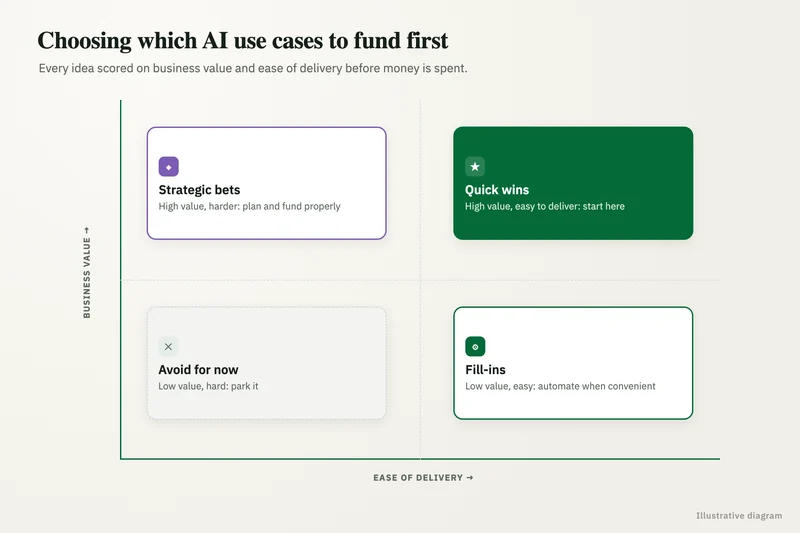
- Days 15 to 30, prioritization: each use case scored for hours or errors removed, risk, data readiness and build effort. Deliverable: a ranked shortlist of two or three, with a baseline for each.
- Days 20 to 40, governance: an acceptable use policy, data classes, approved tools, human-review rules for anything touching money, customers or regulated data. Deliverable: a policy your counsel can review.
- Days 30 to 80, pilot: one use case built or configured in your own accounts and tested on real cases with a person reviewing outputs. Deliverable: before-and-after numbers and a monthly running cost.
- Days 80 to 90, roadmap: what to scale, what to drop, who owns each item and the budget for the next two quarters. Deliverable: a 12-month roadmap and a handover.
How does an existing Copilot or ChatGPT rollout change the scope?
It shifts the work from choosing tools to making the ones you have pay back. Many mid-market firms bought Microsoft Copilot, ChatGPT or Gemini seats in 2025 or 2026 and now see uneven use. A consultant should start by reading the admin usage reports, finding which roles use the tool weekly and which seats sit idle, and checking whether file permissions were cleaned up before rollout.
From there the useful work is usually in three places: role-based training on real tasks, a short list of custom assistants for repeated jobs such as proposal reviews or month-end commentary, and moving the processes that need system-to-system automation out of chat and into a proper workflow. Our Gemini vs Copilot and Copilot vs ChatGPT Enterprise guides cover the tool decision in detail.
What if you are PE-backed or run several business units?
PE-backed and multi-entity companies need the same plan with two additions: a value case the owners can read, and governance that works across entities. The sponsor will want the expected savings tied to EBITDA lines and a quarterly report on what was delivered, so baselines from the pilot matter even more. Our guide to AI consulting for private equity covers the portfolio view in more depth.
For multi-entity groups, the common mistake is letting each unit buy its own tools and consultants. A better pattern is one group-level policy and tool list, a shared scoring method for use cases, and pilots in the unit with the cleanest data, then reused across the others. Shared back-office processes such as accounts payable, reporting and customer service are usually the easiest to repeat.
What should a mid-market AI consulting proposal show, and what are the red flags?
A good proposal names the deliverables, the people doing the work, the systems in scope, the price per phase and the exit point after each phase. It should also say how results will be measured and who owns the accounts, code, prompts and data at the end. Our guide to choosing an AI consulting firm has a full question list; these are the red flags we see most in mid-market proposals.
- A long discovery phase with no named deliverable at the end of it.
- Hourly billing with no estimate of total hours or a cap.
- A platform already chosen before anyone has looked at your systems or data.
- Case studies that are all Fortune 500 programs with nothing at your size.
- Builds hosted in the consultant's accounts, so you cannot leave without a rebuild.
- No mention of monthly running costs for models, platforms and staff review time.
- Promises of guaranteed savings or a percentage return before any baseline exists.
When should a mid-market company not hire an AI consultant?
Do not hire one if you cannot name an internal owner who will give the project a few hours a week, because the work will stall when the consultants leave. Hold off as well if leadership has not agreed what a good result looks like, or if a pending ERP or CRM migration will change the very processes you want to improve; finish the migration first.
You may also not need a consultant at all if the need is narrow and well defined, such as rolling out an assistant your suite already includes or configuring an AI feature your helpdesk vendor sells. In that case a short readiness check and the vendor's own onboarding may be enough, and our guide on whether to hire an AI consultant walks through that test.
How Greenwolf Tech Labs works with mid-market companies
We work with US companies remotely, in US time zones, through AI strategy consulting that starts with a free review of your processes, systems and existing AI tools. From there we quote a fixed price for each phase: assessment, prioritization, governance, a pilot and the roadmap. You own every account, prompt, workflow and document, and a person stays in the loop on anything touching money, customers or regulated data.
Our work is rooted in the back-office data problems that RSM's survey highlights. In one of our case studies, an insurance brokerage cut a recurring report from 4 to 5 hours to under 5 minutes by standardizing every insurer's spreadsheet into one dashboard. We can also act as your fractional Chief AI Officer after the first 90 days. Email info@aiconsultingservicesusa.com or book a free review to see what a first phase would cover for your company.
FAQ
Frequently asked questions
What counts as a mid-market company?
Definitions vary. RSM's 2026 survey defines the US middle market as companies with $30 million to $10 billion in annual revenue, while many buyers use headcount, roughly 100 to 1,000 staff. For AI planning, what matters more is having several core systems, a small IT team and no dedicated data science group.
How much does AI consulting cost for a mid-market company?
It depends on the provider type and scope far more than on company size. Published third-party rate bands by provider type are collected in our AI consultant cost guide. Ask any firm for a fixed price per phase, starting with an assessment, so you can stop if the numbers do not hold up.
How long does a mid-market AI consulting engagement take?
A first engagement covering assessment, prioritization, governance and one pilot usually fits in about 90 days. Scaling the pilot to more teams or adding the next use cases then runs over the following two to four quarters, ideally led by an internal owner.
Should a mid-market company hire a Chief AI Officer?
Usually not full time at first. A fractional Chief AI Officer gives senior ownership of the roadmap, vendor choices and governance for a few days a month, which suits most companies with 100 to 1,000 staff. Hire full time when AI is central to the product or several large builds run at once.
Are Big Four firms worth it for mid-market AI projects?
They can be when the program spans many business units or heavy regulatory exposure. For most mid-market companies, a specialist firm or a regional advisor delivers a ranked plan and a working pilot faster and with less overhead. Compare who actually does the work, not just the brand.
What is the best first AI project for a mid-market company?
Usually a back-office process with high volume, clear rules and data you already have, such as reporting, invoice or document intake, or customer service triage. MIT NANDA reported in 2025 that the biggest returns came from back-office automation, even though more budget went to sales and marketing.
Keep reading
Related pages
Get started
Tell us where AI should pay back
Describe the work that eats your team's time and the systems you run. We reply within one business day with the use cases we would test first, the risks to plan for and a fixed-price proposal.
- Free 30-minute AI review
- Fixed quote before any work starts
- Advice that is vendor-neutral, in plain English
Prefer email? info@aiconsultingservicesusa.com
Book a free AI review
Two lines is enough to start.