

Industry guide
AI consulting for marketing agencies: what to fix first, what it costs and how to stay safe with client work
AI consulting for marketing agencies helps agency owners decide which internal workflows AI should take over, how to price the work that comes out faster, and what rules protect client data and contracts. This guide is for founders, managing directors and operations leads at US agencies of roughly 10 to 300 staff. It ranks the usual first projects, works through a costed example, covers the contract and copyright questions clients now ask, and shows when a consultant is not worth the fee.
Book a free AI review
Two lines is enough. A specialist replies within one business day.
Executive summary
What does AI consulting for marketing agencies include?
AI consulting for marketing agencies maps where your team loses unbilled hours (reporting, briefs, proposals, QA, research), ranks AI uses by time saved and client risk, and sets rules for client data, disclosure and contracts. The output is a costed plan with owners, a pricing approach for AI-assisted work and a first project with a measured baseline.
What to take away
- Start with unbilled internal work such as reporting and proposals, not client-facing creative.
- Client contracts, NDAs and tool data terms decide what AI is allowed to touch.
- Purely AI-generated output may not be copyrightable, which matters for work you hand over.
- Price AI-assisted work on deliverables and outcomes, or faster delivery quietly cuts your revenue.
What does AI consulting for marketing agencies actually cover?
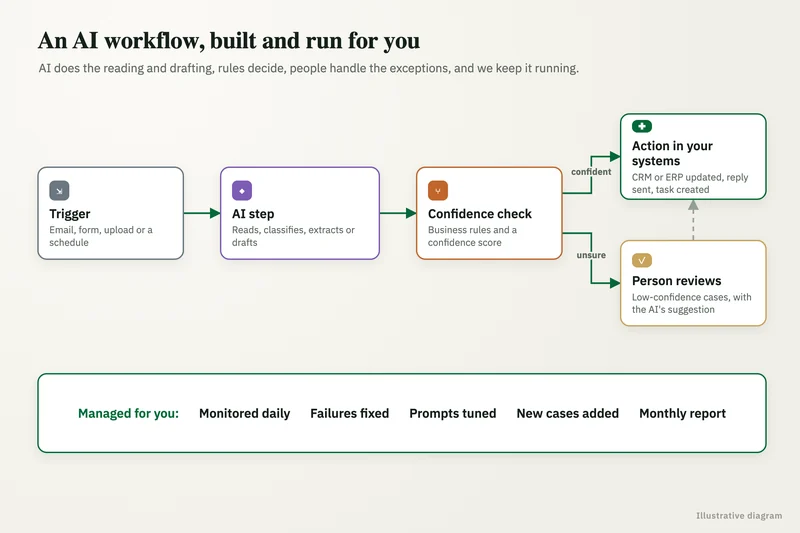
It covers three things an agency owner usually cannot sort out between client calls: which workflows AI should change, under what rules, and how the agency gets paid once the work speeds up. A good engagement looks at operations, contracts and pricing together, because changing one without the others is where agencies get hurt.
Operations is the obvious part. A consultant walks through how a brief arrives, how a campaign gets planned, how assets move through review, how the monthly report is built and how a proposal gets written, then measures the hours each step takes. Most agencies find that the biggest time sinks are not the creative work clients see, but the unbilled assembly around it: pulling numbers from GA4, Google Ads, Meta Ads Manager and LinkedIn Campaign Manager, rewriting the same capability sections in every pitch, and chasing approvals in Slack and email.
The second part is rules. Agencies hold other companies' data, brand assets and unreleased plans, so every AI use has to fit the client contract, the NDA and the data terms of the tool. The third part is commercial: if a report that took three hours now takes forty minutes, the agency needs to decide whether that time goes back into strategy, into more clients per account manager, or into a lower price. Leaving that decision to chance is the most common mistake we see.
Why are marketing agencies hiring AI consultants now?
Because nearly every agency already uses AI, but very few have turned it into margin or a better offer. In The State Of AI Inside US Marketing Agencies, 2026, published with the 4As in June 2026, Forrester reported that 61% of agencies still classify AI as a cost of business rather than something they sell or price. Teams pay for chat subscriptions and AI features inside their tools, staff use them ad hoc, and the savings disappear into longer meetings and extra revision rounds.
Contracts have not caught up either. ADWEEK's quarterly marketing tracker with NewtonX, published in March 2026, found that 39% of agency contracts do not address AI usage at all. That leaves both sides guessing about whether client files can go into an AI tool, who owns AI-assisted assets, and whether faster delivery should change the fee.
Clients are also asking sharper questions in reviews and RFPs: which tools touch our data, are our files used to train models, and how do you check AI output before it reaches us. An agency with written answers wins those conversations. One without them looks careless, even if its people use AI responsibly.
Which agency workflows should AI handle first?
Start with work that repeats every week, is not billed directly, and has an easy human check. Reporting, proposal drafts and brief intake usually come first; brand strategy, crisis communication and anything with regulated claims come last or not at all. The table ranks the common candidates by risk and by whether they make a sensible first project.
The systems column matters as much as the use case. If campaign data already flows into Looker Studio through a connector, reporting commentary is a small step. If every account manager keeps numbers in their own spreadsheet, the first project is really data cleanup, and the consultant should say so before quoting anything else.
| Workflow | Who owns it | Systems involved | Client risk | Good first project? |
|---|---|---|---|---|
| Monthly and weekly client reports with written commentary | Account managers, analysts | GA4, ad platforms, Looker Studio, Sheets | Low (analyst reviews before sending) | Yes |
| Proposal and pitch drafts from past wins | Founders, new business | Google Drive or SharePoint, CRM such as HubSpot | Low (internal until sent) | Yes |
| Brief intake and clarifying questions | Account and project managers | Forms, email, Asana, Monday.com or ClickUp | Low | Yes |
| Competitor and audience research summaries | Strategists | Web research, social listening exports | Low to medium (facts must be checked) | Often |
| Ad copy and social variants for testing | Copy and paid media teams | Ad platforms, Canva, brand guidelines | Medium (claims, brand voice) | After rules are set |
| SEO content drafts | Content teams | CMS, keyword tools | Medium (accuracy, client approval) | After rules are set |
| Time tracking and scope-creep alerts | Operations, finance | Harvest, project tool, QuickBooks | Low | Often |
| Client-facing chat or automated replies | Client services | Email, chat, CRM | High (speaks for the client) | No |
Worked example: what is reporting automation worth to a 25-person agency?
Here is a planning example with round numbers. Every input is an assumption for illustration, not a benchmark, so replace each one with your own figures before deciding anything.
The agency has 30 retainer clients and sends each one a monthly report. Today an account manager spends about three hours per report pulling numbers from four platforms, building charts and writing commentary, which is 90 hours a month. After automation, a connector pulls the data into a fixed template, an AI step drafts the commentary from the numbers and last month's notes, and the account manager spends about 45 minutes checking and editing each report. That is 22.5 hours a month, a saving of 67.5 hours.
At an assumed fully loaded internal cost of $60 an hour, the saving is worth about $4,050 a month, or roughly $48,600 a year, before running costs. If connectors, model usage and workflow tools cost around $300 a month, the net is about $3,750 a month. Against a one-off fixed project fee, you can see quickly how many months it takes to pay back, and the same arithmetic tells you whether a quote is reasonable.
The more important question is what happens to the 67.5 hours. If they go to proactive strategy calls that keep clients longer, the value is larger than the hourly math. If they quietly disappear, the agency has paid for a tool and gained nothing. Decide this before the build, and track it afterwards.
- Baseline: 30 reports x 3 hours = 90 hours a month.
- After: 30 reports x 45 minutes = 22.5 hours a month.
- Saved: 67.5 hours a month, about $4,050 at an assumed $60 an hour.
- Assumed running costs: about $300 a month, leaving roughly $3,750 net.
How should agencies handle client data, contracts and copyright with AI?
Treat it as a contract question first and a tool question second. Your client agreement and NDA define what you may do with their data, and the AI tool's data terms define what the vendor may do with it. Many business and enterprise plans state that your inputs are not used for model training, while consumer accounts can work differently, so read each tool's current terms before any client file goes in.
Copyright needs a clear answer too. In Part 2 of its report on copyright and artificial intelligence, released January 29, 2025, the US Copyright Office concluded that purely AI-generated material is not copyrightable and that prompts alone do not make someone the author, although human selection, arrangement and modification of AI output can be protected. If your contract promises the client full ownership of deliverables, make sure a person is genuinely shaping the final work, and say so in the statement of work.
Advertising rules still apply to AI-assisted work. The FTC's Consumer Reviews and Testimonials Rule, announced August 14, 2024, bans fake reviews, including AI-generated reviews attributed to people who do not exist. Use the checklist below as a starting point with your own counsel. This is not legal advice.
- Add an AI clause to new contracts and renewals: which tools may be used, for what tasks, and how output is reviewed.
- Keep an approved tool list with each vendor's data terms, and block client data from personal or free accounts.
- Ask clients in regulated sectors (health, finance, legal) for written approval before their data touches any AI tool.
- Name a human approver for every client-facing asset and log which tool and source material produced it.
- Record human edits on key creative so ownership claims in your contract hold up.
- Write an internal acceptable-use policy and train staff on it before scaling any workflow.
How should an agency price AI-assisted work?
Price the deliverable and the outcome, not the hours. If you bill by the hour or build retainers from hour estimates, every efficiency gain from AI comes straight out of your revenue. Agencies that keep pricing on hours tend to end up in an awkward conversation where the client asks why the bill has not fallen.
Three approaches work better. Fixed fees per deliverable (a monthly report, a campaign launch, a landing page) let you keep the margin from faster production. Tiered retainers sell a defined scope and service level, such as weekly insights instead of monthly. And new AI-enabled services, such as faster creative testing or answer engine optimization for client brands, give you something new to sell rather than the same thing cheaper. A consultant should model each option against your current client mix before you change any contract.
What does AI consulting for a marketing agency cost?
It depends on the type of firm far more than on the agency's size. The bands below come from Softude's 2026 guide to AI consulting rates and apply to consulting generally, not only to agencies; they are not our prices. Use them to check whether a quote is in a sensible range.
For most agencies the realistic scope is a short assessment followed by one fixed-price project, such as reporting automation or a proposal assistant, rather than a long retainer. Softude puts a single use case at three to five months of work at the firms it surveyed, but a narrowly defined internal workflow in an agency with tidy data can move faster. Ask any firm to separate the advisory fee from the build fee and from monthly running costs, so you can compare like with like. Our AI consultant cost guide has the full breakdown.
| Provider type | Hourly rate | Typical project fee | Source |
|---|---|---|---|
| Freelance AI consultants | $150-300/hr | $10k-35k | Softude, 2026 guide |
| Specialist AI agencies | $150-350/hr | $25k-150k | Softude, 2026 guide |
| Mid-market consulting firms | $250-500/hr | $50k-250k+ | Softude, 2026 guide |
| Big Four and top strategy firms | $500-1,000+/hr | $200k-1M+ | Softude, 2026 guide |
How does an AI consulting engagement for an agency run, step by step?
A sound engagement moves from measurement to rules to one live project, in that order. Each stage should have its own price and an exit point, so you can stop after the assessment if the plan does not justify a build.
- Workflow audit: interviews with the founder, operations, two or three account managers and whoever runs reporting, plus a week of rough time tracking on the target workflows.
- Systems and data review: what your ad platforms, analytics, project tool and CRM can export, which AI features you already pay for, and where data lives in personal spreadsheets.
- Rules: an approved tool list, client data rules, an AI contract clause and a review step for client-facing output.
- Pricing model: how fees change for AI-assisted deliverables, tested against your top ten accounts.
- First project: one workflow built in your own accounts, run alongside the old process for a few weeks, then measured against the baseline.
- Rollout and training: the working process extended to every account team, with short training on the rules and the new workflow.
When should a marketing agency not hire an AI consultant?
Skip the consultant if the agency has fewer than about ten people and an operations lead who enjoys building workflows. Connecting a reporting connector to Looker Studio and writing a few tested prompts is well within reach of a capable in-house person, and a few online courses plus your own acceptable-use policy may be enough.
Also hold off if the real problem is not AI. If clients leave because results are weak, faster reports will only show that more clearly. If scope creep is unmanaged, AI will help you produce more unpaid work. Fix the offer and the contracts first.
A consultant earns the fee when the agency is large enough that small inefficiencies multiply across dozens of accounts, when clients in regulated sectors demand written AI rules, or when leadership needs an outside view to change pricing. In those cases, the cost of a wrong first project or a contract dispute is usually higher than the fee.
How Greenwolf Tech Labs approaches AI consulting for marketing agencies
We start with a free review of your workflows, tools and client contracts, then quote a fixed price for each phase. We have delivered 100+ projects over 8+ years, and reporting automation is familiar ground: our case studies include an insurance brokerage where an automated pipeline merged every insurer's spreadsheet into one dashboard and cut report time from 4-5 hours to under 5 minutes.
Everything we build stays in your accounts, including connectors, prompts and dashboards, and a person on your team approves anything that reaches a client. If the review shows you can do the work in-house, we will tell you and hand over the plan. If you want a partner for delivery as well as advice, our automation consulting service covers both.
Case study · Insurance brokerage, Australia
Automation and dashboarding
Policy data arrived as spreadsheets from several insurers, each in a different structure, and every client report took hours of manual cleanup. An automated pipeline that standardizes every insurer's file and feeds a single reporting dashboard.
- Report time cut from 4-5 hours to under 5 minutes
- Reporting accuracy up from about 75% to 99%

FAQ
Frequently asked questions
What does an AI consultant do for a marketing agency?
An AI consultant measures where the agency loses unbilled hours, ranks AI uses by time saved and client risk, and sets rules for client data and contracts. They then help deliver one workflow, such as automated reporting, and measure it against a baseline.
How much does AI consulting cost for a marketing agency?
Softude's 2026 guide puts freelance AI consultants at $150 to $300 an hour with projects around $10,000 to $35,000, and specialist AI agencies at $25,000 to $150,000 per project. We quote a fixed price per phase after a free review, and running costs for tools are billed by the vendors directly.
Can agencies put client data into ChatGPT or Claude?
Only if the client contract allows it and the tool's data terms are acceptable. Business and enterprise plans generally exclude inputs from model training, while consumer accounts may not, so check current terms and keep client data out of personal accounts.
Who owns AI-generated work an agency delivers to a client?
The US Copyright Office concluded in January 2025 that purely AI-generated material is not copyrightable, though human selection, arrangement and editing can be protected. Agencies promising full ownership should make sure people genuinely shape the final work. This is not legal advice.
Should agencies tell clients they use AI?
Yes, in writing. ADWEEK's 2026 tracker with NewtonX found that 39% of agency contracts do not address AI at all, which invites disputes later. A short clause naming the approved tools, the tasks they cover and the human review step usually settles the question.
Will AI replace account managers at agencies?
In our experience it changes their week rather than removing the role. Report assembly, meeting notes and first drafts get faster, while client relationships, judgment calls and approvals stay with people. The agency decides whether saved hours go to strategy, more accounts per manager or lower fees.
How long does an AI project take for a marketing agency?
A focused assessment usually takes a few weeks. Softude's 2026 guide puts a single use case at three to five months at the firms it surveyed, though a narrow internal workflow with clean data can move faster.
Keep reading
Related pages
Get started
Tell us where AI should pay back
Describe the work that eats your team's time and the systems you run. We reply within one business day with the use cases we would test first, the risks to plan for and a fixed-price proposal.
- Free 30-minute AI review
- Fixed quote before any work starts
- Advice that is vendor-neutral, in plain English
Prefer email? info@aiconsultingservicesusa.com
Book a free AI review
Two lines is enough to start.