

Industry guide
AI consulting for staffing agencies: what to automate, what to avoid and how to buy it
AI consulting for staffing agencies helps owners and operations leaders decide which recruiting, sales and back-office work AI should take over, which candidate decisions must stay with a recruiter, and how to prove the result in fill rate and gross margin. This guide is for US staffing and recruiting firms with roughly 10 to 300 internal staff who are tired of ATS add-on demos and want a plan that holds up with clients, candidates and regulators.
Book a free AI review
Two lines is enough. A specialist replies within one business day.
Executive summary
What does AI consulting for staffing agencies involve?
AI consulting for staffing agencies is advisory work that maps your desks, ATS and VMS workflows, ranks AI uses by hours saved and legal risk, checks screening tools against rules such as NYC Local Law 144, and launches one measured pilot. A good engagement ends with a ranked use-case list, a policy and a working first project.
What to take away
- Start with redeployment, sourcing from your own database and back-office reporting, not automated candidate rejection.
- NYC Local Law 144 applies to employment agencies as well as employers.
- AI calls to candidates fall under the TCPA, so consent and disclosure come first.
- Judge any pilot on submittals per recruiter, time to submit and gross margin, not on logins.
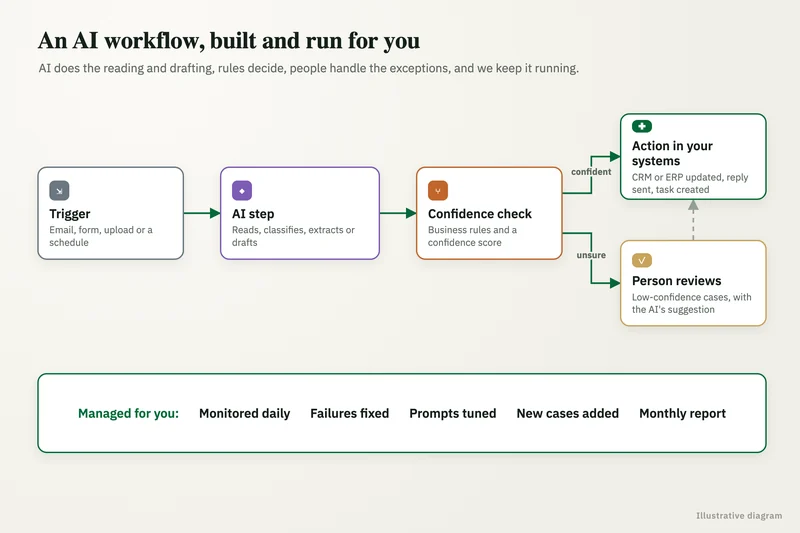
What does AI consulting for staffing agencies actually include?
It covers four things: deciding where AI pays back in your specific mix of desks, picking or configuring the tools, setting the rules that keep candidate decisions lawful, and measuring a first project against a baseline. The point is not to buy more software. Most staffing firms already pay for AI features inside Bullhorn, Avionte, JobAdder, Crelate, Ceipal or Loxo that nobody has configured properly, and the first job of a consultant is often to get value from what you already own.
A typical engagement for a firm with 20 to 100 recruiters runs as a short assessment followed by one pilot. The assessment produces the items below, each of which your team keeps using after the consultants leave.
- Workflow map: how a job order moves from intake to submittal, interview, offer, start, timesheet and invoice, with the hours each step takes on each desk.
- AI inventory: every AI feature already switched on in your ATS, VMS, sourcing tools, texting platforms and the chatbots recruiters use on their own, with the candidate data each one sees.
- Ranked use-case list: each candidate use scored on hours saved, effect on fill rate or margin, legal risk and effort.
- Policy and controls: approved tools, banned inputs, candidate notice language, consent rules for texting and calling, and who signs off on new tools.
- Pilot design: one use case with a baseline, a target, human review and logging of prompts and outputs.
Why are staffing firms hiring AI consultants in 2026?
Because the gap between firms that use AI well and firms that do not is now visible in growth. Bullhorn's GRID 2026 Industry Trends Report, published in February 2026 from a survey of nearly 2,300 recruitment professionals, found top-performing staffing firms were four times more likely to use AI than the rest. The same report found only 10 percent of firms had put agentic AI across their full workflow, which tells you most of the industry is still at the stage of scattered features rather than a working system.
That middle stage is where staffing firms lose money. Recruiters turn on a resume-matching feature on one desk, a texting bot on another and a public chatbot for job descriptions, and nobody owns the results or the risk. Leadership cannot say whether time to submit improved, and the compliance team does not know which tools touch candidate decisions. An outside advisor earns their fee by replacing that patchwork with a short list of uses that are measured, governed and connected to the ATS.
Which staffing workflows should you apply AI to first?
Start where AI saves recruiter and account manager time without deciding anything about a specific candidate on its own. Redeployment, database rediscovery and back-office reporting usually pay back fastest. Automated rejection or ranking of candidates should wait until bias testing, notice and human review are in place. The table sorts common staffing uses by payback and risk.
| Use case | Where the value shows up | Risk level | Human role |
|---|---|---|---|
| Redeployment alerts: flag contractors ending assignments and match them to open orders | Fewer bench days, higher retention of good workers | Low | Recruiter confirms fit and calls the worker |
| Database rediscovery: search past applicants in your own ATS before buying job board leads | Lower sourcing spend, faster time to submit | Low to medium | Recruiter reviews every shortlist |
| Job order intake summaries and job description drafts | Faster intake calls, cleaner orders | Low | Account manager edits and approves |
| Interview scheduling and shift confirmation by text | Fewer no-shows, less phone time | Medium (TCPA consent) | Opt-in captured; staff handle replies the system cannot |
| Credential and document checks for healthcare and light industrial | Faster compliant starts | Medium | Compliance staff verify licenses and I-9 in person |
| Timesheet, VMS and client report consolidation | Hours back for payroll and account teams; fewer billing errors | Low | Payroll approves exceptions |
| Candidate ranking or knockout screening | Recruiter time on high-volume orders | High (NYC, Illinois, California, Colorado from 2027) | Recruiter reviews every rejection; bias audit where required |
| Outbound AI voice calls to candidates | Reach at scale | High (TCPA prior express consent) | Only with documented consent and clear disclosure |
How does AI differ for light industrial, healthcare and IT staffing?
The segment changes the bottleneck, so it changes the first project. A consultant who recommends the same tool for every desk has not looked at your business.
Light industrial and high-volume desks are won on speed and show rates. The best early uses are shift confirmations, redeployment of reliable workers and quick reconciliation of timesheets from client sites. Volume also makes knockout screening tempting, which is exactly where the legal exposure is highest, so keep screening rules simple, documented and reviewed by a person.
Healthcare staffing is won on compliant starts. Nurses and allied professionals cannot start until licenses, certifications, health records and facility requirements are complete, so AI that reads documents, flags expiring credentials and tracks what is missing per facility removes the real delay. Health records bring HIPAA considerations, so any vendor handling that data needs a signed Business Associate Agreement and an enterprise or API tier, not a consumer plan.
IT and professional staffing is won on match quality and recruiter judgment. AI helps most with parsing technical resumes against a job's actual requirements, drafting targeted outreach and summarizing a candidate for the hiring manager. Submittal quality matters more than volume here, so measure interview-to-submittal ratio rather than raw submittals.
What laws apply when a staffing agency uses AI on candidates?
Staffing firms face the same AI hiring rules as employers, and in New York City the law names them directly. This is a planning summary, not legal advice; your employment counsel should confirm how each rule applies to your desks and locations.
New York City Local Law 144 restricts employers and employment agencies from using an automated employment decision tool for hiring or promotion unless it has had a bias audit within the past year, a summary is published and candidates get notice. The city's own FAQ, released in June 2023, says the vendor of the tool is not responsible for the audit; the employer or employment agency using it is. If your ATS ranks or screens out candidates for New York City roles, that duty sits with you, not with your software provider.
Illinois HB 3773 has applied since January 1, 2026 and bars AI use that has a discriminatory effect in recruitment and hiring, with notice duties. California's automated-decision regulations have applied since October 1, 2025. Colorado SB 26-189 adds notice, explanation and human review duties for consequential decisions including employment from January 1, 2027. Our AI consulting for HR guide covers these rules in more detail.
Candidate outreach brings a second set of rules. The FCC ruled on February 8, 2024 that AI-generated voices count as artificial voices under the TCPA, so outbound AI calls to candidates need prior express consent. Some states, including Utah and California, also require disclosure that a person is talking to a bot. Build consent capture into your application flow before you switch on any AI calling or texting.
A worked example: a 40-recruiter light industrial firm
Consider a firm with 40 recruiters across six branches placing warehouse and manufacturing workers. The owner wants AI but has been pitched an automated screening product, a voice bot and an agentic sourcing platform in the same month. The figures below are illustrative assumptions for planning, not results from a client.
The assessment measures a two-week baseline. Suppose each recruiter spends about 5 hours a week confirming shifts by phone, 3 hours rebuilding weekly client reports from VMS exports and spreadsheets, and the firm has an average of 60 contractors a week finishing assignments with no follow-up until they apply again. That is about 320 recruiter hours a week on confirmations and reports alone, plus a pool of known, reliable workers going to competitors.
The ranked plan puts redeployment alerts first, because each reliable worker redeployed is a placement without sourcing cost. Shift confirmation by text with captured opt-in comes second. Report consolidation comes third, because it is low risk and frees account managers for client calls. Automated screening is deferred, since three branches serve New York City clients and the firm has no bias audit or notice process yet. The voice bot is deferred until consent language is in every application.
The pilot runs for six weeks on two branches. The scorecard is redeployment rate, time from order to first submittal, no-show rate and hours spent on reports, compared against the two-week baseline and the four branches not in the pilot. If the numbers move, the same design rolls out branch by branch. Reporting consolidation of this kind is familiar ground for us: for an insurance brokerage we built a pipeline that standardized every insurer's spreadsheet into one dashboard and cut report time from 4 to 5 hours to under 5 minutes, as described in our case studies.
How to choose an AI consultant for a staffing agency
Look for advisors who ask about your desks, ATS and client contracts before they mention a product. In the first call a credible consultant should ask what your fill rate and time to submit are today, which segments you serve, where your candidates and clients are located and which AI features are already switched on.
- Ask which ATS and VMS platforms they have worked with and how they read and write data without creating a second candidate database outside the ATS.
- Ask how they would handle a screening feature for New York City roles under Local Law 144. A vague answer is a warning sign.
- Ask how they capture TCPA consent before any AI texting or calling.
- Ask for a fixed price for the first phase with named deliverables, and a model of monthly running costs per recruiter.
- Ask who owns the prompts, workflows and logs at the end. It should be you.
- Ask what they would tell you not to automate. An advisor with no answer has not thought about candidate risk.
- Check whether they earn referral fees from the tools they recommend, and ask them to say so in writing.
What mistakes do staffing firms make with AI?
Most failures come from buying tools before deciding what to measure. The patterns below come up repeatedly.
- Switching on candidate ranking in the ATS without checking where the roles are located or whether a bias audit is required.
- Running AI tools outside the ATS, so notes, consent records and submittals live in two places and recruiters stop trusting either.
- Measuring adoption (logins, messages sent) instead of submittals per recruiter, fill rate, time to submit and gross margin per placement.
- Letting recruiters paste candidate resumes into consumer chatbots with no business terms on data use.
- Starting with outbound AI calling before consent and disclosure are built into the application flow.
- Buying an agentic platform for every desk at once instead of proving one use case on two branches.
When is AI consulting for staffing agencies not worth it?
If you run a boutique search firm with five recruiters placing a few senior roles a month, a paid engagement is probably more than you need. A written AI policy, a business-grade chat tool, the AI features already in your ATS and an hour of training may be enough. The same applies if your only plan is to turn on one feature your ATS vendor already supports and documents well.
Consulting earns its cost when you run high volume across several branches, serve clients in New York City, Illinois, California or Colorado, operate in healthcare staffing with credentialing and HIPAA duties, have several systems that do not share data, or need to show an enterprise client or MSP how your AI use is governed. On cost, our AI consultant cost guide lists published market rates by firm type. We quote a fixed price for each phase after a free review, you own every account, workflow and log, and a recruiter stays in the loop on every candidate decision.
FAQ
Frequently asked questions
What is AI consulting for staffing agencies?
It is advisory work that helps staffing and recruiting firms decide where AI should be used across sourcing, redeployment, scheduling, credentialing and reporting, and how to use it lawfully with candidates. A typical engagement delivers a workflow map, an AI inventory, a ranked use-case list, a policy and one measured pilot.
Does NYC Local Law 144 apply to staffing agencies?
Yes. The law covers employers and employment agencies that use an automated employment decision tool to screen candidates for hiring or promotion for New York City roles. The city's FAQ says the agency or employer using the tool, not the software vendor, is responsible for the bias audit. Confirm details with employment counsel.
Can a staffing agency use AI to call or text candidates?
It can, with care. The FCC ruled in February 2024 that AI-generated voices are artificial voices under the TCPA, so outbound AI calls need prior express consent, and some states require disclosure that the caller is a bot. Capture consent in your application flow before switching on any AI outreach.
What is the best first AI project for a staffing firm?
For most firms it is redeployment: flagging contractors whose assignments are ending and matching them to open orders in your own ATS. It is low risk because a recruiter makes every call, and it pays back through placements that need no new sourcing. Back-office report consolidation is a close second.
Should we use the AI built into our ATS or hire a consultant?
Start with what your ATS already includes, because it keeps data in one place. A consultant adds value when you need to decide which features to switch on, check them against hiring laws, connect several systems or measure the result. Good advisors will often tell you to configure what you own before buying anything new.
How much does AI consulting cost for a staffing agency?
Cost depends on the number of desks, branches, systems and use cases in scope. Our AI consultant cost guide lists published market rates by firm type. We quote a fixed price for each phase after a free review, so you know the cost of the first step before committing.
Keep reading
Related pages
Get started
Tell us where AI should pay back
Describe the work that eats your team's time and the systems you run. We reply within one business day with the use cases we would test first, the risks to plan for and a fixed-price proposal.
- Free 30-minute AI review
- Fixed quote before any work starts
- Advice that is vendor-neutral, in plain English
Prefer email? info@aiconsultingservicesusa.com
Book a free AI review
Two lines is enough to start.