

Industry guide
AI consulting for real estate: what to fix first and how to hire well
AI consulting for real estate helps brokerages, property managers and commercial real estate firms decide which AI uses will pay back, in what order, and under what rules, before money goes into tools or builds. This guide is for owners, managing brokers and operations leads: it sorts the use cases by type of firm, names the systems involved, covers the Fair Housing and calling rules that catch firms out, and gives you a checklist for choosing a consultant.
Book a free AI review
Two lines is enough. A specialist replies within one business day.
Executive summary
What does AI consulting for real estate include?
AI consulting for real estate is advisory work that maps a brokerage's or property manager's workflows, systems and data, ranks AI use cases by value and risk, and produces a plan with costs, owners and guardrails. Typical first projects are lead response, listing content with a Fair Housing check, lease abstraction and maintenance triage.
What to take away
- Start with lead response, listing content or lease abstraction, not tenant screening decisions.
- Your CRM, MLS feed and property management system decide what is possible.
- The Fair Housing Act still applies to AI copy and ad targeting after HUD withdrew guidance.
- Hire for a scoped plan and one pilot, with a person reviewing anything customer-facing.
What does AI consulting for real estate actually cover?
It covers the decisions that come before and around any AI build: which processes to change, which tools to buy or reuse, what data is needed, who reviews outputs, and how to measure the result. A good engagement ends with a short, ranked list of use cases, a costed plan for the first one and written rules for how agents and staff may use AI.
The work looks different by segment. A residential brokerage cares about speed to lead, listing marketing and agent adoption. A property management company cares about leasing inquiries, maintenance requests, renewals and owner reporting. A commercial real estate owner or investor cares about lease abstraction, deal screening, offering memorandum review and portfolio reporting. One consultant can serve all three, but the plan should never be generic.
The systems matter as much as the models. Most real estate data sits in an MLS or IDX feed, a CRM such as Follow Up Boss, kvCORE or Lofty, a transaction platform such as Dotloop or SkySlope, a property management system such as AppFolio, Yardi, Buildium or Rent Manager, and a shared drive full of leases and PDFs. The consultant's first job is to find out what those systems can export, which AI features you already pay for, and where staff retype the same data by hand.
How are real estate firms using AI in 2026?
Adoption is wide but shallow. The National Association of Realtors 2025 Technology Survey, released in September 2025, found that 32% of Realtors had not yet used AI in their business, and that 46% of those surveyed saw no noticeable impact from it. ChatGPT, Gemini and Copilot were the most named tools.
That pattern is the reason consulting exists in this industry. Individual agents use a chatbot to draft a listing or an email, but the brokerage or management company has no shared process, no approved tools, no review step and no measure of whether anything improved. The gains usually come when AI is attached to a specific workflow and a specific system, for example every new web lead in the CRM getting a reply and a qualification summary within minutes, rather than when more people are told to try ChatGPT.
Which AI use cases pay off first for brokerages, property managers and CRE firms?
The best first projects share three traits: high volume, a clear before-and-after measure, and low harm if a draft is wrong because a person checks it. The table ranks common options. Risk reflects the chance of a legal or customer problem, not technical difficulty.
Notice what is missing from the top of the list: automated tenant approval, automated pricing decisions and AI that drafts contract terms on its own. These touch protected classes, consumer decisions or licensed activity, so they belong later in the roadmap, if at all, and always with a person making the final call.
| Use case | Best fit | Systems involved | Risk | Good first project? |
|---|---|---|---|---|
| Instant lead reply and qualification summary | Brokerages, leasing teams | Website forms, Zillow and portal leads, Follow Up Boss, kvCORE, Lofty | Low to medium (texting and calling rules) | Yes |
| Listing descriptions with a Fair Housing language check | Brokerages | MLS fields, photos, brand style guide | Medium (advertising language) | Yes |
| Lease abstraction into a structured table | CRE owners, property managers | Lease PDFs, SharePoint or Google Drive, Yardi, AppFolio | Low (staff verify key dates and amounts) | Yes |
| Maintenance request triage and vendor dispatch draft | Property managers | Resident portal, AppFolio, Buildium, Rent Manager | Low to medium | Yes |
| Transaction deadline tracking and reminders | Brokerages, transaction coordinators | Dotloop, SkySlope, email, calendars | Low | Yes |
| Owner and investor reporting drafts | Property managers, CRE | Accounting exports, Excel, dashboards | Low | Often |
| Comparative market analysis drafts | Brokerages | MLS data, public records | Medium (accuracy, MLS data license terms) | Sometimes |
| Tenant screening recommendations | Property managers | Screening reports, applications | High (Fair Housing, state law) | No |
| Contract or addendum drafting | Brokerages | Transaction platform forms | High (licensed activity, state rules) | No |
What compliance risks should real estate firms plan for with AI?
Four sets of rules come up in almost every real estate AI plan. This is a summary for planning, not legal advice; confirm specifics with your counsel and your state licensing regulator.
Fair Housing. HUD withdrew its April 2024 guidance on how the Fair Housing Act applies to digital and algorithmic housing ads (notice published in the Federal Register in April 2026, withdrawal effective September 17, 2025). The statute itself was not withdrawn, so discriminatory ad copy or targeting is still a violation whether a person or a model produced it. AI-written listings need a check for steering language about family status, religion, disability and other protected characteristics, plus a human approval step.
Calls and texts. The FCC ruled on February 8, 2024 that AI-generated voices count as artificial voices under the TCPA, so outbound calls using them need prior express consent. In practice, AI voice belongs on inbound calls and callbacks to people who asked to be contacted, not cold calls to homeowners. Some states also require a caller to disclose that it is an AI.
Automated decisions about housing. Colorado's SB 26-189, signed May 14, 2026 and effective January 1, 2027, is a notice-based law covering automated decision-making in consequential decisions including housing. Consumers get an explanation of adverse outcomes, human review and a chance to correct their data. Firms with Colorado rentals should design any screening support with those duties in mind.
Licensed activity and data rights. Drafting contract terms and giving advice are licensed activities in most states, so AI should assist an agent, not act for one. MLS and listing-data agreements also limit how data can be copied, stored or fed into third-party tools, which a consultant should check before any build that uses MLS exports.
How does a real estate AI consulting engagement run, step by step?
A focused engagement for a small or mid-size firm usually runs in five steps. Each step has its own deliverable and its own decision point, so you can stop after any of them.
- Discovery: interviews with the broker or principal, operations, a few agents or property managers and whoever owns the CRM and PMS, plus a walk-through of where leads, listings, leases and requests actually go.
- Systems and data review: what Follow Up Boss, kvCORE, AppFolio, Yardi or your other platforms can export or connect to, which AI features are already included in your plans, and where data is incomplete.
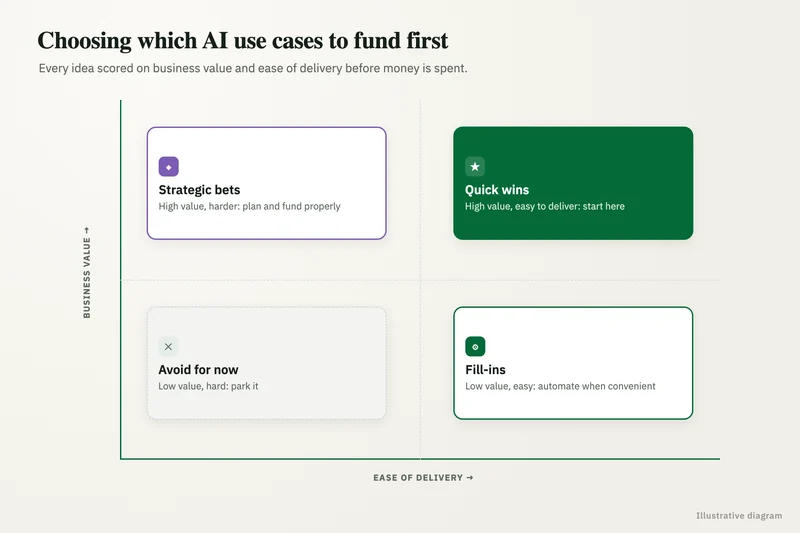
- Use-case scoring: each candidate is rated on volume, hours saved, revenue impact, data readiness and compliance risk, then placed on a value and ease matrix.
- Pilot design: the first use case gets a written spec covering inputs, outputs, review steps, confidence thresholds, logging, running cost per lead or per document, and the measure of success.
- Rules and rollout: an AI use policy for agents and staff, short training on approved tools, and a decision on whether to build, buy or extend what you have, with the next two use cases queued.
A worked example: is AI lead response worth it for a 40-agent brokerage?
Use your own numbers here; the figures below are illustrative assumptions, not benchmarks. Say a brokerage receives 600 online leads a month across its website and portals. Today an inside sales assistant spends about 6 minutes per lead checking the CRM, reading the inquiry and sending a first reply, which is 60 hours a month, and leads arriving after 7 pm wait until morning.
A scoped pilot sends every new lead an immediate reply in the brokerage's voice, writes a three-line qualification summary into the CRM record (timeline, price range, pre-approval status, preferred contact method) and routes it under the existing round-robin rules. The assistant now reviews summaries and handles the replies that need judgment, at perhaps 2 minutes per lead, or 20 hours a month. The 40 hours released are the measurable gain, and the after-hours wait disappears.
Against that, count the one-time cost of design and setup, model and texting fees per lead, any CRM add-on, and a few hours a month for someone to review flagged conversations and adjust prompts. If those monthly running costs come to less than the value of 40 staff hours, and contact rates hold or improve over a 60 to 90 day test, the pilot has earned the next step. If not, you have learned that cheaply. For published consulting fee ranges, see our AI consultant cost guide.
How do you choose an AI consultant for a real estate firm?
Pick the consultant who asks about your systems and your compliance exposure before talking about models. Use these questions on every shortlist call.
- Which of our systems (MLS feed, CRM, transaction platform, PMS) have you worked with, and what can you get in and out of them?
- How will you keep Fair Housing language and ad targeting risks out of anything you recommend?
- What is the fixed price of the first phase, and what exactly do we receive at the end of it?
- What will the recommended setup cost to run each month, per lead, per call or per document?
- Who owns the accounts, prompts, code and data when the engagement ends?
- Where does a person review outputs, and what gets logged?
- Which use cases would you advise us not to do, and why?
When should a real estate business not hire an AI consultant?
Skip the consultant if you are a solo agent or a small team with one clear need that an off-the-shelf tool already solves, such as the AI features built into your CRM. Try those first; they cost little and teach you what you actually want.
Also wait if your data is not usable yet. If leads are scattered across inboxes and spreadsheets, or leases are scanned images with no naming convention, the first project is getting records into one system with consistent fields. A consultant can help scope that, but nobody should sell you an AI layer on top of it.
Finally, be wary of any proposal that starts with automated tenant approval, AI pricing decisions or contract drafting without an agent in the loop. Those can come later with the right controls; they are rarely the right first move.
How Greenwolf Tech Labs approaches AI consulting for real estate
We start with a free review of your workflows and systems, then quote a fixed price for each phase with the deliverables listed. You own the accounts, prompts, code and data, and a person stays in the loop on anything touching clients, money or screening decisions. Because we advise and can also build, the plan we write is one we know can be delivered and run at the cost we model.
Real estate work is often deadline and document heavy, which is close to work we have done elsewhere. For a regulatory consulting firm we built a compliance management tool with recurring task generation, owners, due-date reminders and client-wise dashboards; status reports now take under 15 minutes instead of 4 to 5 hours. The same pattern applies to transaction deadlines, lease critical dates and renewal tracking. You can read more in our case studies.
Case study · Logistics company, UK
Route planning automation
Dispatch typed every address into Google Maps, which optimizes only 25 stops and cannot add time at each stop. A Python tool that loads addresses automatically, adds buffer time per stop and optimizes the full route.
- Manual address entry eliminated
- Delivery estimates customers could rely on

FAQ
Frequently asked questions
What is AI consulting for real estate?
It is advisory work that helps brokerages, property managers and commercial real estate firms choose, plan and govern AI use cases. The output is a ranked list of uses, a costed plan for the first one and rules for staff, rather than a tool sold off the shelf.
How can AI help a real estate brokerage?
The most common wins are instant replies and qualification summaries for new leads, listing descriptions checked for Fair Housing language, transaction deadline reminders and CRM data cleanup. Each works best when connected to the CRM and transaction platform you already use, with an agent reviewing anything sent to clients.
Can property management companies use AI for tenant screening?
AI can help organize applications and flag missing documents, but the approval decision should stay with a person. Screening touches the Fair Housing Act, and laws such as Colorado SB 26-189 (effective January 1, 2027) add notice, explanation and human review duties for automated housing decisions. This is not legal advice.
Is AI-written listing copy a Fair Housing risk?
Yes, if nobody checks it. Models can produce phrases that describe the ideal buyer or neighbors in ways that suggest steering. HUD withdrew its 2024 digital advertising guidance, but the Fair Housing Act still applies, so use a language check and a human approval step.
Can real estate agents use AI to call leads?
Only with care. The FCC ruled in February 2024 that AI-generated voices are artificial voices under the TCPA, so outbound AI calls need prior express consent. AI voice is safest for inbound calls and callbacks to people who asked to be contacted.
How much does AI consulting for real estate cost?
It depends on scope, the number of systems and the type of firm you hire. We quote a fixed price per phase after a free review. Our AI consultant cost guide lists published third-party rates by provider type.
How long does a real estate AI project take?
A discovery and planning phase for a small or mid-size firm is usually a matter of weeks. A first pilot then needs enough live volume to measure, often 60 to 90 days of real leads, documents or requests, before deciding whether to expand.
Keep reading
Related pages
Get started
Tell us where AI should pay back
Describe the work that eats your team's time and the systems you run. We reply within one business day with the use cases we would test first, the risks to plan for and a fixed-price proposal.
- Free 30-minute AI review
- Fixed quote before any work starts
- Advice that is vendor-neutral, in plain English
Prefer email? info@aiconsultingservicesusa.com
Book a free AI review
Two lines is enough to start.