

Nonprofit guide
AI consulting for nonprofits: what to buy, what it costs and what to skip
AI consulting for nonprofits helps a mission-driven organization decide which AI tools to adopt, which tasks to hand them, what rules staff must follow and how to measure whether the time saved is real. For a small or mid-size nonprofit, a useful engagement is usually a short readiness assessment, a policy and a trained team, not a large build. This guide sets out the nonprofit discounts the major AI vendors now offer, published consulting prices, a worked first-year budget, the use cases that pay off first and the questions to ask before you sign.
Book a free AI review
Two lines is enough. A specialist replies within one business day.
Executive summary
What does AI consulting for nonprofits cost and include?
AI consulting for nonprofits usually covers a readiness assessment, use-case selection, an AI use policy, tool choice and staff training. One published nonprofit package prices a two-week assessment at $2,500 and a team rollout at $4,500 to $7,500. Vendor discounts now cut ChatGPT, Claude, Copilot and Google Workspace seats sharply for eligible nonprofits.
What to take away
- Most nonprofits already use AI informally; the gap is strategy, policy and training, not access.
- OpenAI, Anthropic, Google and Microsoft all sell discounted AI seats to eligible nonprofits.
- A small nonprofit can often fund a first year of AI for roughly $10,000 to $14,000.
- Keep people in charge of anything touching donors, beneficiaries, eligibility or grant compliance.
What does AI consulting for nonprofits include?
A good engagement answers four questions: which work should AI help with, which tools should staff use, what data is off limits and how you will know it is working. The output is a short written plan, an approved tool list, an AI use policy the board can adopt and a trained team, plus a shortlist of the next projects worth funding.
The work differs from AI consulting for companies in three ways. Budgets are restricted, so every recommendation has to fit inside existing software and grant rules. Data is sensitive in two directions, since donor records and beneficiary records carry different obligations. And success is measured in staff hours returned to programs and fundraising rather than revenue, so the measurement plan has to be agreed before any tool goes live.
Strategy and implementation are separate decisions. Many nonprofits only need the advisory half: an assessment, a policy and training on tools they already pay for. A build, such as an assistant that drafts grant reports from your program data, comes later and only if the first phase shows it would pay back.
Why are so many nonprofits looking for AI help in 2026?
Because use has run ahead of planning. Virtuous surveyed 346 nonprofits for its 2026 Nonprofit AI Adoption Report (published February 2026) and found that 92% use AI in some capacity, yet only 7% report major improvements in their ability to achieve their mission. The report calls this an efficiency plateau: staff draft emails faster, but the organization works the same way it did before.
The 2026 State of Nonprofit AI report from NTEN and The Bridgespan Group, based on 917 respondents, points to the same cause. It found that 58% of organizations have no AI roadmap and 57% of executives report no dedicated AI budget. That is the gap a consultant should close: a plan, a budget line, rules and training, so the tools staff already use start returning measurable time.
Which nonprofit AI discounts are available from OpenAI, Anthropic, Google and Microsoft?
All four major vendors now run nonprofit programs, and the discounts are large enough to change the budget. Prices below come from vendor pages and published summaries we read in October 2026. Eligibility rules differ, and vendors use verification partners, so confirm the current rate and your eligibility before you plan around it.
The practical point: a nonprofit that already runs Google Workspace or Microsoft 365 may get useful AI at little or no extra cost, and should test that before buying a second tool. A good consultant starts with what you already pay for.
| Vendor program | What eligible nonprofits get | Source |
|---|---|---|
| OpenAI for Nonprofits | Discounted ChatGPT Business and Enterprise; nonprofit consultant pages in 2026 list ChatGPT Business at about $8 per user per month on annual billing | OpenAI program (launched May 2024); justinmckelvey.com, 2026 |
| Claude for Nonprofits (Anthropic) | Up to 75% off Team and Enterprise plans, connectors for Blackbaud, Candid and Benevity, and a free AI Fluency for Nonprofits course | Anthropic announcement, December 2, 2025 |
| Google Workspace for Nonprofits | $0 core edition; Business Standard $3.50 and Business Plus $6.16 per user per month on a one-year commitment; Enterprise editions 70%+ off | Google for Nonprofits offerings page, October 2026 |
| Microsoft 365 nonprofit plans | Copilot Chat included on eligible Microsoft 365 plans at no extra charge; Microsoft 365 Copilot add-on about $306 per user per year at nonprofit pricing; no nonprofit price for Copilot Business | o365hq.com, checked October 11, 2026 |
How much does AI consulting for nonprofits cost?
Published nonprofit prices range from a few thousand dollars for a fixed package to five figures a month for an embedded team. Justin McKelvey's nonprofit page lists a two-week AI readiness assessment at $2,500 and a team rollout with training at $4,500 to $7,500. Phos AI Labs, at the other end, lists a $10,000 discovery phase followed by retainers of $10,000 to $50,000 a month, aimed at larger organizations. Our AI consultant cost guide covers the wider market, where Softude's 2026 guide puts freelance consultants at $150 to $300 an hour.
Most small and mid-size nonprofits do not need a retainer. A fixed fee for an assessment, a fixed fee for policy and training, and a decision point before any build keeps the spend inside a single budget line and makes it easy to report to a board or a funder.
| Line item | Published figure | Source |
|---|---|---|
| AI readiness assessment (2 weeks) | $2,500 | justinmckelvey.com nonprofit page |
| Team rollout and training (about 2 weeks) | $4,500 to $7,500 | justinmckelvey.com nonprofit page |
| Discovery phase, larger nonprofits | $10,000 | Phos AI Labs, 2026 |
| Embedded monthly retainer, larger nonprofits | $10,000 to $50,000 per month | Phos AI Labs, 2026 |
| Freelance AI consultant, general market | $150 to $300 per hour | Softude, 2026 guide |
What does a first-year AI budget look like for a 40-person nonprofit?
Here is a worked example using the published figures above. The nonprofit has 40 staff, runs Microsoft 365 and Salesforce Nonprofit Cloud, and wants help with grant writing, donor acknowledgments and board reporting.
Consulting: a readiness assessment at $2,500 plus a rollout with policy and training at $4,500 to $7,500, so $7,000 to $10,000. Seats: if all 40 staff get ChatGPT Business at about $8 a month on annual billing, that is about $3,840 a year. Alternatively, give everyone the Copilot Chat already included in Microsoft 365 and buy the Copilot add-on only for 10 heavy users at about $306 each, about $3,060 a year. First-year total: roughly $10,000 to $14,000 depending on the mix.
Now test it against time. If a loaded staff hour costs your organization $35 (use your own figure), $12,000 equals about 343 hours, or roughly seven hours a week across the whole team. If the assessment cannot show at least that much repeatable work AI can take on, such as first drafts of grant narratives, acknowledgment letters and meeting summaries, the plan should be smaller. Running this math before signing is the single best protection against an AI project that never pays back.
Which AI use cases pay off first for nonprofits?
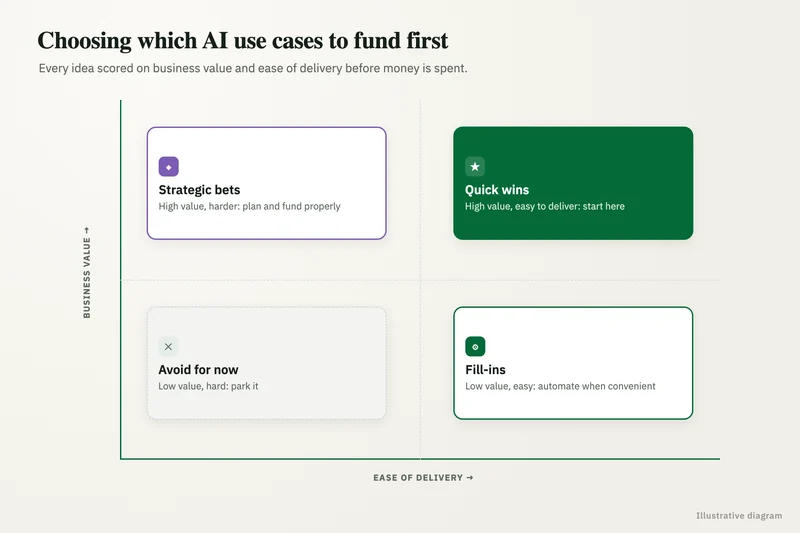
The best first use cases are writing-heavy, repeated often and already reviewed by a person before anything goes out. That combination gives quick time savings with low risk. Decisions about people, such as who qualifies for a service, are the wrong place to start.
| Use case | Systems involved | Risk | Human review |
|---|---|---|---|
| Grant proposal first drafts from past proposals and program data | Google Drive or SharePoint, Candid | Medium | Program and development leads edit every draft |
| Grant and impact report drafting | Program spreadsheets, Salesforce Nonprofit Cloud | Medium | Numbers checked against source data |
| Donor acknowledgment and thank-you letters | Blackbaud Raiser's Edge NXT, Bloomerang or DonorPerfect | Low | Spot-check before each batch |
| Board packet and meeting summaries | Microsoft 365, Google Workspace | Low | Executive director approves |
| Volunteer and program FAQ assistant | Website, shared documents | Medium | Answers limited to approved documents, with escalation |
| Eligibility or case decisions about beneficiaries | Case management systems | High | Not a starting point; humans decide |
What should a nonprofit AI policy cover?
A nonprofit AI policy should fit on two pages and answer what staff can use, what data they can put in and who checks the output. Virtuous found that 47% of nonprofits have no AI policy at all, which means staff are making these calls one by one.
If your organization delivers health services and handles protected health information, any AI vendor that touches that data needs a signed Business Associate Agreement under HIPAA, and major model vendors sign these only on certain business or enterprise tiers, not consumer plans. Also read each funder's grant terms for rules on data handling and AI use in proposals and reports. This is not legal advice; have counsel review the final policy.
- Approved tools: list them by name, on the organization's business accounts, never personal logins.
- Data rules: no beneficiary case details, health information or full donor records in tools without a signed agreement.
- Review: a named person approves anything sent to donors, funders, beneficiaries or the public.
- Disclosure: when the organization tells people they are reading or talking to AI output.
- Ownership and logging: who owns prompts and outputs, and where usage is recorded.
- Review cycle: the policy is revisited at least every six months as tools change.
How do you choose an AI consultant for a nonprofit?
Choose the consultant who starts from your current tools, prices in fixed phases and can show how they measure time saved. Ask these questions on the first call, and treat vague answers as a no. Our guide on how to choose an AI consulting firm covers the general vetting process in more depth.
- Will you use the nonprofit discounts and the AI already in our Microsoft 365 or Google Workspace before recommending anything new?
- Is each phase fixed price, and what exactly is delivered at the end of it?
- How will you measure hours saved, and what is the baseline?
- Which of our donor and beneficiary data will you or the tools see, and under what agreement?
- Do we own every account, prompt, document and workflow you set up?
- What will this cost us per month to run after you leave?
- What would you advise us not to do with AI?
When should a nonprofit not hire an AI consultant?
Skip the consultant if you have fewer than about ten staff and one person willing to own AI adoption. Free vendor training, such as Anthropic's AI Fluency for Nonprofits course, plus a short policy and the discounted seats above may be enough. Also wait if your donor or program data lives in scattered spreadsheets with no agreed owner; fix that first, because no AI plan survives bad source data.
Be wary of any proposal that opens with a custom build, a long retainer or a promise of transformation. The NTEN and Bridgespan findings suggest most nonprofits lack a roadmap and a budget line, so the first purchase should create those, not a platform.
What does a 90-day nonprofit AI plan look like?
A practical first 90 days moves from inventory to policy to two measured pilots, with a go or stop decision at the end. Each step below should have an owner on your side, not only on the consultant's.
- Weeks 1 to 2: inventory current AI use, tools and licenses; interview development, programs, finance and operations leads; record baseline hours for target tasks.
- Weeks 3 to 4: pick two use cases from the priority table, choose tools within existing licenses or nonprofit discounts, and draft the AI policy for board approval.
- Weeks 5 to 8: train staff by role on real work, such as a live grant draft, and run both pilots with named reviewers.
- Weeks 9 to 12: compare hours and error rates with the baseline, decide which pilot to keep, and write the next-year plan and budget line.
How does Greenwolf Tech Labs work with nonprofits?
We start with a free review of your processes, systems and current AI use, then quote a fixed price for each phase, usually a readiness assessment followed by policy and staff training. We recommend tools you already own or can get at nonprofit rates before anything new, you keep every account, prompt and document, and a person stays in the loop on anything touching donors, beneficiaries or money.
Where a build makes sense later, we can deliver it. Deadline-driven reporting is familiar ground: for a regulatory consulting firm we built a compliance tool with recurring tasks, owners and due-date reminders that cut status reporting from 4 to 5 hours to under 15 minutes (see our case studies). Grant reporting calendars follow the same pattern. Email info@aiconsultingservicesusa.com or book a free review to see whether AI is worth it for your organization this year.
Case study · Insurance brokerage, Australia
Automation and dashboarding
Policy data arrived as spreadsheets from several insurers, each in a different structure, and every client report took hours of manual cleanup. An automated pipeline that standardizes every insurer's file and feeds a single reporting dashboard.
- Report time cut from 4-5 hours to under 5 minutes
- Reporting accuracy up from about 75% to 99%

FAQ
Frequently asked questions
How much does AI consulting for nonprofits cost?
Published nonprofit packages start around $2,500 for a two-week readiness assessment and $4,500 to $7,500 for a team rollout with training, according to Justin McKelvey's nonprofit pricing. Firms serving larger organizations list discovery at about $10,000 and retainers of $10,000 or more a month. Most small nonprofits only need the fixed-price packages.
Do AI companies offer discounts to nonprofits?
Yes. Anthropic offers up to 75% off Claude Team and Enterprise plans, OpenAI runs a nonprofit program for ChatGPT Business and Enterprise, Google Workspace for Nonprofits has a free core edition, and eligible Microsoft 365 nonprofit plans include Copilot Chat at no extra charge. Eligibility is verified, so confirm before budgeting.
Can nonprofits use ChatGPT or Claude to write grant proposals?
They can use them for first drafts, using past proposals and program data, as long as a person edits and fact-checks every draft. Read each funder's guidelines for rules on AI use, and never paste beneficiary case details into a tool that has no data agreement with your organization.
Is donor data safe in AI tools?
It is safer on business or enterprise plans with admin controls than on personal accounts, which is why the policy should name approved tools and ban personal logins. Keep full donor records out of AI tools unless the vendor agreement covers that data, and limit access to the staff who need it.
Do small nonprofits need an AI consultant?
Not always. A nonprofit with fewer than about ten staff can often get far with free vendor training, discounted seats and a short policy. A consultant is worth it when several teams use AI with no shared rules, or when you want a measured plan and budget line to show your board or funders.
What is the first AI project a nonprofit should do?
Start with repeated writing work that a person already reviews, such as donor acknowledgment letters, board summaries or grant draft sections. These save time quickly with low risk. Leave decisions about beneficiaries, eligibility and money to people.
Can grant funding pay for AI consulting?
Sometimes, if the grant allows capacity-building or technology spending, so check the terms with your program officer. Fixed-price phases with clear deliverables are easier to justify in a budget and report on than open hourly billing.
Keep reading
Related pages
Get started
Tell us where AI should pay back
Describe the work that eats your team's time and the systems you run. We reply within one business day with the use cases we would test first, the risks to plan for and a fixed-price proposal.
- Free 30-minute AI review
- Fixed quote before any work starts
- Advice that is vendor-neutral, in plain English
Prefer email? info@aiconsultingservicesusa.com
Book a free AI review
Two lines is enough to start.