

Industry guide
AI consulting for distributors: what to fund first and how to get it into daily operations
AI consulting for distributors helps wholesale and industrial distribution companies decide which AI use cases will move margin, in what order to build them and how to run them safely on top of the ERP they already have. This guide is for owners, presidents and operations or finance leaders at US distributors with roughly 20 to 1,000 staff who want a short, ranked plan rather than another pilot that never reaches the warehouse floor.
Book a free AI review
Two lines is enough. A specialist replies within one business day.
Executive summary
What does AI consulting for distributors involve?
AI consulting for distributors means choosing the few workflows where AI pays back, usually order entry from emails and PDFs, quoting, product data and customer service, then checking that ERP and pricing data can support them, setting rules for supplier and customer data, and running one measured pilot. A good engagement ends with a ranked roadmap and one use case live.
What to take away
- Start with order entry, quoting and product data, where hours and errors are easy to count.
- Distribution Strategy Group found only 15% of distributors have a proven AI use case in daily operations.
- Your ERP item master, pricing matrices and customer records decide what AI can do reliably.
- Fund one fixed-price pilot with a named owner before buying licences for everyone.
Why do distributors need a different AI plan?
Because a distributor's profit lives in thin margins, high transaction volume and a huge catalog, so the AI questions are different from a software company or a law firm. A typical wholesaler processes thousands of order lines a week, maintains tens of thousands of SKUs with supplier-supplied descriptions of uneven quality, and prices through customer-specific contracts, rebates and matrix pricing in the ERP. Small errors repeated at that volume cost real money, and small time savings at that volume add up quickly.
The data also sits in specific places. Orders arrive by email, PDF purchase orders, EDI 850 transactions, phone calls and a B2B web portal. Product, pricing and customer records live in a distribution ERP such as Epicor Prophet 21, Infor CloudSuite Distribution, NetSuite, Microsoft Dynamics 365 Business Central, Acumatica or SAP Business One. A plan that ignores those systems produces demos, not results.
The execution gap is wide. Distribution Strategy Group's 2026 research, reported in September 2026, found that 93% of wholesale distribution executives call AI a strategic priority, yet only 15% of distributors have moved a proven use case into daily operations. Distribution Strategy Group also reported in May 2026 that US Census Bureau survey data show wholesale trade adopting AI below the national average. Most distributors are not short of interest; they are short of a sequence that gets one use case working and then the next.
Which AI use cases pay off first for distributors?
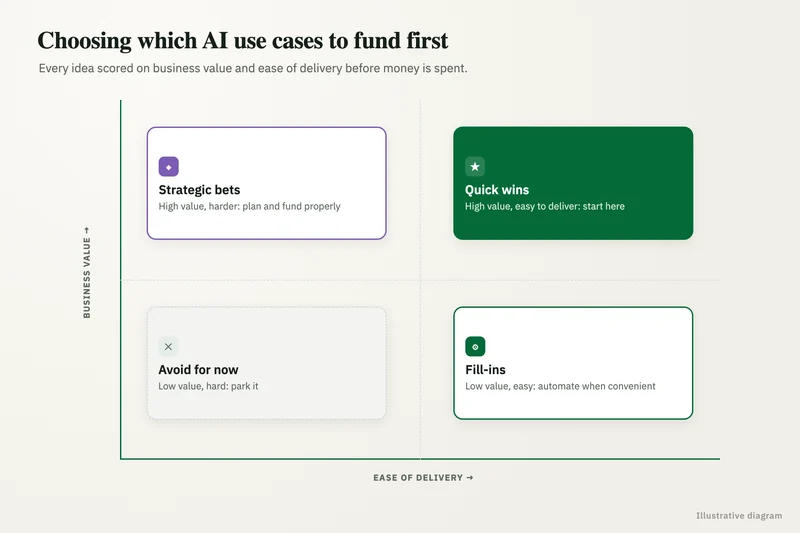
The best first use cases are frequent, rule-heavy and easy to measure: turning unstructured orders into ERP sales orders, drafting quotes, cleaning product data and answering routine customer questions. Demand forecasting and dynamic pricing can pay well, but they depend on clean history and carry more risk, so they usually come second or third.
The table below is the shortlist we start from when ranking use cases with a distributor. Effort assumes an ERP with an API or a reliable import route; older on-premise systems add integration work.
| Use case | What AI does | Systems involved | How to measure | Typical effort |
|---|---|---|---|---|
| Order entry from email and PDF | Reads customer POs, matches customer part numbers to your SKUs, creates draft sales orders for review | Shared inbox, ERP sales order API, customer cross-reference table | Minutes per order, keying errors, same-day ship rate | Low to medium |
| Quote and RFQ response | Pulls items, contract prices and stock from the ERP to draft a quote a rep approves | ERP pricing and inventory, CRM such as HubSpot or Salesforce | Quote turnaround time, win rate | Medium |
| Product data cleanup | Standardizes supplier descriptions and attributes, flags duplicates and missing fields | ERP item master, PIM, ecommerce catalog | Items enriched per week, search success on the web portal | Low to medium |
| Customer service answers | Answers order status, tracking, availability and document requests from ERP data, hands off exceptions | ERP, carrier tracking, helpdesk such as Zendesk | Tickets handled without a person, response time | Medium |
| Supplier and vendor research | Finds and screens alternate suppliers against your rules for a sourcing or line review | Supplier database, spreadsheets, web research | Hours per sourcing project | Low to medium |
| AP and supplier invoice matching | Extracts supplier invoices and matches them to POs and receipts, flags variances | ERP AP module, EDI 810, document inbox | Invoices per clerk hour, exceptions caught | Medium |
| Demand forecasting and replenishment | Adds signals to suggested purchase quantities by item and branch | ERP purchasing and inventory history | Stockouts, inventory turns, excess stock | High |
What does an AI use case look like in numbers? A worked example
Here is an order entry example with round numbers. The volumes and the $32 loaded hourly cost are assumptions for illustration, not industry benchmarks; replace them with your own figures before making a decision.
A 120-person industrial distributor receives about 1,500 emailed or PDF purchase orders a month. Each takes an inside sales rep around 6 minutes to key into the ERP, or 150 hours a month. Roughly 3% of orders need a correction later because of a wrong item, quantity or ship-to address.
With AI reading each PO, matching customer part numbers against a cross-reference table and drafting the sales order, the rep reviews and releases it instead of keying it. If review takes 2 minutes, monthly effort falls to 50 hours, freeing about 100 hours. At the assumed $32 an hour, that is around $3,200 a month of capacity, or about $38,400 a year, before counting fewer correction credits, faster same-day shipping and reps spending more time selling.
Against that, budget for the one-time build and the running cost: model usage per document, a workflow platform such as n8n, Make or a Python service, and a person reviewing exceptions. If the yearly running cost plus a fair share of the build stays well below the value of the freed hours and avoided errors, the use case earns its place on the roadmap. If the order volume is a few hundred a month, it may not, and a simpler fix such as a better customer portal can win.
Is your ERP and product data ready for AI?
Usually partly, and an AI consulting engagement for a distributor should find out exactly where before any build starts. Most failures in distribution AI trace back to data the model has to rely on: duplicate items, missing units of measure, customer part numbers that were never cross-referenced and pricing logic that lives in a senior rep's head.
These are the checks we run during a readiness review with a distributor:
- Item master: share of SKUs with complete descriptions, units of measure, pack quantities and key attributes; number of near-duplicate items.
- Customer cross-references: whether customer part numbers and ship-to codes are stored in the ERP or only in reps' memories and spreadsheets.
- Pricing: whether contract prices, matrix pricing and rebates are maintained in the ERP, so an AI-drafted quote uses the same price a person would.
- Access route: whether your ERP version offers a usable API, scheduled exports or EDI, and who controls user permissions for an integration account.
- Volume and baseline: current counts and time per task for the candidate workflows, so savings can be measured rather than estimated afterwards.
- Exceptions: how orders, quotes and invoices that do not fit the normal path are handled today, because AI should route those to a person, not guess.
How should distributors govern AI with supplier and customer data?
Treat supplier costs, rebate agreements and customer-specific pricing as confidential data with written rules, because they are what competitors would most like to see. Some supplier and buying-group agreements also restrict how pricing and program terms can be shared, so check them before that data goes near any AI tool. This is operational guidance, not legal advice.
In practice the rules are short. Approve specific business or enterprise plans from Microsoft, OpenAI, Anthropic or Google with data terms you have read, and keep personal accounts away from pricing and customer files. Give integrations their own ERP user with read access limited to what each workflow needs. Keep a log of prompts, outputs and who approved each order or quote. Set a confidence threshold so low-confidence matches go to a human review queue instead of into the ERP. Anything that commits money, such as a price below floor, a credit or a purchase order to a supplier, stays with a person. Our AI governance consulting work turns these points into a one-page policy staff can follow.
What should AI consulting for distributors deliver?
Decisions and one working proof. At the end of the first phase, leadership should know which three to five use cases come first, what each is expected to save or earn, which data must be fixed first, which tools are approved for which data, and what the next twelve months cost to run.
In our AI strategy consulting work the outputs are an inventory of AI tools already in use across branches and departments, a ranked use-case list scored on value, data readiness and effort, a data cleanup list for the ERP, a short AI use policy, a measurement plan with baselines, and a fixed-price pilot on the top use case. If you want us to build the pilot as well, we can, and you keep ownership of the accounts, code, prompts and data.
One example from our case studies fits distribution sourcing closely: for a sourcing and supplier quality consultancy we built two tools that find candidate suppliers and apply the client's screening rules automatically, cutting time spent on supplier scouting by 85% and its cost by 91%. Line reviews and alternate-source searches at a distributor follow the same pattern.
What does a 90-day AI plan for a distributor look like?
Ninety days is enough to go from scattered experiments to one use case in daily operations and a funded roadmap. The plan below assumes one executive sponsor, usually the COO or VP of operations, who can make decisions within a day or two.
- Days 1 to 15: interview inside sales, purchasing, customer service, warehouse and finance leads; collect sample POs, quotes and invoices; record volumes and minutes per task.
- Days 16 to 30: run the ERP and data checks, score use cases, pick the pilot and publish interim rules on which AI tools may touch pricing and customer data.
- Days 31 to 60: build the pilot against a test company or sandbox in the ERP, then run it on live orders or quotes with a person approving every output; track accuracy and time.
- Days 61 to 75: tune matching rules, cross-references and prompts from the errors found, set the confidence threshold and train the team that will own it.
- Days 76 to 90: compare results with the baseline, decide whether to extend to more branches or customers, and confirm the next two use cases and their budgets.
What mistakes do distributors make with AI, and when should you skip a consultant?
The most common mistake is starting with the most exciting use case instead of the most countable one. Forecasting and dynamic pricing are attractive, but without clean history and agreed pricing rules they stall, while order entry and product data quietly deliver. Other frequent mistakes are piloting outside the ERP so nothing changes in daily work, skipping the customer cross-reference cleanup, letting each branch pick its own tools, and declaring success without a baseline.
You may not need a consultant if you are a single-branch distributor whose ERP vendor already offers an AI order entry or search feature that fits your volume, or if you have an internal systems lead with time to run one pilot. Turning on what your ERP or ecommerce platform already includes is often the cheapest first step. Outside help is worth paying for when you run several branches or business units, have more than one candidate use case competing for budget, need integration across ERP, CRM and email, or want an independent view before committing to a vendor's AI add-on.
How do you choose an AI consulting partner for a distribution business?
Choose a partner who asks about order volume, your ERP and how pricing works in the first meeting. Those questions show they understand where a distributor's money is made and lost.
Then ask for specifics. Which workflow would they start with, and what would they measure? Have they worked with your ERP's API or import tools? How will low-confidence matches be handled? Who owns the code, prompts and accounts afterwards? Is the first phase a fixed price with a clear exit point? Our guide on how to choose AI consulting firms has a fuller checklist, and our AI consultant cost guide collects published market rates so you can sanity-check any proposal. For distributors that also run their own fleets or third-party logistics, our page on AI in logistics covers dispatch, routing and proof-of-delivery work.
Case study · Sourcing and supplier quality consultancy
Supplier scouting automation
Analysts found and filtered suppliers by hand on Google for every client brief. Two tools that find candidate suppliers and apply the client's screening rules automatically.
- 85% time saving
- 91% cost saving

FAQ
Frequently asked questions
How are distributors using AI today?
The most common uses are reading emailed and PDF purchase orders into the ERP, drafting quotes, cleaning product descriptions and attributes, and answering order status and availability questions. More advanced distributors add AI to demand forecasting and replenishment. Distribution Strategy Group's 2026 research found only 15% of distributors have a proven use case in daily operations, so most are still early.
What is the best first AI project for a wholesale distributor?
For most distributors it is order entry from emails and PDF purchase orders, because volume is high, the work is repetitive and minutes per order are easy to measure. Product data cleanup is a close second when the web portal or ERP search is weak. Both keep a person approving the output at first.
Does AI work with Epicor Prophet 21, Infor, NetSuite or Business Central?
Yes, where your version offers an API, scheduled exports, EDI or a reliable import route; check which of these your licence and hosting model include.The integration account should have limited permissions and every AI-created order or quote should be logged. Older on-premise versions may need extra integration work, which a readiness review should identify early.
How much does AI consulting cost for a distributor?
It depends on the number of branches, systems and use cases in scope. We quote a fixed price per phase after a free review, so you know the cost of the first step before committing. Our AI consultant cost guide collects published third-party rates by type of firm.
Can AI set prices for a distributor?
AI can suggest prices or flag quotes that fall below margin targets, but it should work inside the contract prices, matrix pricing and rebates already maintained in your ERP. Final pricing decisions, especially below floor or on strategic accounts, should stay with a person. Clean pricing data comes before any pricing AI.
Is it safe to put supplier pricing and customer data into ChatGPT or Copilot?
Only on approved business or enterprise plans whose data terms you have checked, and only where supplier and buying-group agreements allow it. Personal accounts should never be used for pricing, rebate or customer files. Integrations should use their own limited ERP user and keep logs of what they read and wrote.
How long before a distributor sees results from AI?
A well-scoped first use case such as order entry can usually run on live orders within about 60 days and be measured against a baseline by day 90. Forecasting and pricing projects take longer because they depend on clean history. Results depend more on data quality and a committed owner than on the AI tool chosen.
Keep reading
Related pages
Get started
Tell us where AI should pay back
Describe the work that eats your team's time and the systems you run. We reply within one business day with the use cases we would test first, the risks to plan for and a fixed-price proposal.
- Free 30-minute AI review
- Fixed quote before any work starts
- Advice that is vendor-neutral, in plain English
Prefer email? info@aiconsultingservicesusa.com
Book a free AI review
Two lines is enough to start.