

Industry guide
AI consulting for car dealerships: what to fix first and how to buy it
AI consulting for car dealerships helps dealer principals, general managers and dealer group operators decide which AI tools are worth paying for, in which department, and how to prove the result in the DMS and CRM rather than in a vendor's slide deck. Most dealers already pay for some AI inside their CRM, phone platform or chat widget; the hard part is choosing, connecting and measuring it. This guide covers the use cases that usually pay back first, the compliance duties that come with AI vendors touching customer data, a worked example and a 90-day plan.
Book a free AI review
Two lines is enough. A specialist replies within one business day.
Executive summary
What does AI consulting for car dealerships include?
AI consulting for car dealerships is an outside review of sales, BDC, service, F&I and back-office workflows that ranks AI use cases by payback, picks or audits vendors, checks them against the FTC Safeguards Rule and TCPA consent rules, and sets up measurement in the DMS and CRM so the store can see which tools actually move appointments, shows and gross.
What to take away
- Cox Automotive found 82% of dealers use AI, but few can show the revenue gain.
- Start with lead response, service scheduling and back-office documents before pricing or F&I tools.
- AI vendors that touch deal jackets fall under your Safeguards Rule vendor oversight duties.
- Measure every tool against appointments, shows, ROs and gross in your own DMS and CRM.
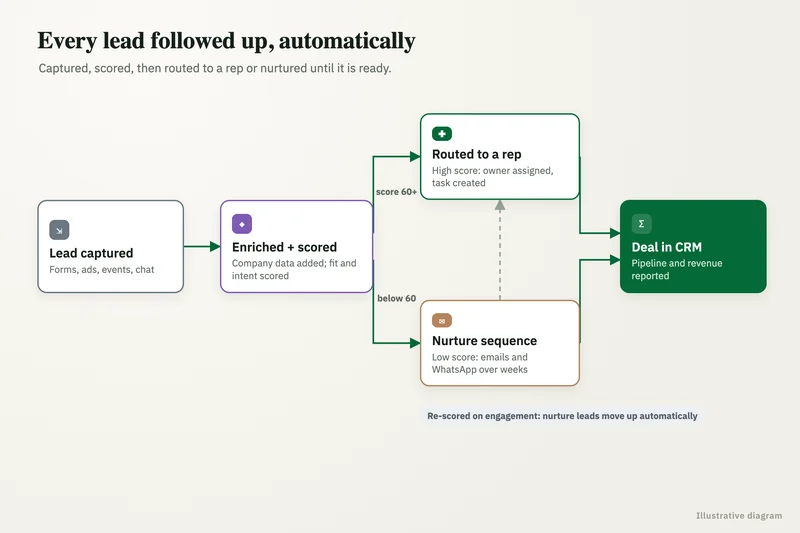
Why are dealers hiring AI consultants now?
Because most dealerships already bought AI and cannot tell whether it works. Cox Automotive's AI in Auto Retail Tracker, published in August 2026 from surveys of 987 dealers across the first two quarters of the year, found that 82% of dealers use AI, yet only 22% of AI users report the sales and revenue growth that 69% expected. About a third either are not measuring impact or are unclear how they measure it.
The same tracker found that dealers working with an external AI partner reported revenue growth at 36%, against 21% for dealers going it alone. That is a correlation, not proof that consultants cause growth, but it matches what we see in practice: the gap is rarely the software itself. It is the missing link between the tool and the dealership's own numbers, the lack of an owner for each tool, and overlapping vendors doing the same job inside the CRM, the phone system and the website chat.
A typical store now has an AI feature in its CRM (VinSolutions, DealerSocket, Elead or the DMS vendor's own CRM), another in its phone or call-tracking platform, a chat or text assistant on the website and possibly a separate service scheduling assistant. Each vendor reports its own success metric. Nobody reconciles those metrics against appointments that showed, repair orders opened and gross booked in CDK, Reynolds and Reynolds, Dealertrack or Tekion. That reconciliation is the first job of AI consulting for car dealerships.
Which AI use cases pay back first at a dealership?
The use cases that pay back first share three traits: high volume, a clear existing metric and low risk if the AI gets one wrong, because a person reviews the output or the cost of an error is small. Pricing, credit and F&I product recommendations score lower on the third test, so they usually come later. The table ranks the common options by department.
| Department | AI use case | Systems involved | Metric to track | Typical priority |
|---|---|---|---|---|
| Sales and BDC | Instant first response and follow-up on internet leads, after-hours text and email | CRM (VinSolutions, DealerSocket, Elead), lead providers, website chat | Response time, appointment set rate, show rate | First wave |
| Sales and BDC | Call analysis: missed opportunities, unbooked calls, coaching flags | Call tracking and phone platform, CRM | Calls converted to appointments | First wave |
| Service | Online and phone appointment booking, recall and maintenance outreach | Service scheduler (Xtime, myKaarma or DMS scheduler), DMS, phone system | Booked appointments, missed calls, RO count | First wave |
| Service | Status updates and approval requests for open repair orders | DMS, texting platform | Hours to approval, cycle time | Second wave |
| Back office | Deal jacket checks, title and registration paperwork, funding conditions | DMS, document storage, lender portals (RouteOne, Dealertrack) | Contracts in transit days, funding delays | Second wave |
| Used vehicles | Appraisal support, reconditioning tracking, aged unit alerts | Inventory tool (vAuto or similar), DMS | Days to frontline, aged units | Second wave |
| Management | Daily and monthly reporting across rooftops in one view | DMS exports, CRM, accounting | Hours spent on reports, decision lag | First wave for groups |
| F&I | Menu and product recommendation, compliance checks | F&I menu system, DMS | Product penetration, chargebacks, audit findings | Later, with legal review |
What does a dealership AI consulting engagement deliver?
A useful engagement ends with decisions and evidence, not a slide deck about the future of automotive retail. For a single rooftop or a small group, the core deliverables are usually these:
- An inventory of every AI feature already paid for, by vendor and department, with monthly cost and any overlap.
- A ranked use-case list scored on volume, payback, risk and data access, like the table above but built from your store's numbers.
- A measurement plan: which DMS and CRM fields prove each tool works, and a baseline taken before anything changes.
- A vendor shortlist and scorecard for the top two use cases, including integration method, data access and contract terms.
- A Safeguards Rule and consent review of each AI vendor that touches customer information or makes calls and texts.
- A 90-day pilot plan with an owner per tool, a go or no-go threshold and a rollback path.
What does the FTC Safeguards Rule mean for dealership AI tools?
The FTC states that automobile dealers who finance or facilitate financing, or who lease vehicles for longer than 90 days, are financial institutions under the Safeguards Rule. That rule requires a written information security program, a Qualified Individual to run it, risk assessments, encryption of customer information, multi-factor authentication for anyone accessing it, and oversight of service providers through contracts and periodic reassessment. Since the 2023 amendments took effect in May 2024, a security event involving unencrypted information of at least 500 consumers must be reported to the FTC as soon as possible and no later than 30 days after discovery.
AI tools make the service-provider part of the rule harder. A lead response assistant reads names, phone numbers and trade-in details. A deal jacket checker reads credit applications, driver's licenses and Social Security numbers. Before signing, ask each vendor where data is stored, whether it is used to train shared models, who at the vendor can see it, how access is logged and how quickly they will tell you about an incident. Put the answers in the contract and in your written program. Your Qualified Individual should sign off on any AI tool that touches the deal side of the store.
Phone and text tools carry a second set of rules. The FCC ruled on February 8, 2024 that AI-generated voices count as artificial voices under the TCPA, so outbound calls using them need prior express consent. Some states also require disclosure that a caller is an AI, and states with two-party consent rules for call recording apply to AI phone assistants that record calls. This is not legal advice; have your dealer counsel review any outbound AI calling or texting program before launch.
A worked example: AI lead response for a single-rooftop BDC
The numbers below are illustrative, to show how a consultant should frame the decision. Replace them with your own CRM data.
Assume a franchise store receives 600 internet leads a month. Its CRM shows that leads arriving after 7 pm or on Sundays, about 30% of the total, get a first human reply the next morning. Its appointment set rate is 22% for leads answered within an hour and 12% for leads answered the next day. If an AI assistant answers the 180 after-hours leads within minutes and sets appointments at even 18% instead of 12%, that is about 11 more appointments a month.
Now apply the store's own show rate and close rate. At a 60% show rate and a 40% close on shows, 11 appointments become roughly 2.6 extra sales a month. Multiply by the store's average front and back gross per unit and compare that with the tool's monthly fee plus the BDC time spent reviewing its conversations. If the result is positive with conservative inputs, the pilot is worth running. If it only works with optimistic inputs, fix the human response time first, because that is cheaper.
The same arithmetic works in service: missed calls per week from the phone platform, times the share that would have booked, times average customer-pay RO value. A consultant's job is to make sure every input comes from your DMS, CRM or phone reports, and that the pilot measures the same fields afterwards.
AI consultant, DMS vendor or AI vendor: who should a dealer hire?
Dealers have three sources of help, and each fits a different situation. The table shows where each is strongest.
| Option | Best when | Watch out for |
|---|---|---|
| Your DMS or CRM vendor's AI add-ons | You want one contract, native data access and the use case is standard (lead response, service scheduling) | Measurement comes from the same vendor selling the tool; limited help comparing alternatives |
| A specialist automotive AI vendor | One clear problem, such as service phone calls or BDC follow-up, and a proven product for it | Overlap with tools you already pay for; data access terms; long contracts |
| An independent AI consultant | Several vendors already in place, unclear results, a dealer group needing one plan across rooftops, or a custom workflow no product covers | Consultants who only advise and never connect tools to data; open-ended hourly billing |
| Doing it in-house | A group with an IT or digital lead who has time to own vendor selection and measurement | The project stalls when that person is pulled back into daily operations |
A 90-day plan for AI at a dealership
Ninety days is enough to prove or kill one or two use cases. Longer pilots usually mean the success measure was never defined.
- Days 1 to 15: list every AI feature and vendor already paid for, pull 90 days of baseline data from the DMS, CRM and phone platform, and interview the GM, sales manager, BDC manager, service manager and office manager.
- Days 16 to 30: rank use cases, pick one in sales or BDC and one in service, write the success thresholds and complete the Safeguards Rule and consent review for the chosen vendors.
- Days 31 to 75: run the pilots with a named owner for each, review a sample of AI conversations every week and track the agreed fields against the baseline.
- Days 76 to 90: compare results with the thresholds, cancel what did not pay back, negotiate terms for what did and choose the next use case from the ranked list.
What does AI consulting for car dealerships cost?
There is no published price list specific to dealerships, so use general AI consulting benchmarks and scope carefully. Our AI consultant cost guide collects published third-party rates by firm type, from freelancers to the largest firms. For a single rooftop, a focused review of existing tools plus a 90-day pilot plan is a much smaller piece of work than a group-wide strategy across many stores and brands.
Two things move the price most at a dealership: the number of vendors and rooftops involved, and whether the consultant also connects tools to the DMS and CRM or only advises. Ask for a fixed price per phase, with the deliverables listed, and keep the running cost of each AI tool (per-seat, per-lead or per-minute fees) in the same business case, since those fees continue long after the consulting work ends.
Common mistakes, and when a dealer should not hire a consultant
The most common mistake is buying a second tool for a problem the first tool already covers, such as a standalone chat assistant on top of a CRM that already answers leads. The second is trusting vendor dashboards instead of DMS and CRM data. The third is giving an AI vendor access to deal jackets before the Qualified Individual has reviewed the contract. The fourth is launching outbound AI calls or texts without checking consent records.
You probably do not need a consultant if you run one rooftop with one CRM, have a single clear problem such as after-hours lead response, and your CRM vendor already offers a tool for it with measurement you can verify in your own reports. Turn it on, set a baseline and review it in 60 days. Outside help earns its fee when there are several vendors, several stores, unclear results or a workflow that no off-the-shelf product handles.
When we work with multi-location businesses, the first win is often reporting rather than customer-facing AI. In one of our case studies, an insurance brokerage cut report time from 4 to 5 hours to under 5 minutes by standardizing each source's spreadsheet into one dashboard. Dealer groups pulling numbers from several DMS instances face the same problem.
How Greenwolf Tech Labs helps dealerships with AI
We start with a free review of your current tools, systems and goals, then quote a fixed price for each phase. We can advise on strategy and vendor choice, and we can also build the connections and custom workflows that off-the-shelf products leave out, such as cross-rooftop reporting or document checks. You own the accounts, code, prompts and data, and a person stays in the loop on anything that touches money, customers or regulated data.
If a smaller first step would answer your question, such as an AI readiness assessment of one store, we will suggest it before a larger engagement.
FAQ
Frequently asked questions
How are car dealerships using AI in 2026?
Cox Automotive's August 2026 tracker found the most common uses among dealers using AI are automating tasks (40%), coordinating customer follow-up (40%) and generating content (38%). In practice that means lead response, call analysis, service scheduling and marketing copy.
Do AI tools at a dealership fall under the FTC Safeguards Rule?
The rule covers dealers who finance, facilitate financing or lease vehicles for more than 90 days, and it requires oversight of service providers that access customer information. An AI vendor that reads leads, credit applications or deal jackets is such a provider, so it belongs in your written security program and vendor contracts. This is not legal advice.
Can a dealership use AI voice calls for sales follow-up?
Only with care. The FCC ruled in February 2024 that AI-generated voices count as artificial voices under the TCPA, so outbound calls using them need prior express consent. Some states also require AI disclosure, so have dealer counsel review the program first.
What is the best first AI project for a car dealership?
Usually after-hours lead response in sales or phone booking in service, because both have high volume, existing metrics and low risk. Dealer groups often get a faster win from consolidated reporting across rooftops.
Should we use our DMS vendor's AI or hire a consultant?
If you have one store, one clear problem and your DMS or CRM vendor offers a tool you can measure in your own reports, start with the vendor. A consultant helps most when you have several vendors, several rooftops or results you cannot verify.
How long does it take to see results from dealership AI?
A focused pilot with a baseline and clear thresholds can show whether a tool works within about 90 days. If a vendor cannot define the success measure before launch, results will be hard to prove at any length.
How much does AI consulting for car dealerships cost?
Price depends on the number of rooftops, vendors and whether the work includes connecting tools to your DMS and CRM. Our AI consultant cost guide lists published third-party rates by firm type, and we quote a fixed price per phase after a free review.
Keep reading
Related pages
Get started
Tell us where AI should pay back
Describe the work that eats your team's time and the systems you run. We reply within one business day with the use cases we would test first, the risks to plan for and a fixed-price proposal.
- Free 30-minute AI review
- Fixed quote before any work starts
- Advice that is vendor-neutral, in plain English
Prefer email? info@aiconsultingservicesusa.com
Book a free AI review
Two lines is enough to start.