

Legal AI guide
AI consultant for law firms: what to hire one for, and what to ask first
An AI consultant for law firms helps partners decide which AI tools to adopt, for which matters, under which ethics rules, and how to prove the time savings before rolling them out firm-wide. This guide is for managing partners, COOs and practice leaders at US firms of roughly 10 to 200 lawyers who need a defensible plan, not another vendor demo.
Book a free AI review
Two lines is enough. A specialist replies within one business day.
Executive summary
What does an AI consultant for law firms do?
An AI consultant for law firms audits how the firm already uses AI, picks the few workflows worth changing, vets legal AI vendors for confidentiality, writes the firm's AI policy against ABA Formal Opinion 512 and state bar guidance, trains lawyers to verify output, and measures time saved on real matters before a wider rollout.
What to take away
- ABA Formal Opinion 512 makes competence, confidentiality, supervision and fees the four core design constraints.
- Clio's 2025 report found most legal professionals use AI, but fewer use legal-specific tools.
- Start with a policy, one or two workflows and a verification step before buying firm-wide licenses.
- Skip the consultant if you have one clear use case and a vendor that already fits it.
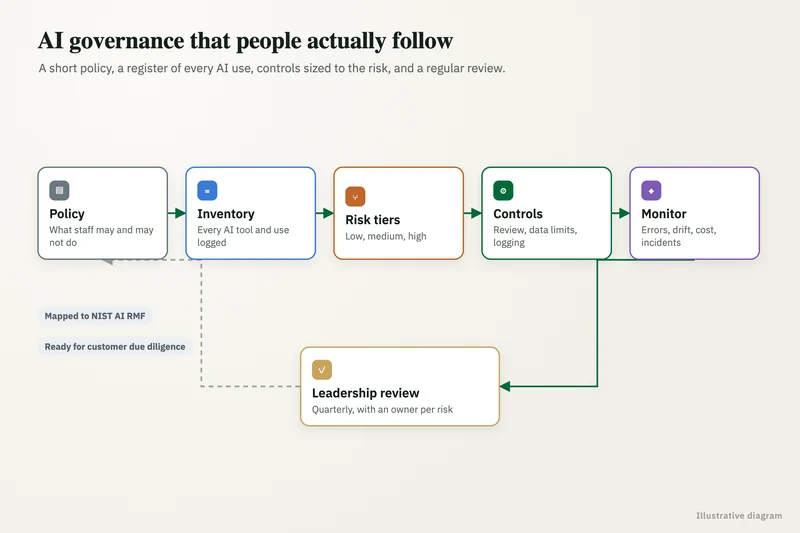
What does an AI consultant for law firms actually do?
A good AI consultant for law firms turns scattered, informal AI use into a short list of approved tools, approved uses and checks that partners can defend to clients, courts and insurers. The work is advisory first: deciding what to do and in what order. Building or configuring tools comes later, and only for the workflows that earned it.
In practice that means six pieces of work. Each one should end in a document or decision you keep, not a slide deck.
- Shadow AI audit: who is already pasting client material into ChatGPT, Claude, Gemini or Copilot, on which account type, and with what retention settings.
- Workflow selection: scoring intake, conflicts, document review, first drafts, research memos, deposition summaries and billing narratives by hours spent, risk and data sensitivity.
- Vendor evaluation: comparing legal-specific products such as Harvey, Thomson Reuters CoCounsel and Lexis+ AI against general assistants your firm may already license, such as Microsoft 365 Copilot.
- Firm AI policy: approved tools, prohibited inputs, verification rules for anything filed or sent to a client, and how AI time is billed.
- Training: practical sessions on prompting, citation checking and spotting fabricated authority, run on the firm's own document types.
- Measurement: a baseline of hours per task before the pilot and the same measure after, so the partnership decides on numbers.
Why law firms need a different kind of AI consultant
Law firms carry duties that most businesses do not, and a generalist who treats a firm like any other company will miss them. The ABA issued Formal Opinion 512 on July 29, 2024, its first formal ethics opinion on generative AI, and it ties AI use directly to the Model Rules a lawyer can be disciplined under.
The risk is no longer theoretical. The Maryland State Bar Association reported in July 2026 that Damien Charlotin's database of AI hallucination cases had logged 1,240 US filings containing fabricated AI material since April 2023, with 668 of them in 2026 alone. Most of those came from self-represented litigants, but lawyers accounted for 256 of this year's instances, and courts issued monetary sanctions and disciplinary referrals.
There is also a tool-choice problem. Clio's 2025 Legal Trends Report found that 79% of legal professionals use AI, but only 40% use legal-specific AI products, down from 58% the year before. In other words, many lawyers are drifting toward general chat tools on whatever account they happen to have. That is exactly the situation a consultant should resolve first: not by banning tools, but by giving people an approved option that is safer and better for legal work.
How ABA Formal Opinion 512 shapes a law firm AI plan
Opinion 512 does not ban any tool; it tells lawyers what they must understand and control. A competent AI consultant for law firms should map every recommendation to these rules. The table below summarizes the opinion's main points and what each means for your plan. This is a summary, not legal advice, and your state bar's guidance may add requirements.
| Model Rule | What Opinion 512 says | What your AI plan needs |
|---|---|---|
| 1.1 Competence | Lawyers need a reasonable understanding of the specific tool's capabilities and limits and must not rely on output without appropriate verification. | Tool-specific training and a written verification step for every output type. |
| 1.6 Confidentiality | Evaluate the risk of disclosing client information; self-learning tools may require the client's informed consent. | Vendor review of training use, retention and access; a list of data that never goes into AI. |
| 1.4 Communication | Whether to tell clients about AI use depends on the facts of each matter. | A default disclosure position and engagement-letter language reviewed by your ethics counsel. |
| 3.3 Candor to the tribunal | Review output for accuracy, missing controlling authority and misleading arguments before filing. | Cite-checking against a primary source before anything is filed. |
| 5.1 and 5.3 Supervision | Supervising lawyers need clear policies, training and monitoring, including of outside providers. | A named AI owner, an approved-tool list and periodic spot checks. |
| 1.5 Fees | Bill actual time spent, not time saved, and not time spent learning a tool; some AI costs are overhead. | A billing rule for AI-assisted work and flat-fee review where AI cuts effort. |
Which law firm workflows should an AI consultant look at first?
Start where volume is high, the output is checked by a lawyer anyway, and an error is caught before it reaches a client or court. Leave anything that ends in a filing without strong cite-checking until the firm has its verification habits in place.
Our rule of thumb when ranking workflows is simple: high hours, internal-only output and clear right answers go first. Research memos and briefs come later, when the firm has a legal research tool with citations to primary sources and a habit of checking them.
| Workflow | Typical AI role | Risk level | Usually a good first pilot? |
|---|---|---|---|
| Client intake and conflicts | Summarize inquiries, extract parties and route to the right attorney | Low to medium | Yes, with a human conflicts check |
| Deposition and transcript summaries | Draft summaries with page and line references | Low | Yes |
| Document review and due diligence | Flag clauses and issues across a data room | Medium | Yes, with sampling and lawyer review |
| First drafts of routine documents | Draft from firm templates and clause banks | Medium | Often |
| Billing narratives and time entries | Clean up and standardize entries | Low | Yes, with Rule 1.5 in mind |
| Legal research and brief writing | Find authority and draft arguments | High | Only with a legal research tool and mandatory cite-checking |
| Client-facing chat on the website | Answer general questions and book consults | High | Rarely as a first project |
A worked example: a 25-lawyer litigation and business firm
Here is how we would structure an engagement for a hypothetical 25-lawyer firm with a litigation group and a transactional group. It is an illustration of the method, not a client result.
Weeks 1 and 2 are discovery. We survey lawyers and staff about current AI use, review which accounts and settings they use, and pull time data for five candidate tasks. Suppose associates spend about 6 hours on each deposition summary and the firm handles around 20 depositions a month: that is roughly 120 hours a month on one task, all of it reviewed by a lawyer anyway. That task goes to the top of the list.
Weeks 3 and 4 are decisions. We compare two or three tools against the firm's own anonymized transcripts, check each vendor's terms on training use, retention and access, and draft the AI policy and billing rule. The partners approve one pilot and one tool.
Weeks 5 to 10 are the pilot. Four associates use the approved tool on live transcripts, a supervising partner spot-checks a sample of summaries against the transcript, and we log time per summary and every error found. If summaries drop from 6 hours to 2 with an acceptable error rate, the firm has measured evidence for about 80 hours a month returned to billable or higher-value work, and can decide whether to extend it. If they do not, the firm has spent weeks, not a year of licenses, finding out.
The same structure works for intake, contract review or billing narratives. What changes is the baseline task and the verification step.
Vendor due diligence checklist for legal AI tools
Every tool that touches client information needs written answers to these questions before anyone uploads a document. Put the answers in a file the supervising partner signs off on, so the Rule 5.3 record exists if a client or insurer asks.
- Does the vendor train or fine-tune models on our inputs or outputs, and can that be switched off by contract, not only in settings?
- How long are prompts, files and outputs retained, and can we set retention to zero or delete on demand?
- Who at the vendor, and at its model providers, can access our data, and under what logging?
- Where is data stored and processed, and which sub-processors are involved?
- Does the tool respect our document-management permissions and ethical walls, or does every user see everything indexed?
- Does research output link to primary sources so a lawyer can verify every citation?
- What audit logs can we export showing who asked what and when?
- What happens to our data and prompts if we cancel?
Questions to ask an AI consultant for law firms before you hire
The best test of an AI consultant for law firms is whether they talk about your duties and your data before they talk about tools. Ask these in the first meeting and listen for specific answers.
- How would you map your recommendations to ABA Formal Opinion 512 and our state bar's guidance?
- Do you receive referral fees or commissions from any legal AI vendor you might recommend?
- How will you measure time saved, and what baseline will you collect before the pilot?
- What does our AI policy look like at the end, and who maintains it?
- Will you handle our client data at all, and if so, under what confidentiality terms?
- What is the fixed price of the first phase, and what exactly do we receive?
- Who owns the prompts, templates and configurations you build for us?
How much does an AI consultant for a law firm cost?
Law firm AI consulting is usually priced as a short fixed-fee assessment, a fixed-fee pilot, or a monthly advisory retainer. Published rates vary widely by provider type, and our AI consultant cost guide collects third-party hourly and project figures in one table so you can sanity-check a proposal.
Two cost lines are easy to miss. First, legal AI licenses are often priced per seat and can exceed the consulting fee within a year, so test on a small group before committing firm-wide. Second, partner and associate time spent in the pilot has an opportunity cost; a good plan keeps that time to a few hours a week. We do not publish rates: after a free review we quote a fixed price per phase.
When a law firm should not hire an AI consultant
Not every firm needs one, and a consultant who says otherwise is selling hours. You can probably skip outside help in three situations.
First, a solo or very small practice with one clear need, such as transcript summaries, can trial a reputable legal AI product for a month, read its data terms, and decide. Second, if your practice management or research vendor already offers an AI feature covered by your existing contract and confidentiality terms, start there and write a one-page policy. Third, if partners are not willing to change how work is assigned or billed, a consultant cannot fix that, and the money is better kept until they are.
You should hire help when several practice groups are using different tools on personal accounts, when a client or insurer has asked about your AI controls, or when you are about to sign a firm-wide license and nobody has measured whether it saves time on your matters.
How Greenwolf Tech Labs works with law firms
We work as AI strategy consultants for professional services firms in US time zones. A typical engagement starts with a free review, then a fixed-price discovery phase that produces your AI policy, an approved-tool shortlist and a ranked list of pilots. We have built compliance and reporting tools for a regulatory consulting firm, described in our case studies, and the same discipline applies here: named owners, due dates and a person reviewing anything that matters.
You keep the accounts, prompts, templates and data. If the plan calls for a build, such as an intake workflow connected to your practice management system, we can deliver it, but the first decision is always whether it is worth doing. Tell us how your firm uses AI today and we will tell you where we would start.
Case study · Logistics company, UK
Route planning automation
Dispatch typed every address into Google Maps, which optimizes only 25 stops and cannot add time at each stop. A Python tool that loads addresses automatically, adds buffer time per stop and optimizes the full route.
- Manual address entry eliminated
- Delivery estimates customers could rely on

FAQ
Frequently asked questions
Do law firms need an AI consultant?
Not always. A small firm with one clear use case can often trial a legal AI product directly. An AI consultant for law firms is most useful when several groups use different tools, when clients or insurers ask about AI controls, or before a firm-wide license is signed.
What is ABA Formal Opinion 512?
It is the American Bar Association's first formal ethics opinion on generative AI, issued July 29, 2024. It applies existing Model Rules on competence, confidentiality, communication, candor, supervision and fees to AI use. It does not ban tools, but it requires lawyers to understand them and verify their output. This is not legal advice; check your state bar's guidance too.
Can lawyers put client information into ChatGPT?
It depends on the account, the vendor's data terms and the client. Opinion 512 asks lawyers to assess the disclosure risk and says self-learning tools may need informed client consent. Consumer accounts with default settings are usually the wrong place for client material; business or enterprise tiers with no training on inputs and controlled retention are a different conversation.
Can a law firm bill clients for time saved by AI?
No. Opinion 512 says lawyers may bill for time actually spent, including reviewing AI output, but not for time saved or for learning a tool. Some tool costs can be passed through as expenses and others are overhead. Many firms review flat-fee pricing for work where AI sharply reduces effort.
What are the risks of AI for law firms?
The main risks are fabricated citations reaching a court, client data exposed through unsuitable tools, unsupervised staff use and billing errors. The Maryland State Bar Association reported 1,240 US filings with fabricated AI material in Damien Charlotin's database by July 2026. A written policy, verification rules and approved tools address most of these risks.
How long does an AI consulting engagement for a law firm take?
A discovery phase that produces a policy and a ranked pilot list typically takes two to four weeks. A measured pilot on one workflow usually runs another four to eight weeks. Firm-wide rollout depends on how many practice groups and tools are involved.
Should a law firm use a legal-specific AI tool or a general assistant?
For legal research and anything filed, legal-specific tools that link to primary sources are usually safer. For drafting emails, summarizing internal notes and admin work, a general assistant on a business tier the firm already licenses can be enough. Most firms end up with one of each, under one policy.
Keep reading
Related pages
Get started
Tell us where AI should pay back
Describe the work that eats your team's time and the systems you run. We reply within one business day with the use cases we would test first, the risks to plan for and a fixed-price proposal.
- Free 30-minute AI review
- Fixed quote before any work starts
- Advice that is vendor-neutral, in plain English
Prefer email? info@aiconsultingservicesusa.com
Book a free AI review
Two lines is enough to start.