

Education guide
AI consultant for education: what schools, colleges and edtech teams should hire for
An AI consultant for education helps a school, district, college or edtech company decide where AI should and should not be used, write the policy that governs it, vet vendors against student privacy law and train staff to use approved tools well. Most institutions do not need a large build first: they need a policy, an approved tool list, a privacy review and a trained team. This guide explains what the work covers for each type of buyer, the 2025 and 2026 rules that now shape it, a worked time budget, the questions to ask before you sign and when you should not hire anyone.
Book a free AI review
Two lines is enough. A specialist replies within one business day.
Executive summary
What does an AI consultant for education do?
An AI consultant for education helps a school, college or edtech company choose where AI is useful, write an AI use policy, check AI vendors against FERPA, COPPA and state privacy rules, train staff by role and plan one or two measured pilots. Good engagements start with tools the institution already licenses and keep people in charge of decisions about students.
What to take away
- Start with policy, privacy review and training before buying any new AI product.
- Ohio required every public district to adopt an AI policy by July 1, 2026.
- Amended COPPA Rule obligations have been enforced by the FTC since April 22, 2026.
- Back-office work like admissions and scheduling often pays back faster than classroom tools.
What does an AI consultant for education actually do?
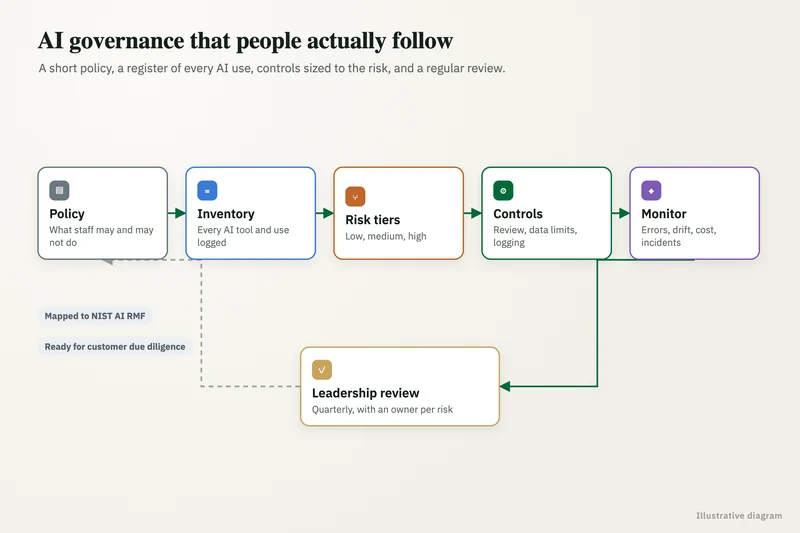
An AI consultant for education turns scattered, informal AI use into a governed plan: what staff and students may use, with which data, for which tasks, and how the institution will know it is working. The usual outputs are a written AI use policy, an approved tool list, a vendor privacy checklist, role-based training and a short roadmap of pilots with owners and measures.
The work splits into two halves that many providers blur. The instructional half covers teaching, assessment, academic integrity and AI literacy for students. The operational half covers the work that runs the institution: admissions and enrollment inquiries, scheduling, family and student communications, document handling, reporting and finance. Instructional coaches and former teachers usually cover the first half well. Business and operations consultants cover the second. Ask any candidate which half they actually deliver, because a policy that ignores operations leaves the office staff improvising, and an operations plan that ignores the classroom misses the risks parents care about most.
We work mainly on the governance and operations side: policy, vendor review, staff training, use-case selection and, where it pays back, building the workflow. For curriculum design and classroom pedagogy, pair any operations-focused consultant with your own instructional leaders.
Which education buyers need an AI consultant, and for what?
The right scope depends on who you are. A public district answers to a school board, state law and federal grant rules. A private school answers to parents and its own board. A college has faculty governance and research data. An edtech company is the vendor the others are vetting. The table below shows what each type of buyer typically needs first.
| Buyer | Usual first need | Main rules to check | Typical first pilot |
|---|---|---|---|
| Public school district | Board-approved AI policy, approved tool list, staff training | FERPA, state student privacy law, any state AI policy mandate | Drafting family communications and meeting summaries with staff review |
| Charter network or private school | Policy plus parent-facing explanation of AI use | FERPA where it applies, COPPA for tools used by under-13s, state privacy law | Admissions inquiry responses and enrollment follow-up |
| College or university | Institution-wide AI strategy and faculty guidance | FERPA, research data agreements, accessibility requirements | Student services FAQ assistant grounded in approved documents |
| Edtech or tutoring company | Product and data practices that pass school vendor reviews | COPPA (as amended), FERPA school-official terms in customer contracts, state privacy law | Internal support and sales responses to district security questionnaires |
Why are schools hiring AI consultants in 2026?
Because the rules arrived faster than most institutions could write their own. Three developments since mid-2025 turned AI from an optional topic into a governance task.
First, states began requiring local policies. Under Ohio House Bill 96, every traditional public district, community school and STEM school had to adopt a formal AI policy by July 1, 2026, and the Ohio Department of Education and Workforce published a model policy in December 2025 that districts can adopt as written or adapt. Tennessee's Public Chapter 550 similarly requires local boards to adopt policies on student and staff AI use. Other states have issued guidance rather than mandates, so check what applies where you operate.
Second, federal money now explicitly covers AI. The US Department of Education's Dear Colleague letter of July 22, 2025 said grantees may use federal funds for AI-supported work such as high-quality curriculum tools, high-impact tutoring and college and career advising, provided initiatives are educator-led, ethical, accessible, transparent and compliant with federal privacy law. The Department then finalized AI as a discretionary-grant priority, effective May 13, 2026.
Third, children's privacy rules tightened. The FTC's amended COPPA Rule took effect June 23, 2025, and enforcement of the new requirements began April 22, 2026. That puts pressure on every tool used by children under 13 and on every edtech vendor selling to K-12.
What do FERPA and COPPA mean for AI tools in schools?
In short: student records can only go to an AI vendor under terms your institution controls, and tools used by children under 13 carry extra consent and security duties. A consultant's job is to turn that into a checklist your staff run before any tool is approved.
Under FERPA, schools commonly share education records with vendors through the school-official exception, which requires that the vendor performs a service the school would otherwise use employees for, is under the school's direct control regarding use and maintenance of the records, and uses the data only for the authorized purpose. When a staff member pastes a student's work or record into a general-purpose AI tool on a personal account, none of those conditions is met, which is why the approved tool list and the ban on personal logins matter more than any other policy line.
The amended COPPA Rule, as summarized by Davis Polk, requires separate parental consent before disclosing children's personal information to third parties, and the FTC said the exception for disclosures integral to the service does not cover sharing to train or otherwise develop artificial intelligence. It also requires a written information security program with annual risk assessments and a written data retention policy that rules out indefinite retention. Edtech vendors should expect districts to ask for all three. This is not legal advice; have counsel review your policy and vendor contracts.
- Does the vendor contract state that student data is not used to train or improve AI models?
- Is the tool used on an institutional account with admin controls, never a personal login?
- Where is data stored, how long is it kept and how is it deleted at contract end?
- If students under 13 use it, how is parental consent handled, and who gives it?
- Can the institution export prompts, outputs and usage logs for review?
- Does the tool meet your accessibility requirements for students with disabilities?
Which AI use cases pay off first in education?
The safest early wins are high-volume writing and administrative tasks that a person already reviews before anything goes out. Decisions about individual students, such as grading, discipline, placement or admission, are the wrong place to start, because errors there are costly and hard to detect.
Operations work is often overlooked. Admissions and enrollment teams answer the same questions every season, office staff rebuild schedules and rosters by hand, and finance teams chase tuition and fee follow-ups. These tasks are easy to measure and rarely touch sensitive student records directly, which makes them good candidates for a first pilot.
| Use case | Typical systems | Risk | Human review |
|---|---|---|---|
| Drafting family newsletters, notices and translations | Google Workspace, Microsoft 365, school messaging tools | Low | Staff approve before sending |
| Admissions and enrollment inquiry replies | Admissions CRM, shared inbox, website forms | Low to medium | Answers limited to approved documents; edge cases routed to staff |
| Meeting notes and board packet summaries | Google Meet, Teams, shared drives | Low | Author checks before circulation |
| Lesson and rubric first drafts for teachers | Gemini for Education, Copilot, approved tools | Medium | Teacher edits every draft |
| Student services FAQ assistant | Website, student handbook, policies | Medium | Cites sources; escalates anything personal |
| Grading, discipline, placement or admission decisions | Student information system | High | Not a starting point; people decide |
What does a worked AI budget look like for a 60-staff private school?
Here is an illustration with numbers you should replace with your own. A private school with 60 staff and 500 students runs Google Workspace for Education. Its admissions office of three people estimates it spends 12 hours a week answering repeat inquiries and scheduling tours in peak season, and teachers estimate an hour a week each on newsletters, notices and routine parent emails.
Tools: Google states that Workspace for Education includes Gemini for Education at no cost, with data not used to train AI models or reviewed by people to improve them. So the first question is whether the school can meet most needs with what it already has, before paying for a second AI product.
Time: if an approved assistant and templates cut the admissions load by a third, that is about 4 hours a week. If teacher communications drop by 20 minutes per teacher per week across 40 teachers, that is about 13 hours a week. Together that is roughly 17 hours a week. At a loaded staff cost of $40 an hour (use your own figure), that is about $680 a week, or roughly $27,000 over a 40-week school year.
The decision rule: the consulting fee for policy, training and two pilots should be clearly smaller than one year of that measured time, and the assessment should test the assumptions above against real logs before anyone commits to a build. For wider market rates, Softude's 2026 guide puts strategy and discovery phases at larger firms at $40,000 to $120,000, which is more than most single schools need; our AI consultant cost guide covers the full range.
How do you choose an AI consultant for a school or college?
Choose the consultant who starts with your existing licenses and privacy obligations, prices each phase at a fixed fee and can explain how they will measure time saved. Ask these questions on the first call, and treat vague answers as a no. Our guide to choosing an AI consulting firm covers the general vetting process.
- Which half do you cover: instruction, operations or both, and who covers the other?
- Will you start with Google Workspace for Education or Microsoft 365 tools we already pay for?
- How will you check each tool against FERPA, COPPA and our state's student privacy law?
- What exactly is delivered at the end of each fixed-price phase?
- How will you set a baseline and measure hours saved?
- Will student data ever pass through your accounts, and under what agreement?
- Do we own every account, prompt, template and workflow you set up?
- What would you advise us not to do with AI this year?
What does a 90-day AI plan for a school look like?
A practical first 90 days moves from inventory to policy to two measured pilots, with a go or stop decision at the end. Each step needs an owner inside the institution, not only on the consultant's side.
- Weeks 1 to 2: inventory current AI use and licenses, interview leadership, IT, admissions, teachers and the business office, and record baseline hours for target tasks.
- Weeks 3 to 4: draft the AI use policy (or adapt a state model policy), build the approved tool list and run the vendor privacy checklist on every tool on it.
- Weeks 5 to 8: present the policy for board approval, train staff by role on real tasks and launch two low-risk pilots with named reviewers.
- Weeks 9 to 12: compare hours and error rates with the baseline, keep or stop each pilot, publish a plain-language note for families and set the next review date.
When should a school not hire an AI consultant?
Skip the consultant if your state has published a model policy you can adopt as written, your staff already use one approved platform through your existing suite, and someone on your team has time to own training. Free vendor training and a state model policy can be enough for a small school.
Also wait if your student information system, admissions data or document storage is disorganized, with no agreed owner. AI drafts are only as good as the documents they draw from, so fix the source first. And be wary of any proposal that opens with a custom build, a long retainer or a product the consultant resells. The first purchase should produce a policy, a vetted tool list and a measured result, not a platform.
How does Greenwolf Tech Labs work with education organizations?
We start with a free review of your processes, systems and current AI use, then quote a fixed price for each phase, usually a readiness assessment followed by policy, vendor review and staff training. We favor the tools you already license, you keep every account, prompt and document, and a person stays in the loop on anything touching students, families or money.
Where a build makes sense, we can deliver it. Structured data entry with validation and approvals is familiar ground: for a therapy services provider we built a guided clinician portal that cut daily data entry from 10 to 15 minutes to under 3 and stopped errors at the source (see our case studies). Service logs, attendance and enrollment records follow the same pattern. Email info@aiconsultingservicesusa.com or book a free review to see what AI should and should not do at your institution this year.
Case study · Therapy services provider
Clinician portal on AppSheet
Clinicians logged sessions in shared spreadsheets, so billing fixed formats, durations and missing authorizations before every cycle. A guided portal with validation, auto-calculated durations, approvals and automatic sync to billing.
- Data entry down from 10-15 minutes a day to under 3
- Errors stopped at the source

FAQ
Frequently asked questions
What does an AI consultant for education do?
They help a school, college or edtech company decide where AI helps, write an AI use policy, vet vendors against student privacy law, train staff and run measured pilots. The best ones start with tools the institution already licenses and keep people in charge of decisions about students.
Do schools need an AI policy?
Some are now required to have one. Ohio House Bill 96 required public districts, community schools and STEM schools to adopt an AI policy by July 1, 2026, and Tennessee requires local boards to adopt AI use policies. Even where it is not required, a policy is the simplest way to stop student data going into unapproved tools.
Is ChatGPT FERPA compliant for schools?
No consumer AI tool is compliant by default; compliance depends on the account type and the contract. Student records should only go to a vendor under terms that meet FERPA's school-official conditions, including direct control over use of the data, which personal accounts cannot provide. Use institutional plans with a signed agreement and check the terms with counsel.
Can federal funds pay for AI in schools?
Yes, for qualifying uses. The US Department of Education's July 22, 2025 Dear Colleague letter said grantees may use federal funds for AI-supported curriculum tools, high-impact tutoring and college and career advising, if initiatives are educator-led and comply with federal privacy law. Check the specific grant's terms before budgeting.
Does COPPA apply to AI tools used in classrooms?
It applies to online services that collect personal information from children under 13, which includes many classroom AI tools. The FTC's amended COPPA Rule has been enforced since April 22, 2026 and requires separate consent for most third-party disclosures, a written security program and a written retention policy.
Is Gemini free for schools?
Google states that Google Workspace for Education includes Gemini for Education at no cost, and that data is not used to train AI models or reviewed by people to improve them. Some advanced features sit in paid add-ons with age limits, so check your edition and admin settings.
How long does an AI consulting engagement for a school take?
A focused first phase covering policy, vendor review, training and two pilots usually fits in about 90 days. Timing depends on board meeting dates and the school calendar, so many institutions plan policy approval for a board meeting and launch pilots outside exam periods.
Keep reading
Related pages
Get started
Tell us where AI should pay back
Describe the work that eats your team's time and the systems you run. We reply within one business day with the use cases we would test first, the risks to plan for and a fixed-price proposal.
- Free 30-minute AI review
- Fixed quote before any work starts
- Advice that is vendor-neutral, in plain English
Prefer email? info@aiconsultingservicesusa.com
Book a free AI review
Two lines is enough to start.